WHEN LOVE MEANT CHOOSING MYSELF

Crystel walked left on the beach. I walked right. We were done with each other for the day. Discovering the wonders of El Paredon, on Guatemala’s Pacific coast, would be done alone. I was not willing to follow her, and she was not willing to follow me. The blue ocean was anything but quiet. It roared with its own intensity, a restless turbulence wrestling against itself. Beyond the break point, surfers waited. Under my feet, the striking black volcanic sand glimmered with heat and stretched as far as I could see. Tall palms and weathered beach huts dotted the coast.

Earlier that morning at the surfboard rental hut, she had said it again, sharp and familiar, “You don’t have to talk for me.” This had become her refrain at twenty-one years old. I’d thrown up my hands, “I was just asking which board might be easier for you to surf with.” This was who we were now. Crystel couldn’t let me parent, and I couldn’t stop being her parent.

Eventually, we would circle back. We always did.

I walked toward a tangle of driftwood and chose it as my turnaround point. Somewhere between that black sand and the roaring ocean, the joy of being with her returned.

At a beachside restaurant, wooden tables were planted right into the sand. A thatched roof swayed gently above, letting the warm air carry the sound of waves through the open sides. Surfboards leaned in a tidy stack nearby. Backpackers drifted in and out: sunburned, barefoot, unhurried. Mellow music floated from a speaker behind the bar. I texted Crystel the name of the place. This time, she didn’t ghost me. When the message bubble appeared with her reply, I felt surprise first then thrill. We weren’t done with each other after all.

The next morning, I brought her a smoothie and pastry in bed. I’d been up for hours, already through my own breakfast, the typical Guatemalan spread of eggs, refried beans, plantains, tortillas, fruit and endless coffee. I lounged beside her considering our air-conditioned room. It was the exact opposite of our homestay, almost unsettling pristine. It felt new, as if someone had built it yesterday and aired it out just for us. The walls were off-white. No pictures. No nails or hooks. No sign that anyone had ever stayed here before. Fresh white towels lay folded in perfect stacks. Crystel was curled up in starched sheets, a quiet bundle in a bed that felt too clean to be real.

There was no furniture. Just the bed, the air-conditioning, and Spanish music drifting from the TV.

I had gotten what I asked for, but would it work? Would four days of salt air, sun, rest, and a spotless hotel room loosen the grip of the PTSD that held tight beneath my ribs? Would this respite from dirt, crumbling sheetrock, clutter, and questionable bedding reset my body?

At last, I had a night of sleep, my body no longer on high alert, scanning for danger. I slept, truly slept. Before we left our homestay, I folded my scratchy blankets and placed the dingy sheets beside the washer, hoping a simple wash would be enough and that somehow, I could carry this newfound tranquility forward.

Our push-pull relationship momentarily eased. From the beach, I watched Crystel battle the surf, fighting against the relentless beach break. Waves slammed in from all directions, crashing into each other. Even mounting her board was a struggle. Still, she kept at it, and ultimately, like I knew it would, determination pulled her through. We strolled the dusty streets of El Paredon, followed her restaurant recommendations, and watched the sun go down side by side.

In the taxi back to our homestay, my stomach tightened. Four and a half hours ahead of us. It started as a cringe then expanded into worry. Can I do this? Will this time away be enough? I wanted it to be. I wanted what Crystel wanted, an authentic Guatemalan home, language immersion, community, conversations around the table. But the farther we drove the more numbness seeped in. That old childhood response, the one my body learned when danger was close. Suddenly, I wasn’t sure any length of time away would be enough. As the landscape shifted outside the window, I could feel my peace slipping away.

“I put your washed bedding back on the bed,” said Maria. She pulled me in for a grandmotherly hug. A bowl of warm soup and tortillas waited for us on the table.

I went to find Crystel.

“Mama Beth,” she whispered, “I think the little boy slept in my bed while we were gone. Stuff is moved around.”

“Does that bother you?”

“No. I just ignore it. I don’t think about it.”

Crayola markings covered the wall. This was probably his room when there were no guests. When we arrived, he likely slept with his parents. I had asked Crystel before we left for El Paredon if she’d like her sheets washed too. She had declined. “I just don’t think about it,” she repeated.

That night, I spread my washed sheet back over the mattress, though it still looked unclean like it had held on to someone else’s sleep. Before I layered the heavy wool blankets, I inspected the sheet closely. I searched for any sign of fleas. If I saw a patchy shadow, I pressed my finger to it to see if it moved. On one faded spot, I found the shell of a bug, small as a seed, light as paper still clinging to the fabric.

I crawled into my extra-large sleep sack, long enough to swallow my whole body and still fold over the pillow. I slid into it feet-first and pulled it up past my shoulders. The top flap had an extra panel, meant to tuck over a pillow, but I used it like a barrier, a clean layer between me and whatever might be hiding in the bedding. I cinched the hood around my neck and pulled the pillow flap across my face like a shield. It wasn’t just something to sleep in. It was something to hide in.

Sleep would not come. My body stayed alert. Racing. Listening. Braced for danger. It felt like being sixteen again, waiting for the fight in my parents’ bedroom to turn violent. There was no fighting in this house, but the clutter, dirt and disarray were enough. They carried me back in time.

“I should be able to do this,” I kept telling myself.
“It’s not so bad.”
“I can handle it.”

But those were the exact words I used to survive my childhood. Back then, I had no choice.

Here I did. I wasn’t the abused girl anymore. I could choose differently now.

That realization changed everything.

The next morning, before breakfast, I started researching hotels with kitchenettes. My worry about the homestay family losing money faded, our stay had already been paid. Jody supported me leaving, she had listened to my tears too many times. I just didn’t want to disappoint Crystel. I had let her lead our days, pick restaurants, navigate cobblestone streets, but this choice was mine. I didn’t need to keep trying to make this work.

I made the reservation, and instantly, the guilt arrived. It felt like I was going to get in trouble, really in trouble. As if someone might hit me, punish me for speaking up. A part of me felt like I’d told on someone. Betrayed them. What would happen now? Would they stop talking to me? Reject me? A bad thing was coming, I could feel it.

This had happened before.

When I reported the incest in my family to the police, the same thoughts spiraled through me, What will they say? What will they do to me? Who will I lose? And all those fears came true. They did reject me. They did ostracize me. I already knew this terrain, the ground where doing the right thing still carries a cost. I’d paid this price before, and my body remembered it before my mind did.

When I told Crystel I had made a hotel reservation for us her face fell. And then I had to ask her to tell the family we wouldn’t be living there.

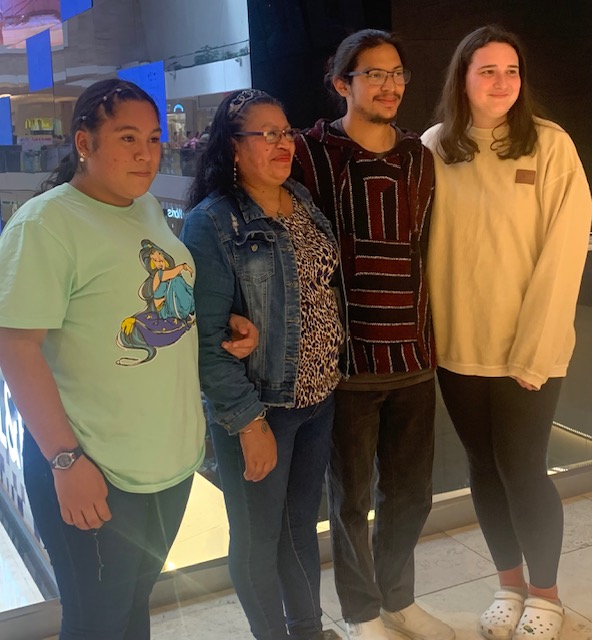
Punishment didn’t come. A reflex older than motherhood. Maria gathered us in for a family photo, her, her daughter, her son-in-law, their five-year-old son, and us. Crystel and I were folded seamlessly into their circle. Grief, relief, and tears rose up all at once. Once again, I was leaving family.

Of course, our last breakfast at the homestay was Crystel’s “BEST EVER” and she was slow to meet me out front.

At sixty-five, I had finally learned that caring for my mental health was not selfish, it was necessary. I honored myself, and in doing so, I preserved the part of me that could love my daughter fully.

Crystel and I stepped forward, not perfectly, but together. I couldn’t stop the waves, inside or out, but I could decide how I met them.

El Paredon sunset

Gotcha Day

Ani, Rosa, Juan, Aryanna (Juan’s girlfriend)

“We missed Juan’s Coming Home Day,” Jody said. Jody and I were doing our usual morning routine with her sitting on the dog bed, her back to the furnace. Buddy and Sadie next to her. Jody and the dogs love the furnace heat in the early morning hours. I reclined with a blanket on the couch. Her memory was jogged by reading a Facebook post about a family celebrating their child’s Gotcha day.   

“I don’t mind,” I said. “I’m not sure that it’s important to them. Maybe it just brings up trauma.”

Jody nodded. An unspoken agreement that we weren’t going to raise the issue.

Coming Home Day, as we have termed it, was the day that Juan and Crystel came home to us from Guatemala. Born six weeks apart, they came home within weeks of each other.

When they were young, we celebrated as if it were another birthday. Cakes, presents, MOA visits, concerts, and waterparks.

It was a day to recognize us coming together as a family and to acknowledge their birth moms.

“Oh, your kids are so lucky,” people often say to us. Even Jody will say, “When I come back, I want to come back as your child.” The last time she said it, which wasn’t that long ago, I said, “You do realize that you’re not saying that you want to come back as my partner.” She laughed and laughed at the truth of it.

It would be so easy to not complicate Juan and Crystel’s adoption and rest with the belief that they are so fortunate.

Recently, I had a dream where I was at a large extended family gathering. Aunts and uncles. Cousins. I was in my twenties. I chatted with relatives, played with the youngsters. I kept an eye out for my birth family. They were late. Delayed. Then, I realized they weren’t coming. There was always so much going on in my home that plans often got waylaid. Or it just wasn’t important for them to come even though the celebration was for me.

I felt this void. This loss. This emptiness. A hole where blood family should be.

I woke up wondering about this empty space for Juan and Crystel. Do they have a dream where their birth family doesn’t make it to their celebration?

Crystel’s birth family

There is trauma in being abandoned. Given up. Relinquished.

Jody and I have done what we could to make them whole with travels to Guatemala, birth family meetings, and name changes.

At five-years-old, they asked, “Whose belly did I come from, yours or Mama Jody’s?” Jody and I explained that there was a third mama in Guatemala. The kids persisted, “No! Mama Bef or Mama Jody!?!”

A hole where blood family should be.

If You See Something, Say Something

If you see something, say something. Bags cannot be left unattended. Murmuring of voices. Click of heels, shuffling of shoes, suitcases rolling and being dragged. A baby crying. All areas of the terminal have been designated as smoke free. At the kiosk, I finished inputting the airline confirmation for our flight.

“Stop it, Crissy,” I hissed. My stomach tensed and knotted. Sounds muffled around me. “Crystel, Stop!” I said louder with more urgency. She had stepped sideways to her own kiosk and was checking herself in. “Crystel, we are under the SAME confirmation!” I glanced at my screen: both of our names were listed. “It might screw us up if you check yourself in!” Veins stood out on my neck.

She hesitated. Her lips tightened. With chin held high, she turned her back to me.

Our 4-week Guatemalan trip had scarcely begun. A minute ago, we hugged Jody goodbye. I knew that defiance stance well. Even as a toddler she didn’t like to be told what to do. She insisted on dressing herself, zippering her own jacket, putting on her own shoes. It made for some fanciful ensembles. Beads adorning her hair, mismatched socks. Even her crib couldn’t hold her. After putting Juan in his car seat, I’d dash back to get Crystel who was waiting in her crib. Until the day she met me at the screen door. Grinning from ear to ear, clapping her hands.

Crystel was an accomplished traveler; she’d spent a year in Hawaii as a national exchange student and had traveled alone to Vietnam and Korea. Yet, I was still the mother. I was holding all our valuables, the passports, global entry passes, credit cards, and cash.

Sighing, I clicked on our names, printed our boarding passes and bag tags. “Crystel, here.” She jerked her head sharply and wouldn’t meet my gaze. I raised my eyebrows and handed her the documents.

Crystel had invited me on this trip with a simple, “Why don’t you come?”

Why not, I thought. Crystel and I have similar personalities. Always up for an adventure, searching for the unfamiliar. Both of us enjoy researching, planning, and arranging travel.

Xela, Guatemala located in a remote mountain valley in the western highlands, was known for the best place to learn and improve your Spanish. Crystel and I would have a full immersion experience living with a Guatemalan family that didn’t speak English. Five days a week, four hours a day, we would attend Spanish classes and be tutored by our own teacher.

Crystel walked with purpose towards security. Her long black hair was braided, bouncing against her back. When she was little, I researched how to perfect pigtails. She wasn’t a little girl anymore. She was 21 and I was 65. I inhaled deeply, relaxed my gait.

As expected, my double knee replacement set off the alarm. I pointed to my knees. A female TSA agent was beckoned. While waiting for the pat down inspection, I scanned the conveyor belt for my backpack and tray of valuables. I held my arms out, spread my legs. I wanted to holler for Crystel to secure my possessions as they emerged from the x-ray machine. I couldn’t yell at her. I couldn’t even see her as she had gone on.

I started sweating, my shoulders tightened. All I could imagine was all our cash, credits cards, my phone and passport disappearing. Our travel ended before we had even left the airport.

Minutes later, I gathered my items at the end of the conveyor. Crystel was waiting around the corner out of eyesight. “CrySTEL,” I said sternly. “We know I’m going to be stopped every time at security. We need you to go through first, then secure our stuff. I have everything on the conveyor.”

Her eyes flickered with recognition. She understood we were in this together. Our success depended on each other. We were bound. In the past hour, Crystel had also established that I was traveling with my equal, my adult daughter.

Heading toward our concourse I tripped. We both laughed.

“Are you up for a Chai?” I asked.

From the First Time We Held Her

Sitting across from Crystel who was with her ‘squad’ as she would come to call her eleven nieces and nephews, Jody and I watched her draw the children to her. A magician she was. Instead of pulling scarves one by one out of a hat she charmed each child and tenderly tucked them around her heart. The children, enchanted and mesmerized, enveloped her, this aunt from the United States. This aunt they were meeting for the first time.

Where was Juan?  Alarmed, I stood up and quickly scanned the dining room. Eight tables had been strung together to accommodate Crystel’s twenty-five Guatemalan relatives. Fried chicken, burgers, and pizza permeated the air. Chatter of families, scraping chairs, little kids running.

Of course. He was sitting directly across from Crystel. Silent, strong, and loyal he was smiling broadly at her playfulness. That morning Crystel insisted that Juan sit next to her in the van on the way to meet her birth family. Since both are adopted, only he could understand the anxiety of meeting strangers connected by blood and the intense three-hour reunion that would occur.

Adopted together at seven and eight months old, they were only six weeks apart in age. Now, both 21, they have had a lifetime of knowing each other. Juan would remain nearby, available. Crystel would do the same for him one week later when it was his birth family reunion.

“Jody, I’m going to ask Mayra if she wants to sit closer to Crystel,” I said. Mayra, Crystel’s birth mom, was sitting quietly next to Juan. Mayra shook her head, no. She encircled her arm in front of her. “This.” Her eyes brimming, “I love watching all this.”

I understood. I, too, have given up an infant in adoption. I imagine meeting my birth son. Sitting across from him, looking closely for resemblance in the eyes, face, and mannerisms. I’d want to intimate who this child is. Ask, Did you have a good life?

Mayra had met Crystel twice before. When she was nine years old and again at eleven. Jody and I had initiated the birth family search and made the reunions possible. After the second visit we were notified by Mayra that Crystel’s birth father had threatened to kidnap her and return her to Guatemala. Crystel was the 8th child in a family of 9 children from the same biological father. She was the only child given up for adoption. Every time Mayra was pregnant, the father said the child was not his. After learning about Crystel from our visit, he threatened he would claim her back because he didn’t want any of his children to grow up apart. He was going to claim her as his own. Jody and I knew this threat to be real. Her estranged birthfather was living illegally in Chicago. A drive of 6 hours and 3 minutes separated us from him. Or was he right down the street, waiting to grab our daughter?

Boxes of Pollo Campero and cheese pizza materialized on the tables. A whirl of activity, Crystel’s brothers and sisters, ranging in ages from 18-34, sprang into action, doling out plates of fried chicken and small bags of fries. Hands reached for slices of pizza. Bottles of soda were poured into smaller cups. Our voices filled the space as we sang “Feliz Cumpleanos” to Juan’s girlfriend, Aryanna. Celebrating her 19th birthday, she blushed, and accepted tres leches, a sponge cake soaked in a sweet milk mixture, and topped with fresh whip cream and a cherry.

Mayra approached Jody and me. Standing next to her, waiting to interpret, was Freddy, Crystel’s eighteen-year-old brother’s boyfriend. He was the only person in their party that was bilingual. Mayra reached down for our hands, brought them together and cupped them in her palms, cradling us. “I can see that my daughter is happy. That you took great care of her,” she said in a burst of Spanish. Tears fell onto her cheeks. “I’m glad that you … you … were the ones that adopted her.” Jody and I teared up. Our eyes were steady on Mayra’s soft round face. Mayra made no attempt to stop crying or to wipe her tears away. Her hands tightened around ours. She continued in her emotion-rich voice, “You … you …  brought her back.” She placed her hands to her heart.

I looked over at Crystel. Sisters, brothers, nieces, and nephews gathered around her. Loud animated laughter. She wasn’t ever ours to keep, I thought. Ever since we adopted her our goal was to bring her back, to her birth country, her birth family. Everything Jody and I have done has been to that end.

She came home to us at seven months old, underweight, and developmentally delayed. The doctors could treat her feeding issues, scabies, and the viral infection. What she needed most of all was the will to live. Jody and I nurtured and loved her, and she found that will within herself. Speech therapy for an articulation disorder addressed her inability to correctly produce speech sounds. Until she didn’t need it or wouldn’t allow it, Juan interpreted for her. They both attended Spanish dual language school in elementary, middle, and high school.

I turned to face Mayra and took a sharp breath. I wasn’t sure if it was the appropriate time to ask but I wanted to know. “What about her birth father?” She brandished the air in front of her. “Don’t worry about him. Erase him from your thoughts.”

Crystel was 18 when she asked Jody and I about her birth father. I showed her his Facebook page. “Why does he have pictures of me on there?” she asked. “He’s been stalking you,” I said. “When you were in fifth grade, he threatened to kidnap you.” She pondered. “I always wondered why my name on class rosters had a note saying I wasn’t to have any visitors.” I explained further, “Schools, law enforcement, friends, neighbors, aunts and uncles all knew. It’s what we did to keep you safe.”

Jody and I have noticed how Crystel has taken responsibility for her own wellbeing. She completed her college sophomore year in Hawaii as a national exchange student, successfully navigating school, friendships, surfing, and a job. At the end of the school year, she traveled independently to Vietnam and Korea. She and I had just completed a month-long homestay in the mountains of Guatemala to take Spanish classes. After school, Crystel climbed volcanoes and managed other excursions without me. She is an accomplished adult. The threat is no longer viable.

Voices became spirited, higher pitched around the tables. Talk of rollercoasters. Mundo Petapa Irtra amusement park where we were was the perfect place for this reunion. Rides, entertainment, playgrounds, restaurants, and a walking zoo were spread over the grounds. Chairs were pushed back. Cleanup started. A trail of children to the bathroom.

Mayra took this moment to walk around the dining area to sit next to Crystel. Both shifted in their chairs to greet each other.  Mayra laid her hand on Crystel’s arm resting on the table. Though Jody and I couldn’t hear the conversation, I imagine Mayra telling Crystel that it had been a difficult time in her life when she surrendered her in adoption. That she missed her every single day. How she carried her in her heart. What a beautiful woman she was. Both had a ready smile and bubbly laugh that leaned toward boisterous. One could easily discern that they were mother and daughter. The same high forehead, cheekbones, distinctive eyebrows, narrow chin, and small lips.

Observing Crystel and Mayra, my eyes glistened. I swiped at my tears. My tendency is to cry when I am moved by the expression of love. I wasn’t raised with love or safety. I was sexually abused and neglected on a constant basis. There was violence. What I wanted for myself, Jody, and our children, was to see what continuous love would look like in a child. I saw the answer in Crystel. She was full, meeting with her birth mom, siblings, nieces, and nephews. She knew where she came from. She knew love was abundant. Jody and I had only gained by this reunion. We had Crystel for 21 years and all her firsts. She’d be ours for the rest of our lives. She’d also have her birth mom, siblings, and her squad.

Daughter, did you have a good life? Mayra knew the answer.

Climbing Mountains

My morning stretch.

My leg was stretched in the roll cradle when the Technical Manager came through the warehouse door.

“No problem here” he said. Not even questioning why a Human Resources Manager would be in the warehouse with her leg raised in the air.

He kept walking until he heard my tussling. “Do you need help?”

“Yeah, my foot is stuck.”

He walked back to me. Smiled. Lifted my foot from where it had gotten wedged into the crook of the iron.

“No problem here,” he said and continued on.

The next day, I was in the warehouse swinging my leg to reach an upright when the Maintenance Manager came by.

“Beth, don’t hurt yourself,” he said.

“You guys must have moved these uprights. I could reach them last week.” He chuckled.

I’m aging. I’ll be 60 years old next month. I still want to climb mountains.

My afternoon stretch.

I’m finding that I’m not as limber or flexible, and it’s harder to keep the weight off. At my last physical, I told the doctor that even though I’m biking every day, my weight is exactly the same.

“It doesn’t matter how much you bike,” she said. “At your age it’s about what you eat. You have to eat less.”

I paused for a moment. “Well, that’s not going to happen,” I said. “I like to eat.”

She finished injecting cortisone in my right knee. I have osteoarthritis in both knees. It is a degenerative “wear-and-tear” type of arthritis that occurs most often in people 50 years of age and older.

When I hear of someone who has had a knee replaced, my attention sharpens.

I’m afraid of not being able to climb mountains.

On the summit of the Upper Mayan Trail with our guide Alex.

I’m a 2nd Dan Tae Kwon Do Black Belt but haven’t been able to attend classes for a couple of years. I’ve run at least 7 marathons but haven’t run at all for at least a year. I believe I should do the things I can do. I can bike. I can stretch. I can climb mountains …. sometimes.

My goal on our Guatemala trip this June was to hike the Upper Mayan Trail, hiking from the shores of Lake Atilan to Solola. Close to 3000 ft. elevation gain in 4 miles. A very steep trail, with beautiful scenery, and several encounters with local Mayan carrying firewood on their back or working in the fields.

Jody and Crystel led the way, turning from time, encouraging me on. Juan Jose’ and our guide Alex were there with a helping hand. What a gift to have my son reach his hand out to take mine. And, a guide, our friend, who is such a wonderful role model for our children.

I’m aging. There is beauty and grace in that.

Note: the featured image is Juan Jose’, Alex, and Crystel standing on the precipice of the Upper Mayan Trail.