Tag: Elizabeth di Grazia

  • “I’m Not Afraid”

    Cheryl Strayed at Concordia College
    Cheryl Strayed at Concordia College

    Saying “I’m not afraid” over and over got Cheryl Strayed from the Mohave Desert through California and Oregon to Washington State – over an eleven-hundred-mile solo hike on the Pacific Crest Trail. I tried it myself this week–the mantra, not the hike–and it worked. I got through another moment. Cheryl Strayed had many moments on the trail with dangerous animals, a snowstorm, and misery.

    Monday, October 20th, I was with over 2,000 people listening to Cheryl as she spoke from the lectern at Concordia College.

    She dropped bits of wisdom throughout the night.

    “Don’t make fear my God.”

    Her book reading was different from all others that I’ve attended in that she never read a word from Wild. She talked to us. We could have been gathered around a very large coffee table.

    I had her book, Wild, for as long as it took her to do the hike – a summer–before I read a word. I was resistant because I didn’t want to be disappointed. I thought the praise for her writing might be because she was a local girl done good, and if I picked up the book the story would fall apart in my hands.

    Enough people recommended Wild that I finally opened to the first page. Whoa.

    I looked around the gymnasium at Concordia. A couple thousand people, including me, could relate to her story. How did she do that?

    “It’s the only book that spoke to me,” said my friend sitting next to me. Her husband passed away eight months ago. “People know that I like to read. I got a lot of books, but this was the only one….”

    “How can I bear the unbearable?”

    October 22, 2014 091Cheryl called her hike a universal journey. A journey of finding who we are and then coming to peace with that. “Grief is love,” she added.

    Therein lay my answer. Universal truths. Truths that apply to all people.

    “Love is the nutrient that we need.”

    “Alone with something I couldn’t lift but I had to lift it.”

    December 5, Wild will be coming out in movie theatres.

    Cheryl invited me to the after-party. She invited all of us. How did she make me feel included in her trajectory?

    Her author page on Facebook has 105,627 likes. She’s been accessible, not losing herself in her climb.

    In my research of her many interviews and talks around the country she didn’t lose herself in the publishing process or the making of a movie.

    “In a heroic battle to make my way back to myself.”

    During the evening Cheryl spoke about refusing to allow herself, her writing, or her story to be pigeonholed. Wild isn’t just for women. 50 percent of her correspondence is from men.

    She left me with a ‘how to’ for when my book sells: Go in expecting respect and politely inform others. An artist shouldn’t defend his or her work.

    Her book is powerful but she is even more powerful.

    “I’m not afraid,” I can imagine her … me … and all of us … continuing to say on our own personal hike.

  • Why We Read The Books We Do

    Why We Read The Books We Do

    f306a4206f3db95e9d87a8b4aaf37eb6[1]“Guess what I’m reading,” 12-year old Crystel says.

    First, I try the vanilla genres, “Fiction, non-fiction, memoir, science fiction, fantasy?”

    She shakes her head no every time.

    What else is there?

    “Dark Romance,” she says. Her eyes light up.

    Oh, my, I think. “Books let you read anything you want,” I say, thinking of Fifty Shades of Grey, by E.L. James and wondering what she IS reading.

    I have a 1 ½ hour round trip drive to work thus my book reading has become books on tapes. Jody noticed Fifty Shades in the car. She raised her eyebrows.

    “Don’t push Play when the kids are in the car,” I said.

    Fifty Shades ended up too spicy. I returned the trilogy to the library. How much flavoring can one take? Jody’s happy if I hold her hand.

    12-year old Antonio reads Pokémon from back cover to front. “I like reading different stories about Red the Trainer,” he said.

    Recently, he’s been downloading the series onto his IPod to read.

    I’ve not read a single page of Pokémon. I don’t enjoy graphic novels. It reminds me of the funnies. In my family of 14, the funnies were prime reading material on Sunday mornings. I avoided any tussling by turning my back on the colorful newspaper that would be shredded by noon.

    I don’t read fantasy or science fiction either. Give me the real stuff. Memoir, non-fiction, and fiction based on truth.

    One evening, Antonio held up a thick book. “Look what I’m reading,” he said.

    The heftiness of the book surprised me. What could hold his interest that long?

    He laughed. “It has lots of pictures in it.” He had found Wonderstruck by Brian Selznick in his school library. Not that he went to the libary on his own volition. He needed a book for reading prep.

    “Ta dah!” I’m sure he exclaimed after perusing the pages.

    I asked if the illustrations reminded him of his own pencil drawings. “Nope,” he said. There goes that elevated thought.

    After finishing Wonderstruck he found The Invention of Hugo Cabret by the same author.

    Antonio doesn’t know (or care) that the book won the 2008 Caledcott Medal, the first novel to do so.

    With 284 pictures within the book’s 526 pages, the book depends as much on its pictures as it does on the words.

    Selznick himself has described the book as “not exactly a novel, not quite a picture book, not really a graphic novel, or a flip book or a movie, but a combination of all these things.”

    “Guess what page I’m on?” Crystel says in the car, on the couch, in her bedroom, as she makes her way through her dark romance.

    “How did you find this book?” I asked her.

    “When I was on Utube I clicked a thing on Ellen and Twilight.”

    “I learned enough about the characters that when I went to our school library and saw the series, I picked it up. They didn’t have the first book, Twilight but they had New Moon. I read a little from the middle and there were no words that I didn’t know. And this cat is so cute. I’m reading Eclipse now.”

    The four Twilight books have consecutively set records as the biggest selling novels for children.

    Even so, I’m not interested in reading the series. It’s not my genre.

    Is the lesson here that parents can model reading but not the genre?

  • A Wonderful Dilemma for a Middle School Girl

    A Wonderful Dilemma for a Middle School Girl

    Crystel and Natty
    Apple Jack Invitational. Crystel and Natty after their first cross country meet – A one mile race.

    “Go, go, go, dig, dig, dig.”

    I hear my voice replaying on the video and cringe. I sound like a crazy woman.

    It’s just my child running a 5th grade field day race for gosh sakes. In the scheme of things it doesn’t even count. The distance is approximately 50 (or is it 100 yards?) and none of the kids are called back for jumping the gun. Still, there I am, my voice reaching a high pitch squeal.

    Here she comes, my girl crossing the finish line … first.

    I wipe away tears, choke back a sob.

    I’m sure it’s her strong body and competitiveness and has nothing to do with my out of control fervor.

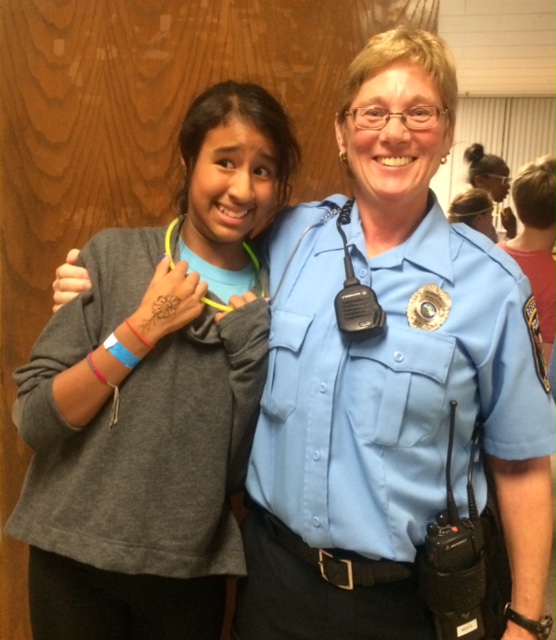
    My daughter is in for some rough years unless I get banned from her sporting events. I don’t think they can do that to moms. But if they do, maybe I can wear my police reserve uniform and sneak in. And, if that doesn’t work, I’ll go as McGruff.

    Not that I screeched any less at her brother when he was running. “Go, Antonio, go. Dig, dig, dig.” He’s in for the same mortification.

    When another mom, texted a photo of 12-year old Crystel and her daughter, following their first cross country race as 6th graders, it hit me that Crystel’s experience in sports will be very different than mine.

    This year marks the 42nd anniversary of Title IX.

    10th place for Crystel and 20th place for Natty at the Apple Valley Cross Country meet
    10th place for Crystel and 20th place for Natty in the 2-mile race at the Apple Valley cross country meet

    In 1970 when I was 12, Title IX had not yet passed. Although I could beat my older brothers at most anything and was the only one who dived off the cliff in Spring Valley, Wisconsin into the Eau Galle Dam, I couldn’t compete in sports.

    Regulations on how to implement Title IX, signed into law, June 23, 1972, did not go into effect until 1975.

    This past summer, Crystel was mulling over which activities and sports she was going to become involved in during middle school. “This is what you call a dilemma, Crystel,” I told her. “You have so many options that you will have to choose.”

    Three weeks into middle school, she’s done what she can to cram in her interests: piano, dance, cross country, and Kor Am Tae Kwon Do. If she could she’d figure out how to add soccer and a number of other after school activities.

    When Title IX was enacted, 1 in 27 girls participated in athletics. One in three girls participates in athletics today.

    In the photo, Crystel and her friend are self-assured, confident, and have just run their first one mile race. According to the Women’s Sports Foundation, women who are active in sports have more self-confidence and are more outgoing than women who do not participate.

    Most people think Title IX only applies to sports, but athletics is only one of ten key areas addressed by the law. Other areas include: access to higher education, career education, education for pregnant and parenting students, employment, learning environment, math and science, sexual harassment, standardized testing, and technology.

    Before Title IX

    • In 1972, women earned just 7% of all law degrees and 9% of all medical degrees.

    • In 1970, women earned only 13.3% of doctoral degrees.

    • Women weren’t awarded athletic scholarships.

    After Title IX

    • For the graduating class of 2013, the Department of Education estimated that women earned 61.6% of all associate’s degrees, 56.7% of all bachelor’s degrees, 59.9% of all master’s degrees, and 51.6% of all doctor’s degrees.

    • Last year, 140 women graduated with a college degree at some level for every 100 men.

    • By 2003, there was more than $1 million in scholarships for women at Division I schools.

    1045198_1472771266320064_3137456199553566764_n1My WordSister, sister in writing, Ellen Shriner has completed a book-length memoir called BRAVADO AND A SKETCHY VISION LED ME HERE, a coming-of-age story that takes place in 1979 and 1980 during her first year of college teaching.

    Her memoir portrays the challenges of women faced as they sought graduate degrees and entered the workforce.

    On July 5, 2012, Ellen also wrote a blog piece about Title IX.

    Thanks to Title IX, Crystel has the wonderful dilemma of choosing which sport she will compete in. Eventually when she joins the workforce, she will have more choices to her liking than women of previous generations had.

    And, because of Title IX, Crystel and Antonio will have to put up with a mom that alternately shrieks and sobs at the finish line.