Tag: COVID-19

  • Mount Fuji and Grey Hair

    “How old are you?” The bike expert was putting a new battery into my cyclecomputer. How old am I? I wasn’t sure. I have had difficulty knowing how old I am. I’m going to retire next year at 63. On my birthday in September, I’ll be 62. I must be 61. 61 I told him.

    “How much do you weigh?” I didn’t know that answer either. When was the last time I was on a scale? He must have taken my pause as a reluctance to reveal my weight. Before he could finish his explanation of why he needed my weight I made a guess and gave him a number.

    On my bike ride home, I wondered, “If I didn’t color my hair, would that help me remember my age?” I don’t feel 61. If my hair was in its natural state, it would be completely silver or white. Maybe I’d look more my age. That is exactly why I have been coloring my hair for years in the first place. I didn’t want my children to have an old mother. I figured I’d wait until after they graduated from high school to go natural. Then the pandemic came. Now seems like a perfectly good time to work with all those feelings that grey hair will bring.

    Sitting in the salon chair, I could see a family resemblance reflected in the mirror. I never wanted my mother or Aunt Annie to slide in and out of my face. With grey hair that might be exactly what I get.

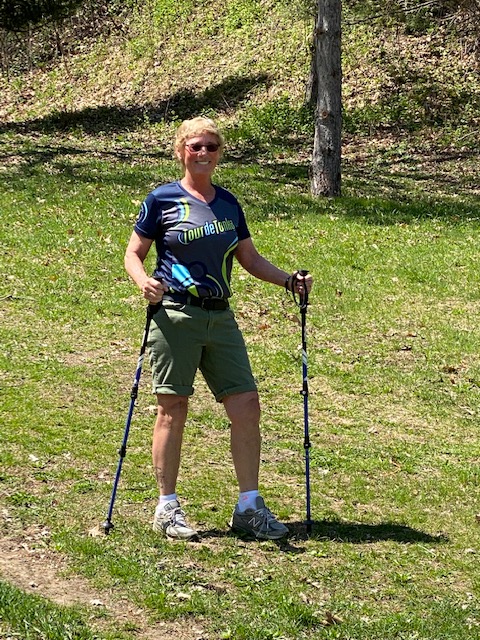
    Hiking up the ski hill, I imagined that our trip to Japan and our climb up Mount Fuji this coming July was still on. That trip may or may not happen. Like the rest of the world with this pandemic, my family and I are on a wait and see. Laboring for breath walking up the steep incline felt great. My entire body was committed to reaching the top. Once there I was graced with the Minneapolis skyline. I will continue to climb and descend regardless of COVID-19. Grey hair will certainly happen.

  • Cocktail Hour

    Before all of us dispersed at the end of the evening, the leg broke loose from the fire pit bowl, toppling hot embers into the street.  It had been repaired once before using a zip tie.

    Our melting pot of a block was gathered together for no reason other than a stay-at-home order was in place for midnight.

    Lawn chairs were haphazardly set in a circular pattern at the dead end of the block in front of the No Parking Fire Lane sign.

    Jody and I had been encouraging these get-togethers for over twenty years. Many had been held in our back yard. Now others on the block often sounded the alarm for a get-together.

    Single, married, remarried, divorced, widowed, Indonesian, Hispanic, African American, white, young, old, Republican, Democrat, gay and straight mixed around the fire that I poked with my 6-foot distancing stick.

    There were those who believed in conspiracy theories, those who loved our President and blame the Chinese, and those attracted to herd immunity. There were also those who were frustrated with the President’s response and reassured by the state’s plans.

    Our entire block of eight houses was represented, in its diversity and imperfection, a potpourri of all there is in the world.

    Throughout the evening, I moved from lawn chair to lawn chair, appreciating all our differences.

    I took pride that we could come together time after time finding commonality and enjoyment in each other.

    Before he left, the oldest guy on the block would say with satisfaction, “None of us on the block have it,” meaning the COVID–19.

    I was happy to be a part of his ‘us.’ He was too. Though in all respects, he and I, are polar opposites in our religious and political views. I take delight in who he is. He’s gifted me fish he’s caught and venison from deer he has killed.

    I believe, that despite our differences, if my family did get COVID-19, he and all the others on our block would look after us. We are all part of the ‘us.’

    His wife stayed back helping me with the now broken fire pit. We doused the embers together. Before she walked down the street, she said, “We need a get-together at our house. We’ve never had people over.”

    Our imperfect block will continue to rendezvous. The broken fire pit will once again get mended. Social distance will be respected in varying degrees.

  • A Larger Force

    Healthy exercise respecting social distance in the neighborhood appeared difficult with a cluster of kids playing soccer, family groups stretching across walks and streets, dog walking people following the direction of their pets. We drove to the quiet side of a nature preserve where trails are seldom used on weekends. One car stood empty in the parking lot. Parents with a preschool child exited a different car.

    We waited for them, but as shoe tying and other preparations continued we made our way to the trail map. The youngster, possibly unaware of social distancing, ran to join us and told her parents that she wanted to be lifted to read the map. Offering her their hands, they assured her they knew the way. We backed away as the child threw a hissy complete with screaming, stomping, and slapping. The right trail choice was any that would create space from the unhappy kid.

    As grandparents we’ve learned about giving young children time to make wise choices instead of forcing action on them. Children of privilege are supported in making choices many times daily from choosing to wear clothes to daycare through patient questioning of resistance at bedtime twelve hours later. Family, friends, complete strangers, might be expected to wait while a child tests the limits or can’t choose. It takes a village after all.

    Then comes COVID-19—no negotiations, no children making choices, no endangering strangers by ignoring social distance guidelines. The village has been forced into change.

    From closed schools, to prohibited playgrounds that look the same as open playgrounds, to stores asking only one family member do household chores; parenting has pivoted in answer to the dual wham of pandemic and economic storms. Parental instincts to keep things normal for the kids are strained as jobs are lost, employers demand long work hours in the family’s home, distance learning replaces classrooms, and being homebound stretches. Hugs of grandparents, cousins and close friends disappeared with no known date of return. Parents have had little time to concentrate on adapting to new burdens, to problem solve, to explore their personal fears or worries.

    Experts say our kids experience anxiety of this crisis just like adults. Some will lose a loved one or friend. The soundtrack of childhood has been interrupted to never play in quite the same way. COVID-19 is drawing new lines on the future maps of kids’ adulthood. Our six-year-old family member misses her classmates, her neighborhood friends, going places with her parents. She understands that the sickness means she can’t ride her bike with other kids, climb or swing at the park, be physically present with her friends. The sickness is beyond her parents’ control. She can make good decisions about a snack or activity, but bigger forces now set the limits beyond the front door.

    Technology gives us time to talk, play games, be with family. A plate or two on the table and tiny faces on a screen may be how we celebrate this spring’s holiday and holy day traditions with those we love. Better than no connection, a card or a phone call. COVID-19 denies us the powerful comfort of each other’s warmth, smell, physical presence whether around the dining table, at a special event, at a hospital bedside. Some of us will stay healthy. Some of us will die in the company of strangers. No screaming, stomping or slapping can change what we have to keep doing. We will gather to celebrate or grieve in the future. God willing.

    Stay home. Stay safe. Keep others safe. May your holy day traditions provide comfort.

    GIFIjEQkRfGDZbThEEbPgw