Navigating Life’s Turbulence: Lessons from a Country Walk

Candidate signs and Halloween decorations needed clearing November 7th along the country road where I walked. My feet moved slower than my thoughts of how to accept election results. 

Five hundred feet ahead, at least a dozen large, wild, turkeys covered the road as well as both shoulders. They can be mean in a standoff. Future concerns fell to immediate safety. Should I turn around, my clap hands, swing a fallen branch to clear a path? Yelling and singing haven’t worked in the past. My walk was over.

Two deer bounded out from woods on one side of the road, gracefully crossed the asphalt, and entered deeper tree growth in beautiful synchrony. The turkeys scurried behind the white tails. Here, then gone. The walk cleared.

 “Awesome” I said out loud at the display of natural beauty. Unattractive turkeys had been swept into a brief glimpse of something amazingly natural on another day of unpleasant election rhetoric and deep discord.

Decades ago, St. Mary’s in Luxemburg, WI began my Christian orientation. Small towns, filled with relatives, made it easier to accept a set of beliefs and traditions. What I still carry is a careful relationship with God. Call it spirituality or faith, old-fashioned or unnecessary, I value the foundation. At the turkey and deer moment, I followed the spoken word with a silent “Thank you, God” for a reminder of good possibilities.

In November, regardless of voting on the winning or losing side, many people remain thankful for family, friends, freedom to have a public opinion. I dread how politics and powerful men with money will affect the quality of life. 

Fear feels like too powerful a word at a time when caution is critical. Fear was two years ago when I had major surgery to save my life. I knew what I feared that day. I could balance fear and hope. Today I can’t name what to fear beyond unpleasant changes. Fear and dread appear in definitions of each word, but fear has a more expansive description. 

I’d love to be one of those deer easily running through the woods. I can accept moving closer to the speed of the wild turkeys shuffling through fallen leaves or awkwardly flying up to their nightly roost. During the day I will keep looking for ways to move the threatening turkeys out of the way of my walk and yours.

Two years of thankfulness. More to come.

Anxiety: It Often Gets the Best of Me

I was an anxious kid, an even more anxious teen. So much so that the nuns at my Catholic school let me skip mass each morning because of how often I threw up or fainted. Even in college, I did so now and again. And while it’s been decades since, anxiety once again has become a near-constant companion, in large part due to COVID.

And I’m not the only one who is anxious.

The World Health Organization (WHO) reported that anxiety increased by 25% across the globe in the first year of the pandemic. And this fall, a panel of medical experts recommended for the first time that doctors screen all patients under the age of 65 for anxiety which, involves asking questions about symptoms: How often do you feel nervous, anxious or on edge? Do you have trouble concentrating? Does worry present you from falling or staying asleep?

I’m not sure why I and all the rest of us age 65 and older aren’t covered by the WHO’s recommendation, but I do believe we ought to be. After all, it’s not like anxiety goes away with age. In fact, I and many of my friends and colleagues who are 65+ report an increase in anxiety, in part because we no longer have the self-esteem and support system that came with our jobs. Health issues are also a factor.

Some of us also report an increase in hang-xiety, which is anxiety some people experience after drinking alcohol. I certainly did shortly after the start of the pandemic when I found myself indulging far too often in a second or even third cocktail, which research shows can decrease dopamine, a neurotransmitter that plays an important role in keeping anxiety under control.

It’s one reason why I reluctantly gave up drinking this year. It’s also why I’m doing other things as well:  

Journaling

Setting reasonable goals

Striving for progress, not perfection

Asking for help and support

Trying eye movement desensitization and reprocessing (EMDR) therapy

I’m also admitting that I’m struggling. Doing so has been tough for me but it’s getting easier thanks to the love and support of family, friends and my fellow writers/Word Sisters.

How A Bullet Journal Helps Ease My Anxiety

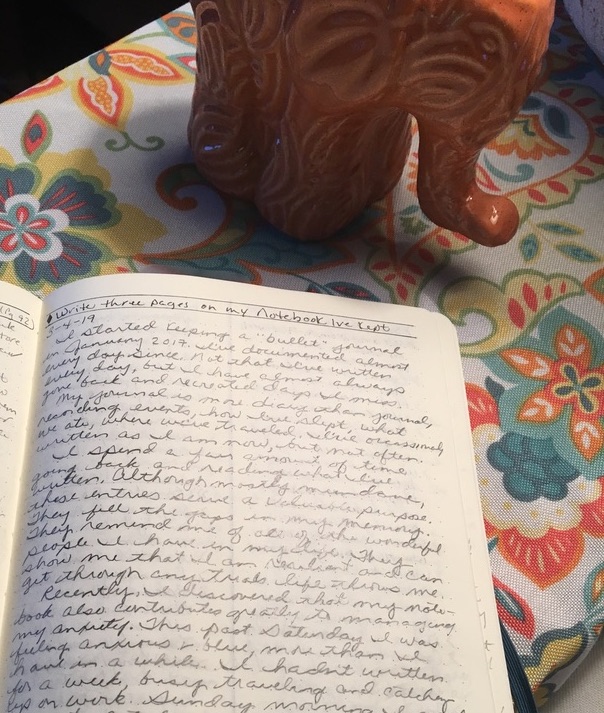
I started keeping a (modified) bullet journal in January 2017, and I’ve recorded almost every day since. Not that I’ve written every day, but I’ve almost always gone back and recreated days I miss.

My journal is more diary than journal, recording events, how I’ve slept, what we ate, where we’ve traveled, things to do. I’ve occasionally written longer forms (this post started as handwritten pages in my bullet journal), but not often.

Lately, I’ve discovered that my notebook contributes greatly to managing my anxiety. On a recent Saturday I was feeling anxious and blue, more than I had in a while. It had been an emotional week. I’d seen my Uncle Don for the first time in years. I’d visited my 90-year-old mother in Michigan and found it difficult to leave her to return home. My husband’s sister was in the hospital with a life-threatening health crisis.

With all of the travel and activity, I hadn’t written in my journal. Sunday morning I made time to catch up on my entries for the week. As I wrote, I could feel the anxiety melting away. Nothing had changed, but the act of documenting my days seemed to be the panacea for my disquiet.

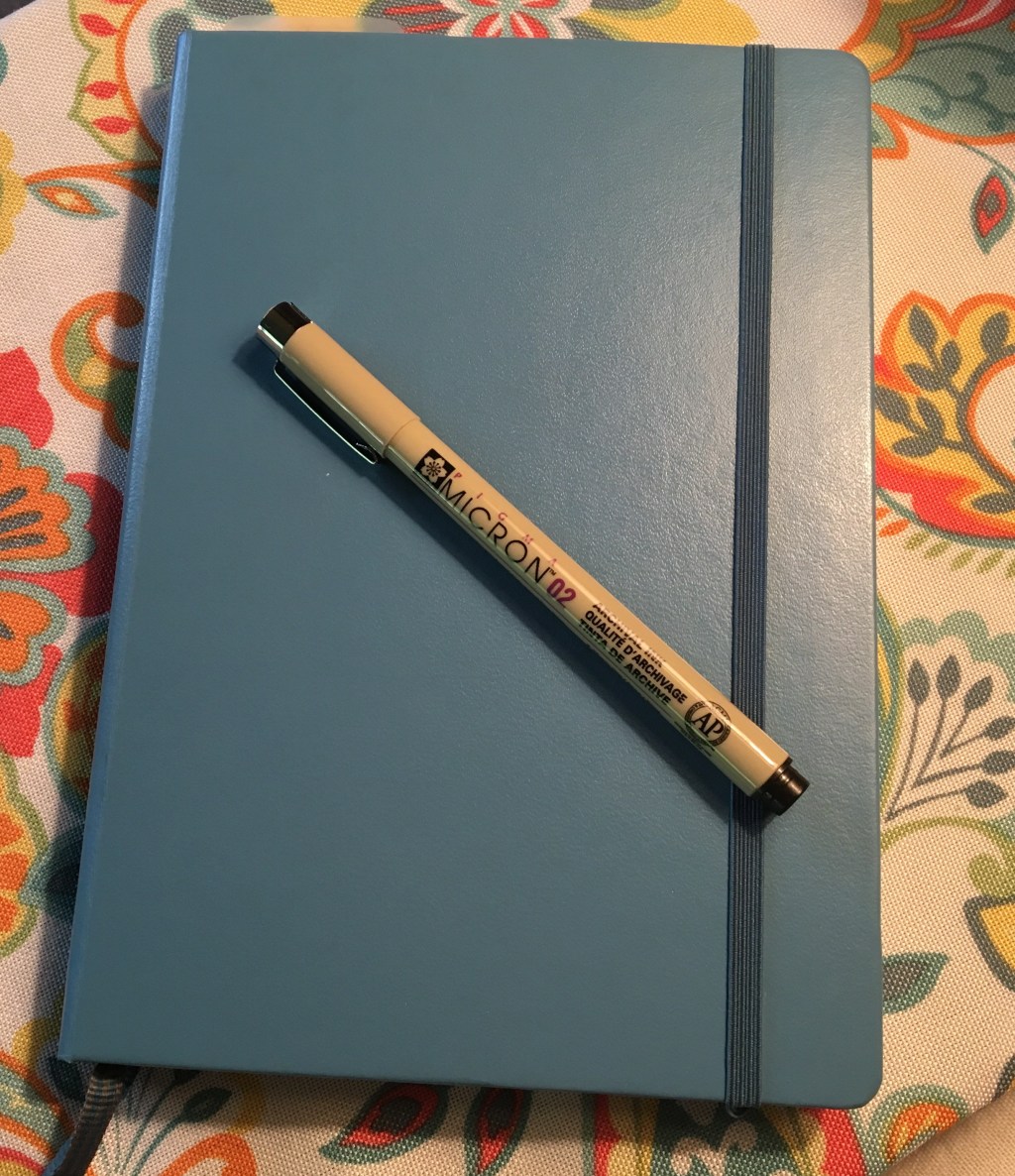
journal with micron penI realized that writing down these events ensures that I’ll have a record of them, that I won’t forget. But my journal also is a container for the challenging events in my life. I can close my journal, snap the elastic band around the cover and my emotions are safe, caught within the margins.
I spend a fair amount of time going back and reading what I’ve written in my notebook. Although mostly mundane, these entries serve a valuable purpose. They fill the gaps in my memory. They remind me of all of the wonderful people I have in my life. They show me that I’m resilient and can make it through any trials life throws me.

Unlike other journals I’ve kept, my bullet journal provides structure and order, two things I crave in my life. I often joke that I have “control issues.” But it’s not really a joke. I need to feel that I can have some control or influence over everything in my life. When I don’t, I get anxious. In a small way my bullet journal gives me that control. If I can put the words on paper, I can get them out of the endless worry loop playing in my head. I know I can always go back to my journal if I need to.

Another thing I love about my bullet journal is that there are no rules. (That seems a little contradictory to the previous paragraph, doesn’t it?) I can use it however I want. I control the contents. (Ah, there it is.) I can put a calendar on a page if I want one there, I’m not confined to the page with the pre-imposed date.

I’ve always loved calendars, but I can’t even count how many planners/diaries I’ve abandoned in my life because I’ve missed days or weeks and can’t tolerate the taunting of all those blank pages. This notebook is the perfect solution. Every page is full of ideas, events, thoughts, emotions, and yes, a calendar if I want one.

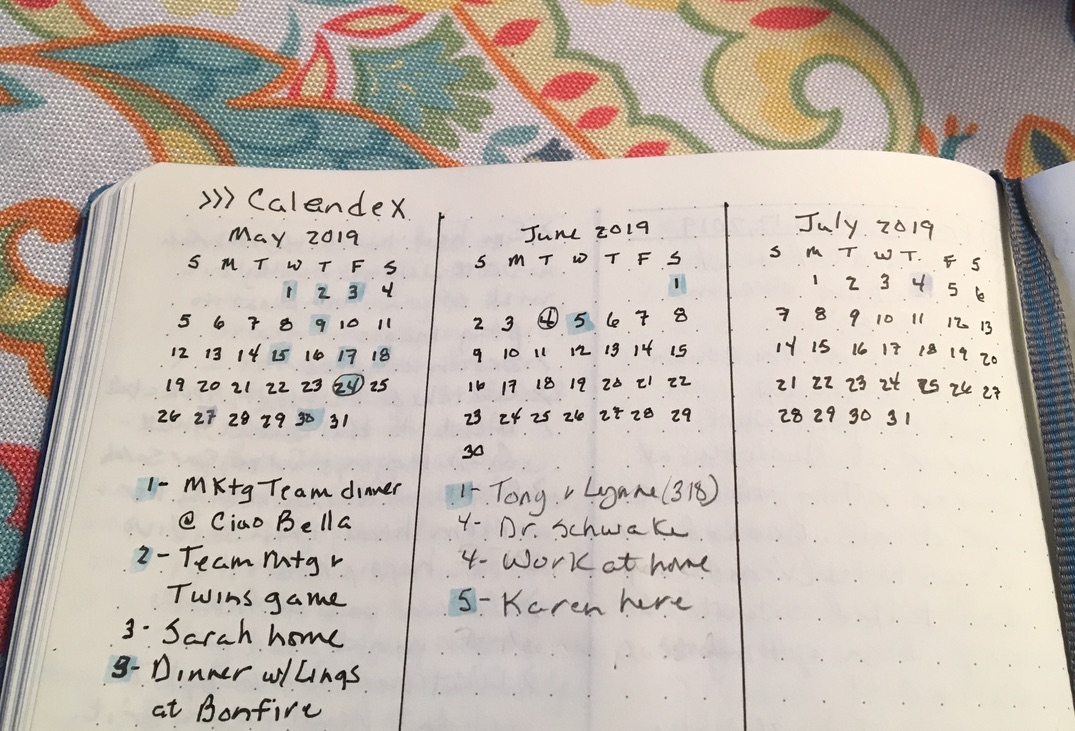
My favorite pages in my notebook are probably my version of the Calendex. I create small calendars across the top of the page using the grid, with a blank column beneath. Throughout the month I document the highlights (dinners out, parties, major purchases or repairs, writing groups attended and missed). At a glance I can recreate a week or month. I can then go to the date in my journal for the details.

Calendex

(Note for BUJO purists: I don’t use my Calendex for future planning. Eddy Hope explains how he created this concept in case you’re curious.)

I’ve learned that I prefer a “dot” notebook with a light grid on the page (Luechtturm1917 is my current favorite brand). I keep a ruler in my notebook and use my favorite pens (Micron-black) to draw lines to section off the page and create calendars and lists. (Lists! How I love a good list.) But I always write in pencil, I like to be able to make changes.

Recently I’ve decided that I want my journal to be more than just an accounting of days. So I’ve started adding sections periodically for “mood” and “observations.” I’m trying to be a little more thoughtful each day and use my notebook for inspiration and creativity. I usually journal early in the morning, when the house is quiet and I’m calm. I realize that it’s probably this time that I gift myself for quiet reflection that contributes most to my emotional state.

My bullet journal is the talisman that allows me to bring together the things that matter most to me – creativity, structure, order, inspiration – to live together in one place. The blank pages aren’t daunting. They’re beautiful and calm, waiting for me to use them.


Grammar Insecurity Is Alive and Well

While visiting with my former neighbors, one of them asked me to explain how to use semicolons. As a writer and former writing teacher, I’ve got that one covered. However, her question opened the floodgates. It turns out that the majority of these smart, well-educated people harbor a secret fear of embarrassing themselves, because they aren’t well versed in some fine point of grammar, punctuation, or word choice.

How does grammar insecurity get started?

I picture some picky 7th grade English teacher or stern editor shaming writers so they feel incompetent. I’m not immune to that fear either—people expect more of you when you write for a living. Although I like correct grammar, punctuation, spelling, and word choice, I’m philosophical about the inevitable errors.

Screen Shot 2015-08-05 at 10.05.02 PMHere’s a secret—the experts don’t agree on the rules.

For example, the rules about comma use depend on what style is being used. If you’re a journalist who follows the Associated Press Stylebook, you omit the comma before “and” when punctuating a list or series. But if you’re an English teacher who teaches the Modern Language Association Style Guide or a journalist taught to follow the Chicago Manual of Style, you would use the serial comma (also known as the Oxford comma). No wonder people get confused about commas!

I’m a big fan of the Oxford comma. This example from Captain Grammar Pants illustrates why I prefer it:

This book is dedicated to my parents, Ayn Rand and God.

(It’s unlikely the author meant that his or her parents are Ayn Rand and God,                          but without a comma after Rand, the meaning isn’t clear.)

This book is dedicated to my parents, Ayn Rand, and God.

(Better! Now all I’m wondering about is why the author is enamored of Any Rand . . .)

The next example isn’t about serial commas, but it’s too much fun to resist:

Let’s eat Grandma!

(How’d Grandma get on the menu?!?)

Let’s eat, Grandma!

(Oh, thank goodness—she’s just being called to dinner.)

The Comma Queen at The New Yorker provides even more insights about commas.

Even when the experts agree on the rules, the rules change. Languages evolve over time.

When I was in grade school, I’d get marked down for splitting an infinitive (the “to be” form of the verb):

To boldly go (OMG—a split infinitive!)

To go boldly (This version keeps both parts of the verb together but it sounds stupid.)

These days few editors concern themselves with split infinitives. English has evolved. Old English turned into Middle English, which gave way to Shakespearean English and was eventually followed by Contemporary English. When was the last time you used “cozening” when you meant “cheating” (Shakespearean English) or “anon” when you meant “soon” (Old English)?

Sharp-eyed readers may notice several errors in this blog. Yeah, I know. I was just testing you!