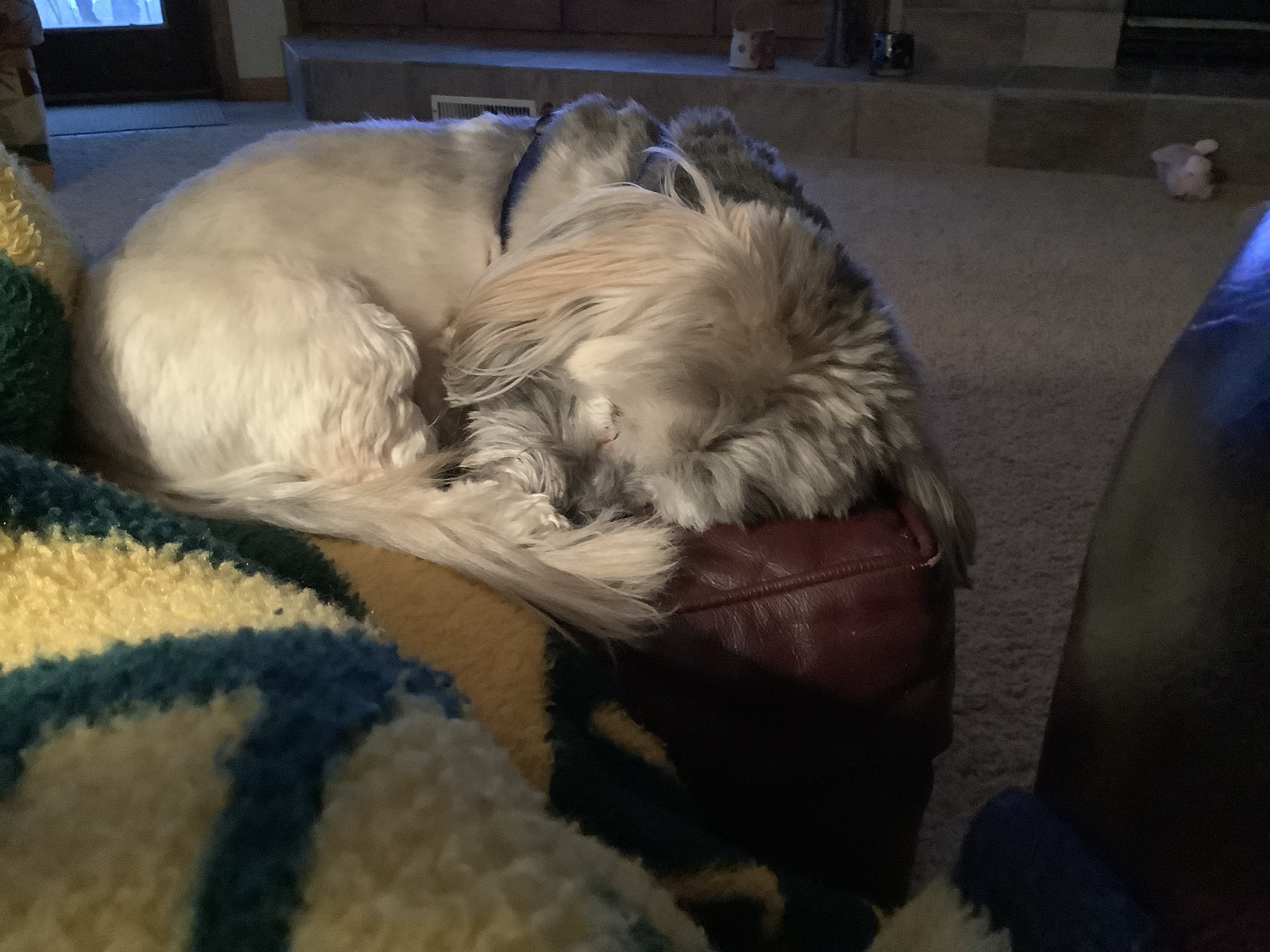
When do people become too old to share their homes with a new dog? How do middle-aged dogs and older people find each other?
During his annual vet visit in February 2020, Rocky was found to have a heart murmur. Covid locked down our city before we could take him to a doggie cardiologist. That visit never happened because Rocky continued his happy, boisterous life.
Walk ahead to 2025 when Rocky hit his senior years. Since dogs pack a lot into lives of ten to fifteen years, their aging process is more compact. More dramatic. Medication helped with high blood pressure and easing anxiety due to dementia. A chiropractor supported with home exercises and massage kept his rear legs working. Playing smaller versions of fetch accommodated diminished vision. The adaptation grows.
Over years, not months, so will ours. For Rocky we’re able to be solid caregivers. I am not sure that I will be physically capable of supporting another dog through their final years. But how would we walk away from a beloved future family member because we’re all aging?
Cats and some rodent pets are not options because of allergies. We’ve done fish and snails when kids were young. None of them check any boxes of what I value in a companion creature. Spending the rest of our lives without a furry friend is hard to accept. Foster care is kind of like babysitting a neighbor’s child now and then. Can be physically demanding. Entertaining. Heart-warming. Then the baby or child goes home and there’s no one to talk to at midnight when sleep is elusive.
Maybe there are dog-share programs or lease a pet centers with humane housing for dogs in transition.
Maybe the quiet house will grow on us after Rocky’s life is over.
During recent conversations with friends, I realized that each of us is considering how to reinvent our lives. One is widowed at 65. Another’s ailing father recently died, ending her time-consuming caretaking responsibilities. A third friend is trying to understand what retirement will look like. I’m contemplating how my life will change when my oldest son moves to the West Coast in a few weeks.
The widow said, “What do I do with all of the expectations I had?” Unspoken is how devastating her loss is. Her best friend is gone. Her children live out of town. This is not what she imagined for her life.
The friend whose father died now has the ability think about how she wants to use her free time. She said, “Now is the time to enlarge my circle of friends and activities. I’m going to need them as I get older.” Unspoken was the awareness that some friends might move away—to warmer climates or to be closer to grandkids—and some will get sick or die. During the next 30 years, the ranks will thin out. Better to cast a wider net.
My semi-retired friend is also considering how to enrich her next 30 years. She already has a full life—plenty of friends, her writing projects, yoga, biking and more. She asked, “What experiences do I still want to have?”
I don’t have answers for my friends, but I do understand the questions. Numerous times, I’ve had to re-envision my life.
Sometimes I’ve embraced the need for a major life change, like when my husband and I decided to downsize and move from the suburbs to the city. We eagerly searched for a new house and tried to picture ourselves in a variety of neighborhoods. We were seeking a new lifestyle, and I was excited about the possibilities.
Other major changes were thrust on me, like family illnesses. When my younger son severely injured his knee and needed to rehab with my husband and me, we all had to figure out the new dynamics.
How odd he must have felt to move into one of our spare bedrooms at 25. He’d been on his own and managing well since he was 19. While he was bedridden, we cooked for him and helped him wash up. He could make his own health care and financial decisions, but little else was under his control at first. When he wanted privacy, he even had to ask someone else to close his door.
Seeing him grimacing in pain and knowing that I couldn’t fix that was hard for me. I also had to walk the line between suitable caretaking like fetching ice packs or water and fussing too much. None of us knew what the next day or next week would bring, but I knew we’d figure it out. And we did.
Image taken by Daniel Schwen. Made available through Wikimedia Commons.
Some big changes are mixed blessings, like my oldest son moving out west. He and his significant other have dreamed about new opportunities for him and a well-regarded medical residency program for her. After months of uncertainty, their life is unfolding as they had hoped. I’m excited for them and think the Bay area will be fun to visit. But I’ll really miss them and know our time together will work differently. We won’t have the impromptu dinners and walks we all love. Instead, our future visits will be planned well in advance. We will need to create different rituals for birthdays and holidays. Inevitably, he’ll be far away and miss out on some events, like going for a beer with his brother, hearing my husband’s band perform, or attending one of my publication readings.
Whenever I’ve undergone a major life change, I’ve had to invent a life that better fits my new circumstances. That requires emotional energy, and sometimes that’s hard to find. But I’ve been separated from family before. My husband and I moved away from my Ohio family nearly 30 years ago. I know a lot about maintaining strong long distance connections.
So I’ve begun thinking about how we can use phone calls and FaceTime to maintain close ties with my son after he moves. I’ve checked out airfares. Bit by bit I’m inventing the new shape of my life.