Tag: adapting

  • Mortal

    Daffodils and forsythia are in bloom here. Egrets and ducks have returned to the pond. We all made it through another winter, a difficult season with plenty of cold, snow, and ice. 

    When I was in my forties, I wrote a short story about a woman whose first serious high school boyfriend was drafted to serve in Vietnam. He would die in battle and be remembered as perpetually nineteen. She went on to college, married, had children. As her son prepares for junior prom, she is reminded of Bernie. On the anniversary of his death, she writes him a letter about what it has been like to age decades beyond her teens.

    Late in 2022, I prepared for serious surgery. The surgeon called me a ‘low risk’ patient and young for my physical age. Tests showed no other options. All was successful, except emotionally I landed in part of the world described in Atul Gawande’s Being Mortal.  He writes that we tend to consider aging a failure, or weakness, rather than a normal process. As we live longer and longer, medical processes becomes part of our experience. Doctors know how to preserve life, but not how to help patients cope with how life continually changes.

    Like most surgery nothing looks different to others, but I know where the scars are and what each means. I know the medications that support carrying me through a normal life expectancy. I am also learning their downsides. I haven’t returned to tap dancing because the studio floor is slippery, and I am still fighting to return to my prior rock-solid balance. Down dog is back on my aspirational list, but for different reasons than undeveloped muscles.

    In the weeks between the first time a doctor said, “maybe six months, certainly not more than a couple of years,” and the night before surgery, I thought about not seeing my granddaughters grow up, about the writing projects that might not be published, about my unwillingness to let life go. When I stopped pushing to be the person folks expect, my fatigue was immense. With surgery on the schedule, I slept a lot, read a lot, thought even more. Because I am used to being productive, I labeled that week practicing recuperation. 

    I have had friends die of cancer without the medical miracle surgery offered me. I am humbled and so respectful of how they faced the eventuality of their passing. 

    This spring I wonder how to make these next many years meaningful. A wise friend told me the body needs at least six months to recover from major surgery then encouraged me to give my emotions the same time. A good plan. I’ll enjoy the daffodils and forsythia, then the tulips and lilacs. The demands of regular life are close enough.

    With love to my brother, Darrell J. Frisque, who passed too young on April 14, 2007.
  • Changing Thanksgiving Traditions

    When I was a girl, Thanksgiving dinner might occur on Thanksgiving itself or the day after—whichever day my father had off from the fire department.

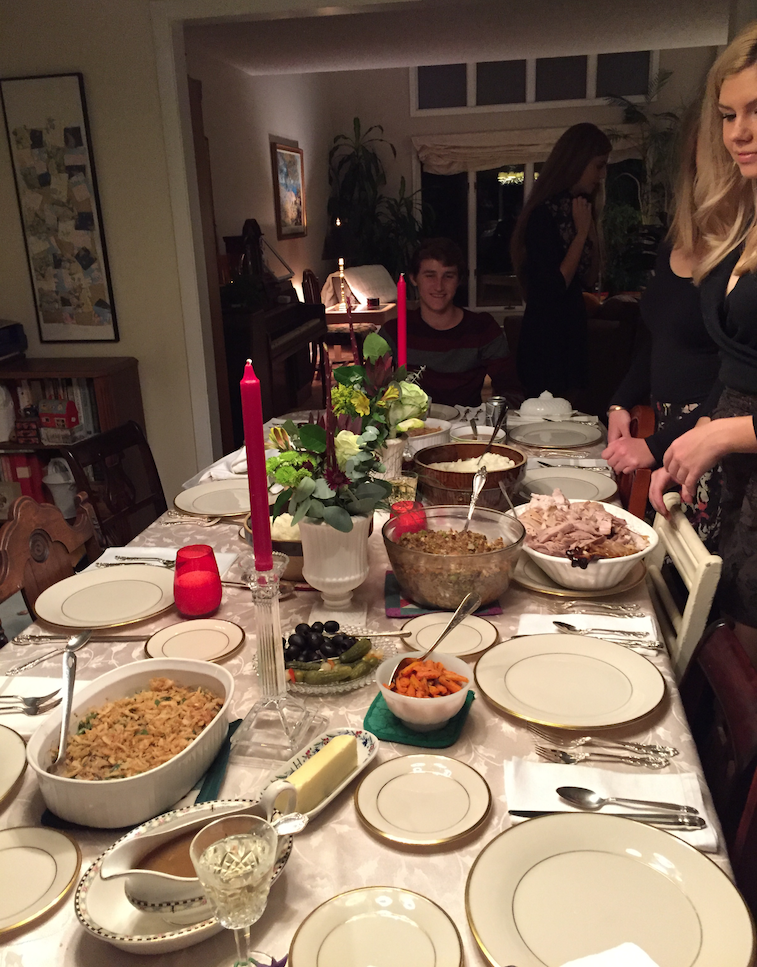
    The table was set for eight with an ironed tablecloth, Mom’s sterling silverware, and her good ivory china bordered with a band of light blue and a thinner band of gold. My father presided at one end of the table and my mother faced him at the opposite end in the chair closest to the kitchen—in case she needed to hop up to get something. My two grandmothers, my two older brothers, my younger sister, and I filled out the sides.

    Mom masterminded the meal—getting up early to put the turkey in the oven, making the stuffing, the green bean casserole, mashed potatoes, gravy, and pie. One of my grandmas brought cranberries and the other brought rolls. My sister and I chopped onions and celery for the stuffing, stirred gravy, and set the table. We also helped clean up. But Mom bore the weight of making this holiday a success. Now that I’ve helped prepare many family holiday meals, I understand and appreciate how much work and pressure this labor of love can be. That we shifted days barely registered with me then. What I recall were the smiling faces and good food.

    As is the way of things, our family grew and we expanded the Thanksgiving table.First came my brother’s wife and their kids. Later, my great aunt and my mother’s sister, both widowed and childless, joined us. When my sister and I married and had kids, we enlarged the table again.

    At that point, there were too many of us for my parent’s small dining room. A dinner for 20-22 was getting to be too much for Mom, who was now in her mid-70’s. Thanksgiving dinner moved to my sister’s bigger house. My parents contributed pre-roasted turkeys from the deli, and Mom brought several pies. My siblings and I prepared the rest of the food. My sister set two adjoining tables with her sterling silverware, ivory china rimmed in gold, crystal goblets, and a flowery centerpiece. Wine flowed freely and we were a festive and rowdy bunch.

    In the last several years, the family circled around the Thanksgiving table has grown smaller. My parents and two aunts are gone now. Our small family of four doesn’t always travel to Ohio for the holiday. Sometimes my sons’ girlfriends join us at our smaller table, but now my sons each need to be a part of their girlfriend’s family gatherings, too. That’s as it should be. Holiday traditions are supposed to flex with a family’s changing circumstances.

    This year, the day of our Thanksgiving celebration shifted once again, because that’s what works best for our sons. Several days ago, I set out my good white china and sterling silverware, arranged flowers, cooked and baked, and gave thanks for the smiling faces at my table.


                    We at the WordSisters wish you a Happy Thanksgiving and hope there are plenty of smiling faces at your table.