Category: Writing

  • Grammar Insecurity Is Alive and Well

    While visiting with my former neighbors, one of them asked me to explain how to use semicolons. As a writer and former writing teacher, I’ve got that one covered. However, her question opened the floodgates. It turns out that the majority of these smart, well-educated people harbor a secret fear of embarrassing themselves, because they aren’t well versed in some fine point of grammar, punctuation, or word choice.

    How does grammar insecurity get started?

    I picture some picky 7th grade English teacher or stern editor shaming writers so they feel incompetent. I’m not immune to that fear either—people expect more of you when you write for a living. Although I like correct grammar, punctuation, spelling, and word choice, I’m philosophical about the inevitable errors.

    Screen Shot 2015-08-05 at 10.05.02 PMHere’s a secret—the experts don’t agree on the rules.

    For example, the rules about comma use depend on what style is being used. If you’re a journalist who follows the Associated Press Stylebook, you omit the comma before “and” when punctuating a list or series. But if you’re an English teacher who teaches the Modern Language Association Style Guide or a journalist taught to follow the Chicago Manual of Style, you would use the serial comma (also known as the Oxford comma). No wonder people get confused about commas!

    I’m a big fan of the Oxford comma. This example from Captain Grammar Pants illustrates why I prefer it:

    This book is dedicated to my parents, Ayn Rand and God.

    (It’s unlikely the author meant that his or her parents are Ayn Rand and God,                          but without a comma after Rand, the meaning isn’t clear.)

    This book is dedicated to my parents, Ayn Rand, and God.

    (Better! Now all I’m wondering about is why the author is enamored of Any Rand . . .)

    The next example isn’t about serial commas, but it’s too much fun to resist:

    Let’s eat Grandma!

    (How’d Grandma get on the menu?!?)

    Let’s eat, Grandma!

    (Oh, thank goodness—she’s just being called to dinner.)

    The Comma Queen at The New Yorker provides even more insights about commas.

    Even when the experts agree on the rules, the rules change. Languages evolve over time.

    When I was in grade school, I’d get marked down for splitting an infinitive (the “to be” form of the verb):

    To boldly go (OMG—a split infinitive!)

    To go boldly (This version keeps both parts of the verb together but it sounds stupid.)

    These days few editors concern themselves with split infinitives. English has evolved. Old English turned into Middle English, which gave way to Shakespearean English and was eventually followed by Contemporary English. When was the last time you used “cozening” when you meant “cheating” (Shakespearean English) or “anon” when you meant “soon” (Old English)?

    Sharp-eyed readers may notice several errors in this blog. Yeah, I know. I was just testing you!
  • A Fool’s Errand or a Worthy Risk?

    I just submitted my memoir manuscript to a publisher. I sweated over every word of the query. I drafted the synopsis and revised it and revised it again so the narrator’s growth was woven into the plot. I fussed over the manuscript sample to make sure it was tight and engaging.

    I believe in my book. If I didn’t think it was worthy, I wouldn’t have spent more than 10 years on it.

    But as I read and reread my handiwork, doubt crept in. I thought, “Am I wasting my time? Will this book even appeal to the publisher?” I sent it off anyhow.

    Next, I polished and fussed with my entry for a writing contest.

    Once again, I was assailed by the same suspicion that this is a fool’s errand. I’ve entered that contest half a dozen times and haven’t won yet. Will this year be any different?

    Some stubborn, optimistic part of me persists.

    While working on these submissions, I countered my doubts with platitudes like, “You miss 100% of the shots you don’t try.”

    Then I questioned the platitudes. It’s ingrained in the American psyche to believe that you’ll succeed if you try hard enough. That isn’t always true. Sometimes you fail anyhow. Then you have to live with the failure and wonder if it’s your fault because you didn’t try hard enough. Huh?!? What maddening logic.

    Americans also love noble failure and tell ourselves, “At least you tried.” That is comforting. Like many Americans, I do believe that it’s better to risk failure than to attempt nothing. Risk is scary, but safety is stifling.

    Finally, I come back to Margaret Atwood’s sensible advice: “Writing is work. It’s also gambling. You don’t get a pension plan. Other people can help you a bit, but essentially you’re on your own. Nobody is making you do this: you chose it, so don’t whine.”

    I’m going to stop whining. As for the entries? Stay tuned.

  • What Was This Farm Girl Doing at AWP?

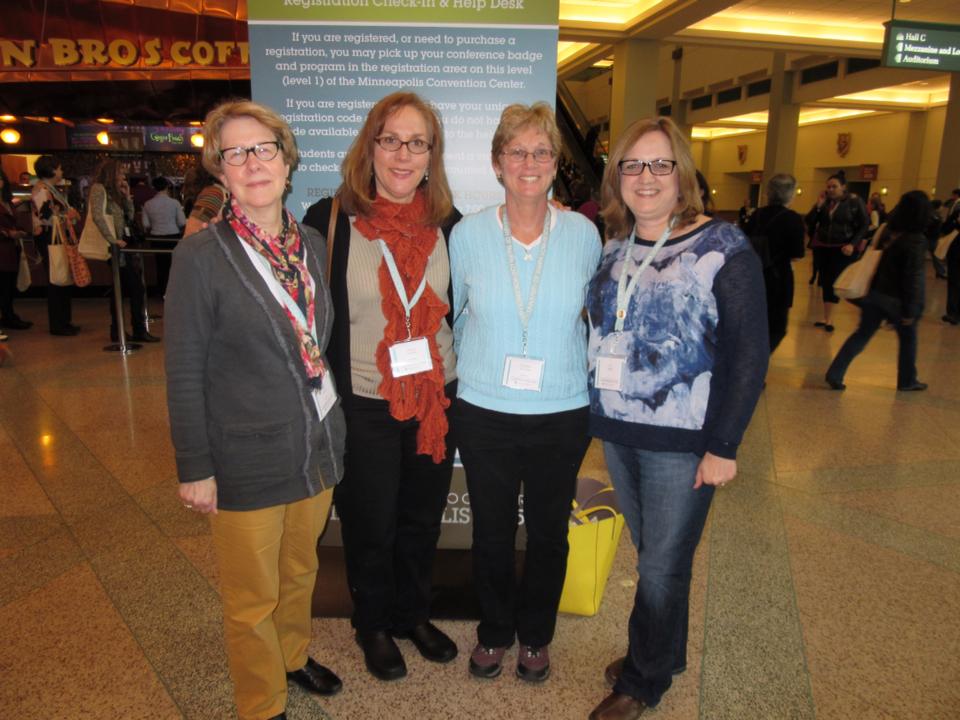
    Ellen, Brenda, and Jill  Members of my Writing Group
    Ellen, Brenda, Elizabeth and Jill
    Members of my Writing Group

    The Association of Writers and Writers Program (AWP) had their annual Conference and Bookfair this past weekend in Minneapolis and over 13,000 people attended, including me.

    I could have left after the first panel discussion I attended: Stranger than Fiction: Personal Essay in the Age of the Internet. I got my money’s worth in the first hour of the four-day conference.

    I heard, “What is our truth and are we doing that on the page?”

    I heard, “I allow myself to be a person who can change.”

    I heard, “Let’s put out shit that matters.”

    Those few words gave me the courage to own my story in its entirety.

    When asked what I write it was easy for me to say, memoir, adopting infants from Guatemala, raising them with another woman, etc…but I generally would not say the whole of it.

    Fear of how people would see me was part of that.

    But, no one else can tell my story.

    My completed memoir manuscript, House of Fire, uses fire as a metaphor for the dysfunction in my family of 14 growing up on a Wisconsin farm. I interweave the incest that defined my childhood and teenage years with how I healed. The book describes how my partner, Jody and I, intentionally created a safe healthy family by adopting and raising two infants from Guatemala.

    I’ve spent over thirty years working on myself to have my past not define me.

    And, to that end, I’ve been successful.

    I contain multitudes: the Tae Kwon Do black belt who is a goof who loves to spar at the Dojang, the mother of two twelve-year olds, the police reserve officer, the human resources manager, the soon to be Assistant Scoutmaster, the writer and author, and the woman who married her partner last August.

    I’m also the woman who suffered repeated sexual abuse, who had a hushed-up abortion after I was impregnated at 14 by one of my brothers, who was pregnant again within a year by another brother, who gave up a son and never saw him again.

    What I wanted most in my early twenties was to know that people could not only survive what I did, but heal and live a good life.

    Now, my book, House of Fire, will help me be that person for others.

    I didn’t go home after that first hour of the AWP conference. I remained among my tribe of 13,000 writers.

    I also have another tribe who I hope to reach through the printed and spoken word.