Write Anyway

Every birthday I consider what the past year has brought and what I hope the upcoming year will bring. This year as I entered a new decade, my focus was also tempered by the awareness that my time isn’t unlimited, and I want to use it well. What will the coming days and years consist of? Family and friends, health upkeep, travel, fun and for me, writing. 

At first, asking what role writing will play in my life seems silly. Creative writing isn’t something you have to retire from. I can write as long as the words and ideas come. But the deeper question is—What are my expectations about publication?

Widely published authors like Stephen King and Joyce Carol Oates can continue publishing as long as they care to. It’s a different matter for the writers I know, who have a modest number of publications. Like it or not, the marketplace may decide for them. Because it’s a personal and potentially painful decision, writers don’t always discuss the dilemma.

In the past 20 years, I’ve written two book-length memoirs, but I’m not seeking publication for either of them. I learned what I could about writing books, but it wasn’t enough. The real gift is what I discovered about myself through the writing process. I’m proud of myself for doing the work. I’m at peace with the idea the books won’t be out in the big world. 

Instead, I’m focusing on writing short memoirs, essays and blogs. My talents and skills are better suited to short pieces. Most years I publish one or two. Not a breath-taking record, but enough for me. Knowing my words and ideas find an audience in an anthology, literary journal or blog is plenty. 

Publication plays a small part in my commitment to writing. I write because it helps me make sense of my world.

Two quotes sum up my outlook. The first comes from a blog by Amy Grier who was struggling with her writing and the state of the world in November 2020. Her thoughts are still relevant:

Writing tethers me to the world in a way nothing else does . . . I don’t know who will be president, what’s happening to my country, even what will happen to me. But I’m going to write anyway. It’s my remedy for despair. It’s how I will survive.”

The next comes from an interview with Margaret Atwood, who offered a few rules for writers. After making practical writerly suggestions, she also said this:

“Nobody is making you do this: you chose it, so don’t whine.”

For as long as it pleases me I will honor my creative nature and write anyway.

Holding the Lantern High

When I first suggested that the WordSisters should road trip to Michigan in Beth’s still-a-dream motorhome, I didn’t really think it would happen. But now, more than a year later, I pull into the campground five miles from my new home in Michigan to see Beth sunbathing in front of a 28’ Winnebago. With the help of her wife, Jody, they’ve driven 10 hours from Minneapolis to visit me in tiny Byron Center, Michigan. Soon Ellen and Brenda emerge from the rig and I’m near tears. They’re here. They’re really here. The power of a 20+ year friendship is made manifest.

L: Sunbathing, R: Beth & Jody

A lot has happened over the two decades that we’ve known one another (no one can say precisely when we first met). I came to the writing group last (as I remember, but it might have been Brenda). There were other writers in the group then, friends and fellow writers who went their separate ways over time until the four of us remain, bonded by the love of writing, a mutual respect for the craft, and compassion for one another’s lives. We’re no longer just writing group acquaintances, but friends. Through our writing we’ve exposed ourselves to one another in ways we don’t to others. 

A lot has happened, too, since that day in May 2023 when the idea of a road trip first took root. My husband and I emotionally dismantled three decades of living in our Minnesota home to move to a townhome in my home state. Ellen became a grandmother. Brenda’s daughter (who we met when she was an infant) successfully navigated her first year of high school. And Beth and Jody bought a motor home, which now sits before me in all its glory.

During the past year I also read Tom Lake (stay with me here) and had the privilege of seeing Ann Patchett at the Fitzgerald Theater in St. Paul, Minnesota, talk about the book, writing, and life with Kerri Miller for MPR’s Talking Volumes Series. At the end of the night, Miller surprised the audience by bringing Kate DiCamillo on stage. For a group of writers and readers, a surprise visit by the hometown star was, I suspect, the same feeling that music fans had back in the day when Prince used to show up unexpectedly at First Avenue. The crowd roared.

The dedication to Tom Lake reads: “To Kate DiCamillo who held the lantern high.” Patchett explained that while writing the book she and DiCamillo would exchange a short email in the morning and again at night. “She would always say, ‘I’m going down the rabbit hole. Good luck in the orchard today,’ and at the end of the day she would say, ‘It’s time to come out of the orchard. I’m holding the lantern up. Just walk towards the light.’ ” 

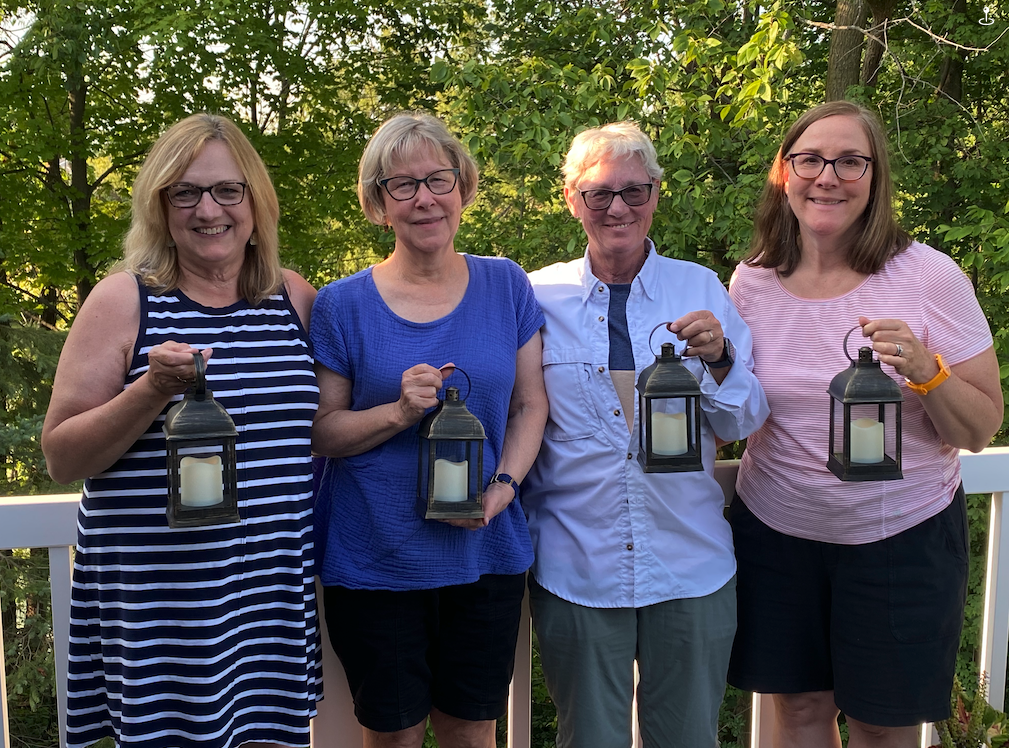
I sat in the balcony of the Fitzgerald next to my book club members (another group of wonderful women I’ve known for over 15 years) and fought back tears. All I could think of then were Ellen, Beth, and Brenda standing at the edge of my proverbial orchard for two decades guiding me with their light. It’s who we are and what we do for one another as writers. So, on the last night of our way-too-short visit, we sit in my sunroom, and I give each of them a lantern. I want them to remember me, which I really don’t fear will be an issue. And I want to remind them to always “hold the lantern high.” I’ve bought one for myself as well, to hold for them as they make their way out of Guatemala, or the ER, or a spiritual labyrinth or one of the many places our life journeys will take us. I want them to know that I will always be there for them holding the light.

Jill, Ellen, Beth, Brenda

The Blue Notebook

I wrote my first novel when I was 10, in a royal blue spiral notebook I’m sure was meant for my math homework. The story was what you might expect of someone that age. The protagonist was an angst-ridden fifth grader whose family didn’t understand her.

I have other notebooks from those days, mostly filled with bad rhyming poetry and rants about my sisters. But the blue notebook is gone. I think, but I don’t know for certain, that I destroyed it in a fit of frustration. This was long before Anne Lamott wrote Bird by Bird, and I understood the value and necessity of a shitty first draft. I just thought I was a bad writer because I couldn’t resolve the plot in a meaningful way. I was 10.

Since then, I’ve written pages and pages, too many words to count. More bad, unpublished poetry. An op-ed about athletes getting more recognition than scholars that was published in the Midland Daily News when I was in high school. A speech that won an award from Optimist International.

After high school I channeled my writing energy into professional writing: news releases, promotional copy, employee newsletters. I don’t remember much creative prose in the early days of my career, but most of my jobs involved writing.

Years later, driving home from a family reunion in Barnesville, Minnesota, my two kids and my mom strapped in the back of our minivan, I decided to go to graduate school for creative writing. There I became the writer I always dreamed I’d be.

I spent the next seven years learning about the craft I’ve loved since I was 10. I was introduced to Anne Lamott, Joan Didion, Janet Burroway, and a host of others who helped me learn that writing is a process and a passion. Sometimes the words flow easily and land on the page perfectly formed. Most of the time, however, it’s a wrestling match, moving words around until they strike the perfect pose or are pinned to the page in beautiful submission.

Now, two decades later, I turn to Julia Cameron, who encourages me more than any of the others to just write. Every day. In a notebook. Longhand.

***

I go to my local office supply store (some still exist post-pandemic, although my favorite has closed) and shop for two notebooks. I pick a college-ruled notebook for my daily pages. I want a different color for the novel I’m going to write. This will be my third novel if you count the abandoned manuscript from childhood. I rifle through the messy piles in the bins of the store searching for the perfect one. I stack the notebooks neatly back on the shelves, turning them right side out until at the bottom of the bin I find it. I can’t say why it’s “the one,” but it is.

I clutch the two notebooks to my chest and head to the cash register. I lay the two side-by-side on the counter, marveling at the possibilities. The black cover will be for my morning pages. And the other—the one with the vaguely familiar royal blue cover—will hold the novel I’m about to begin.

The Fierce Urge to Tell Our Stories

Anne Frank was a vivacious teenager and a keen observer of human nature. She wrote well and her diary often includes deft characterizations of schoolmates, family, and the other people in hiding with her family. When I recently reread her famous diary in preparation for visiting her family’s hiding place in Amsterdam, I was impressed by her lively mind.

Initially, she wrote to sort out her feelings—the same impulse that has prompted me to keep a journal off and on since I was a teenager. Putting my feelings into words helps me understand them. Airing out something on the page calms me and enables me to move on. 

At first, Anne Frank meant her diary to be private. When she was 15, she heard a radio broadcast about a Dutch official who wanted to collect war stories and experiences, so she edited her diary in hopes it might be published one day. Unlike Anne Frank, I don’t want my journals shared with others. They’re histories of cranky confusion, and without context, they would likely distress family or friends once I’m gone and can’t explain.

After her family went into hiding, her diary also served as a record of how they lived—what their space looked like, what their meals were, and what their daily schedule was. As the war intensified, she recorded bombing raids and news updates.

Shortly after I finished the Anne Frank book, my sister asked me to refresh her memory about our great great grandmother—Katherine O’Tanney Feeley who emigrated from Ireland in the late 1800’s. To answer, I searched handwritten notes from my mother and father—a story here, a date and detail there. Some of the notes are sketchy and incomplete, but I decided I would make sense of them in a Word document so others in my family will have a record.

Anne Frank’s story has touched millions all over the world in the decades since she wrote it. I have no such expectation for the family record I’m assembling. All I have are snippets of stories, not much to go on. Perhaps a few family members will have a mild interest. Hearing about people you never knew (even if they’re related to you) can be boring. 

I’m fascinated by the urge to write journals and record family histories. Beyond that is the widespread wish to share the content of our days on social media or like I’m doing with this blog. People across all eras and cultures have felt this fierce need to tell our stories and understand who we are and who we came from. Sometimes we’re saying, “Here’s what happened.” Other times the wish to share is a way of saying, “I’m here. I matter.”

Anne Frank could not have imagined how much her story would matter or how many readers would be touched by her words.

Although my intentions and hopes for my writing differ from Anne Frank’s, I feel a kinship with that young woman born almost a century ago. 

The WordSisters Celebrate 10 Years of Inviting You into Our Lives

In 2012, when Elizabeth and I launched WordSisters, we weren’t sure where this adventure would take us or if we could keep up the discipline of posting once a week. Our original motivation was attracting agents and publishers, but soon we were blogging for the pleasure of writing. We had things to say and stories to share. 10 years later we’re still writing!

Through the years, more sisters in writing joined us: Cynthia and Bev are regular contributors, while Brenda, Jill, Jean and Rosemary have occasionally posted. 

Our insights arise from our lives—mothering, working, aging, living through COVID, reacting to events in the news, planning our futures and setting goals. I’m proud of the breadth of topics we’ve covered and the connections we’ve made with strangers all over the world . 

Most of all I’m proud of us for persisting. For being here long after many bloggers have faded away. 

One of our strengths is the variety of voices, styles, and subject matter each of us brings. In that spirit, here is a collection of best-of posts. I hope you’ll enjoy sampling them. 

Thank you for being our readers.

Ellen

No More Guilt with Every Bite 

What Work Would I Do if I Were an Immigrant?

Elizabeth

I Didn’t Come This Far

Until It Becomes Personal

Cynthia

Shake the Marbles

Broken Dreams

Bev

Let the Hope Shine

When It Comes to Your Age, Do You Share? 

Brenda

Confessions of a Pandemic Parent

I’m (Not) Sorry

Jill

Opposing Thumbs