Category: Working women

  • Anachronisms (Or 3 Reasons Why I Love My Electronic Devices)

    My youngest son and I were talking about eating alone in restaurants, when I flashed back to life before cell phones, tablets, GPS and Internet connectivity. He’s a nice guy, so he didn’t tease me about my “Why in my day, Sonny, we used to . . .” moment. Electronic devices have profoundly changed the outcome of several awkward or frustrating experiences.

    Eating Alone

    While traveling for business in the late 1980’s, I faced a dilemma that no longer exists: how to eat alone in a restaurant without looking weird or attracting unwanted attention.

    Articles for career women advised bringing a book and reading at dinner. That way you wouldn’t feel stupid, and you wouldn’t attract sleazy guys trying to pick you up. Or you could order room service and avoid the whole issue.

    I usually preferred a good meal with a glass of wine to a dry turkey sandwich in my room, so I learned to carry a book. Wait staffs’ reactions and service varied from dismissive to sympathetic. To boost my confidence and convey that I had a right to be there, I was pleasant but a bit aloof. While waiting for my order I sipped my wine and read. Usually that worked, but sometimes I didn’t have the energy for the performance.

    Now I can take my smartphone or tablet and catch up on email, check Facebook, read online, or write and be legitimately busy and content. I don’t have to worry that I look pathetic or vulnerable.

    Missing Connections

    Before cell phones, bad luck could ruin a rendezvous. Imagine this: you’re in Chicago on business. You have a free afternoon before your flight and want to see a college friend. You agree to meet by the lions in front of the Art Institute at 1:00. By 1:15, you’re checking your watch and wondering. At 1:35, you’re frustrated and uncertain. Stay? Go? What’s going on?!?

    Screen Shot 2015-05-27 at 10.47.28 PM

    There was no way for your friend to call or text to say, “Missed my train. Can I meet you inside by the Chagall window at 2:00 instead?” You could go inside alone but she’d have no idea where to find you. Or you could leave, angry and disappointed. Either way, you would have missed each other. The afternoon of laughs and reminiscing couldn’t be salvaged.

    Getting Lost
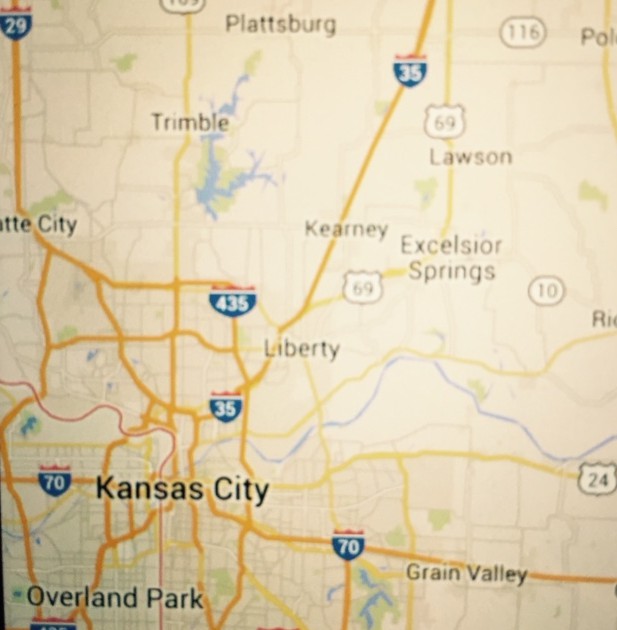
    MissouriFor years, I’ve driven cross-country for family visits to Ohio or vacations in Virginia, Texas, and Montana. I also think nothing of driving to a distant suburb to meet friends for dinner. Usually I navigate these trips successfully . . . as long as I have a map or Garmin for GPS.

    Occasionally, though, I’ve gotten spectacularly lost. Driving 30 miles out my way near Green Bay, Wisconsin. Circling Eden Prairie, Minnesota for 40 minutes (and Eden Prairie isn’t that big). Hubris accounted for these mishaps. I thought I knew where I was going, so I didn’t bring a map.

    Back in the day, the only solution was to stop and ask for directions. I had to hope the person was reliable and not a knucklehead who’d send me the wrong way, because he forgot to mention three important turns.

    If there’s no cell phone signal (rural Montana and Wisconsin come to mind), I can be just as lost as in the old days. Google maps and GPS have definitely reduced the likelihood that I’ll get lost during a road trip, but sometimes they are wrong or incomplete. Just in case, I still carry a paper map and keep my cell phone charged up.

    How about you? What difficult situation has become a thing of the past because of your electronic devices?

  • God Bless Middle-aged Daughters

    As I walk into the skilled nursing center where Mom is rehabilitating, I see other women like myself and think, “God bless middle-aged daughters.”

    We’re the sensible, competent women who make it all happen.

    On the street, we often go unnoticed, although we’re attractive. We dress well, but in age-appropriate clothes. No six-inch heels or short skirts. We may carry 10 to 20 extra pounds, but we’re fit, trim, and solid enough to carry the weight of the world.

    On our lunch hour, after work, or during weekend visits, we go see our failing mothers and fathers. We bring them flowering plants small enough to fit on a bedside table/hard candy/clean sox/good cheer.

    We comb their hair and smooth hand cream on their veiny hands and swollen feet. Once they could manage a demanding job or their family’s busy schedule, keep track of birthdays, recipes and grocery lists, but now they can’t remember what you told them five minutes ago, so we answer the same questions again and again. The times they emerge from the twilight, smile and say, “Oh honey, I wish you could always be here,” are heartbreaking treasure.

    As we go back to the office, drive home, or head to the airport, we sigh at the slippage and blink back tears at the losses. Then we put on our game face because somebody else needs us. We keep moving—plan the marketing campaign, schedule the meeting, throw in a load of wash, or make a decent dinner.

    We are careworn. Our lives are not glamorous (and never were—we didn’t aspire to that). We don’t expect much. We can be made happy with so little—a compliment when we don’t feel sexy or a hug from a kid who often seems oblivious.

    Photo credit: Bokal @ Vecteezy.com
    Photo credit: Bokal @ Vecteezy.com

    Sometimes we need to push back our realities for a little while, so we laugh ourselves silly over a stupid joke when we’re out with our girlfriends or sink into the sofa and pour a second glass of good wine.

  • Writing Memoir Is Risky Business

    Last fall I finished revising my memoir manuscript, BRAVADO AND A SKETCHY VISION LED ME HERE, and I shared it with several friends and family members before I started seeking a publisher. All of them were familiar with the basic premise of the book: it’s a coming-of-age-in-the-workplace story that takes place in 1979-1980. As a young woman, I was unsure about how to apply my feminist principles to my own life—What did I believe? How far was I prepared to go in pursuit of a career? How much did having a relationship and a family matter to me? If I wanted all three, how would that really work day-to-day?

    Sharing the manuscript is scary. I’m exposing my personal life. To judgment – (Your life is boring. Your experiences don’t matter.) To criticism – (The writing is amateurish. The book is poorly written.)

    Writing about my own life means I’m also writing about friends and family in my life. Real risky business. They didn’t ask to be in my book or become part of my creative project. They may resent the intrusion. Hate how I’ve characterized them. Even if I don’t intend to, my words can hurt people.

    There’s a risk that my family won’t like what I’ve written. A risk that goes beyond embarrassment or irritation about the portrayals. More like – “I don’t care for memoirs—all that emotional stuff. I’d rather read a spy novel.” OK, I can handle that. Tastes vary. Vampire novels may be great stories, but they don’t appeal to me.

    But if someone dear to me said, “I’m worried that although I love you, I might not like your writing,” that would be hard. I’d have difficulty separating my relationship from my craft, which is my passion and my life’s work.

    I’m exposing my innermost thoughts. Often they’re innermost for a reason—sometimes because they’re painful. Embarrassing. Unworthy. Or stupid. As a writer, I’ve learned that the painful and embarrassing moments are most worth exploring—they’re most likely to yield the material that others really connect with.

    The story I’m telling is only as good as my craft. As a memoirist, I use my writerly skills to shape the stories I tell. I decide which incidents, feelings and insights will create a story arc and which are extraneous details and better omitted. I use my powers of description, write dialog, and mine my memory for details. I’ve learned to check facts instead of trusting my memory (The lecture happened in February, not November as I recalled) so I can present a scene as accurately as possible. My skills or shortcomings as a writer determine the value placed on my memoir.

    Why take that risk? Some memoirists write in hopes that they can teach others. That’s not what motivates me. Instead, I hope others will recognize something about themselves – “That frustrates me, too.” They’ll enjoy a moment of reminiscence – “OMG, that happened to me!” Or they’ll realize that they’re not the only one – “Wow, I’ve thought that, too.”

    Despite the inherent risks, I examine certain periods of my life to find and share meaning. My experiences are worth writing about, not because they’re mine, but because they’re human and other people will see themselves in some of the central truths of my life, even if the particulars differ. For example, other working women have worried about pay and workplace politics. Today, some young women still wonder about how to balance a relationship with a career, just as I did. Other middle-aged women are looking back and considering their legacy.

    If you write memoir—what makes it worth the risk?

    If you read memoirs—why do they appeal to you?