Category: Travel

  • I’ve Never Been a Daredevil, But . . .

    As I settled into my seat at the movie theater and muted my phone, an unwelcome thought sneaked in, “Is going out to the movies risky behavior?” I stifled it quickly, “A crazed gunman in the old-fashioned Edina Theater? That’s silly.” Worrying about my safety at movie theaters never used to cross my mind. I resent having to consider it now.

    It’s disturbing to realize so many of the ordinary things I do put me in the kinds of places where mentally ill people or terrorists choose to murder and wreak havoc. However, I have no intention of curtailing my activities.

    Shopping at malls – I don’t spend much time in malls, but while there, I have never worried about my safety. However, the shoppers in the mall in St. Cloud, Minn. or near Seattle, Wash. probably didn’t give it a second thought either.

    Tutoring at the high school – I love the work I do tutoring adult immigrants and have never felt remotely threatened by any of them. The students I know are hardworking and determined to learn, get better jobs, and live the American Dream. But schools and colleges have been the scene of mass shootings in recent years. Perhaps I should be worried, but I refuse to be.

     Visiting international cities – I enjoy traveling overseas, but because of the history of terrorism in London, Brussels, and Paris, I will have to consider my safety in airports as well as in the cities themselves when I go. Losing my luggage or getting pickpocketed seem like more realistic threats than terrorism, but I can’t help being aware of the potential for an attack.

    Often, public places happen to be the settings where a personal grudge is played out—I might not be the target—but I still could be injured or killed by a stray bullet. The issue is not that one middle class white person has to think harder about her safety. It’s that no matter who you are or where you live in America, you are at risk of mass shootings, because of our gun laws and cultural tolerance of violence.

    Equally troubling is that zealots with knives, trucks, and bombs threaten people across the world, not just Americans.

    I remain defiant. There are no easy solutions to gun violence and terrorism. But part of the solution has to be resistance—resisting the impulse to hide and resisting the impulse to shrug and say, “Oh well, what can you do?” We have to keep fighting for change.

    Although terrorism and acts of mass violence are now part of our reality, I refuse to give in to fear. I’ve never been a daredevil, but I have no intention of giving up activities I love like movies, shopping malls, tutoring, or traveling.
  • Capturing the Moment

    Since getting my iPhone, I’ve begun taking tons of photos, especially when I’m vacationing. During the nine days I was in Kauai I took 361 photos—mostly of scenery and quirky objects, occasionally of my companions.

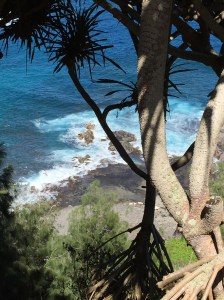
    Near Kilauea lighthouse
    near Kilauea lighthouse
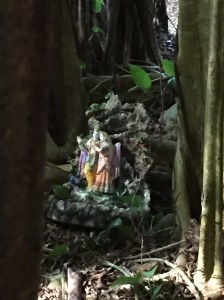
    Tiny shrine under banyan tree at Hindu monastery
    Tiny shrine under banyan tree at Hindu monastery

    That’s about 40 per day. Why not? It’s fun. Taking pictures has become a way of heightening the experience. Documenting and remembering it. But sometimes I wonder: when I’m focusing and framing shots, am I more in the moment or less?

    There’s something acquisitive about taking pictures.

    Click. There. Now I’ve got it. This moment and this place are mine. I can revisit them whenever I want. I’m hoarding a treasure of memories. At some future point, seeing this vista, cool object, or time with friends may be just the tonic I need.

    Of course I've got a beachy sunset photo -- it's Hawaii!
    Of course I’ve got a beachy sunset photo — it’s Hawaii!

    Initially, I might share a handful of photos on Facebook. Snap a funny scene and text it to a friend. After I return from a trip, I fuss with the photos in Photoshop, cropping them or adjusting the lighting. It’s a second way of enjoying the sights. Sometimes I create screensavers. Once in a while I make a printed calendar.

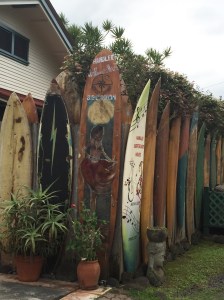
    Surfboard fence in Hanalei
    Surfboard fence in Hanalei

    Having photos allows me to relive the good times. Except that after my first wave of enthusiasm, I rarely do.

    Bird of paradise at Allerton McBryde Gardens
    Bird of paradise at Allerton McBryde Gardens


    At least my photos are easy to store.

    I’m grateful that I don’t have to deal with storing my collection. I think of the albums and boxes of pictures my parents had. Some of them are precious—that’s our history. My three siblings and I lined up in front of the tulip garden at Easter. There we are sprawled in swimsuits on the dock at Lake James.

    But the photos from when my parents were in Hawaii? I’m glad they had the experience, but the images mean very little to me. I wasn’t there. I don’t know the stories. Is there any reason to save those prints now that my parents are gone? Similarly, my Hawaii photos won’t mean anything to my kids either. They weren’t there.

    Fortunately, my fascination with photography doesn’t require much effort or upkeep. As long as I have loads of gigabytes, digital photos are easy to keep.

    There’s one picture I didn’t take in Kauai.

    In Hanapepe, they have a Friday night art gallery crawl. At 6:30, it was dark except for a few streetlights and the lights from shops. The air was cooling but the breeze was still gentle. A dozen shops opened their doors and a handful of food trucks gathered. Several musicians performed here and there—folk music and traditional Hawaiian music.

    An old black pickup truck was parked under a streetlight. The front of it was painted with orange and yellow flames. Hot pink bougainvillea bushes were planted in the truck bed and they bloomed lavishly. Alongside the truck, a woman in a lawn chair was making leis.

    I really wanted to take that photo, but it seemed wrong. Did I have the right to the photo if I didn’t want to buy the lei? Probably didn’t matter. People must do it all the time. That truck is meant to attract attention. Specifically, tourists’ attention.

    After a while, she got up and shook some flowers from the tree behind the truck. Had a cigarette. A friend of hers stopped by with a brown bag of food.

    I let the moment pass. It was too dark for my phone’s camera. It wouldn’t have seen all the color and details my eyes registered during the 20 minutes that I sat on the curb across the street from her eating spicy chicken curry.

    I appreciate both kinds of images—the photos because they can trigger a story and the remembered images that have become vivid because I found the words to turn them into stories.

    Both bring wonderful experiences to mind.

  • The Little Free Library Saved My Camping Trip

    At 11 p.m., the tent, sleeping bags, lantern, bin of dry food, and bug spray were in the car. Early the next morning, we were driving to northern Wisconsin for a four-day tent camping trip. But wait! What was I going to read? All of my books were on my iPad and it would be pretty hard to recharge it while camping.

    As a reading addict, I get panicky at the thought not having at least three books to read when I go on a trip. Barnes & Noble wouldn’t be open before we left. Amazon couldn’t help me.

    For many people, being without books during a camping trip is no problem. There’s hiking. Swimming. Sitting by the fire. Eating s’mores. Stargazing. And we do all of that.

    Lack of old-fashioned paper books would really put a damper on the trip.

    I love losing myself in a story and there are lots of opportunities to read during a leisurely trip like camping. When the birds wake up the campground at 5:30 a.m., I like to burrow into my sleeping bag and read for a while before wrestling into clothes and walking down the road to heed nature’s call. For me, swimming really means reading on the beach and jumping into the lake occasionally to cool off. In the late afternoon, it’s nice to have a beer and read before we make dinner. After the dishes are done and we’ve gathered kindling for the fire, I’ll read a little more before the light fades.

    If we delayed the trip for several hours until the bookstore opened, we would arrive too late to have lunch with a friend who lives near the campground.

    Inspiration struck—I could borrow books from the Little Free Library!

    IMG_1344The libraries dot my Minneapolis neighborhood. A Little Free Library steward makes or buys a house-shaped box, stocks it with books, and erects it in the yard. Patrons can take book or leave a book anytime. If the steward registers the library, it will appear on the world map the Little Free Library organization maintains on its website.

    Little Free Library is a grassroots movement begun in 2009 by Todd Bol of nearby Hudson, Wisconsin. He and Rick Brooks, of the University of Wisconsin-Madison, saw the opportunity to build community and share a love of reading. Initially, they and other volunteers donated time and materials and the movement grew within the region. Word-of-mouth, as well as regional and national media, helped spread the idea, and by the end 2011, there were nearly 400 Little Free Libraries across the U.S. In 2012, the Little Free Library became a nonprofit corporation. In early 2015, nearly 25,000 Little Free Libraries were registered across the world.

    Screen Shot 2015-08-14 at 10.08.38 AMA Mystery, a Memoir and a Novel

    Within blocks of my house, there are eight Little Free Libraries. I visited two and came away with three books to devour on my camping trip: a bestselling mystery, an historical novel, and a memoir I’d read but enjoyed enough to reread. Crisis averted!

    After we returned, I put the books back in circulation and added several more from home. It’s inspiring to see how a grassroots organization can do so much to support a love of reading and foster a sense of community.