While vacationing in the Hudson River Valley, my husband and I toured Kykuit, Rockefeller’s lavish summer home; Val-Kill, Eleanor Roosevelt’s modest cottage; and the Hancock Shaker Community’s very plain dormitories.
Mindful of the red velvet ropes and little fences that kept us from exploring/trespassing, we craned our heads around doorways, peered into corners, and tried to imagine the lives lived there. Despite the tour guides’ colorful stories, sometimes it was hard to breathe life into those rooms. Occasionally, my mind drifted, and I entertained myself by imagining what a future tour guide would say about my home after I’ve achieved some unspecified (and as yet unattained) notoriety.
No doubt, future tourists leaning across the velvet rope blocking entrance to my office will say, “Ooooh, that’s where Ellen used to write! There’s the honey locust she used to look at while she wrote, and there’s the sad clematis on the too-big trellis—remember her blog about defensive landscaping?”
The tour guide might add, “To preserve historical accuracy, we left the pile of mail on the loveseat. Family stories mention that she used to let it ‘age’ for up to two weeks before she dealt with it.” Visitors will chuckle and some of the more avid ones will lean in to snap photos of the mail pile.
“And over there—a see the cat bed on the radiator? Her cat, Pinky, kept her company on cold Minnesota afternoons. Maybe he was even her muse as she struggled to revise her blogs and essays.” The tourists will jostle each other to take pictures of the cat bed.
The guide will probably point out, “Some of the furniture is antique—like the Mission style oak desk. Supposedly Ellen refinished it when she first moved to Minnesota years before she moved here for good. It was the only desk she ever used.” One of the visitors will probably sigh in appreciation. “We believe that she might have been sitting in that beat-up office chair when she received the call about winning the MacArthur Genius Grant/Nobel Peace Prize/Publishers Clearing House Sweepstakes.” More clicking cameras and cell phones.
“Next, we come to the music room, where Ellen’s husband composed his opus . . . .” The tourists will dutifully shuffle across the hall to oooh and ah.
Guatemala City, Guatemala. Heading home with Juan Jose’.
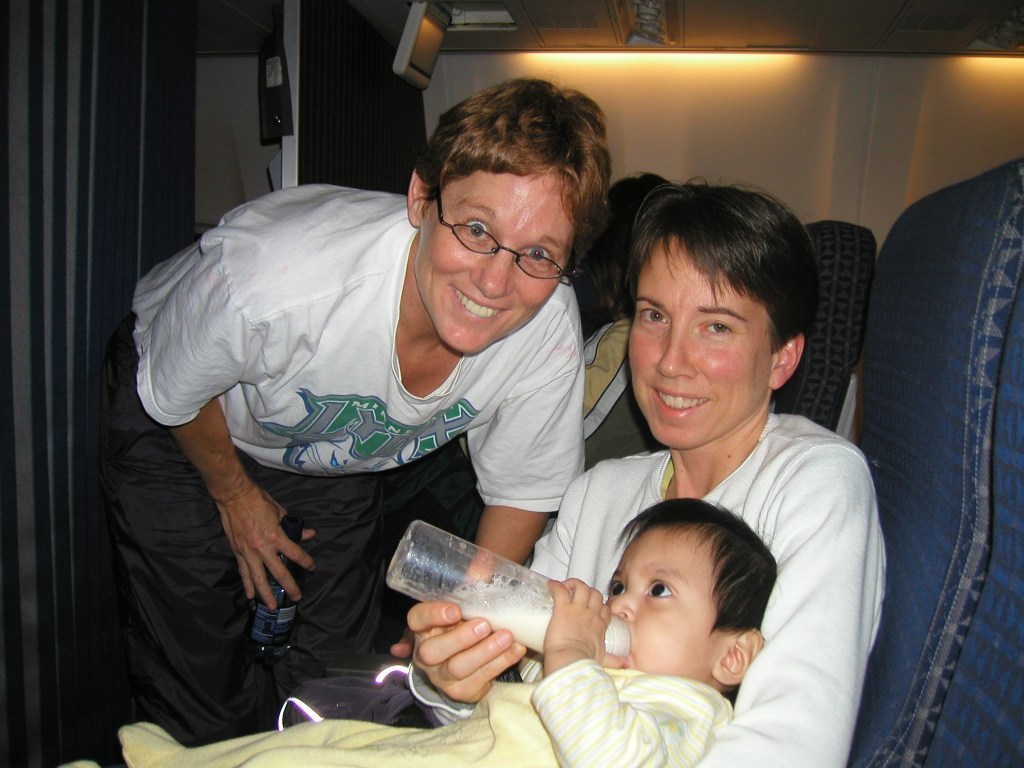
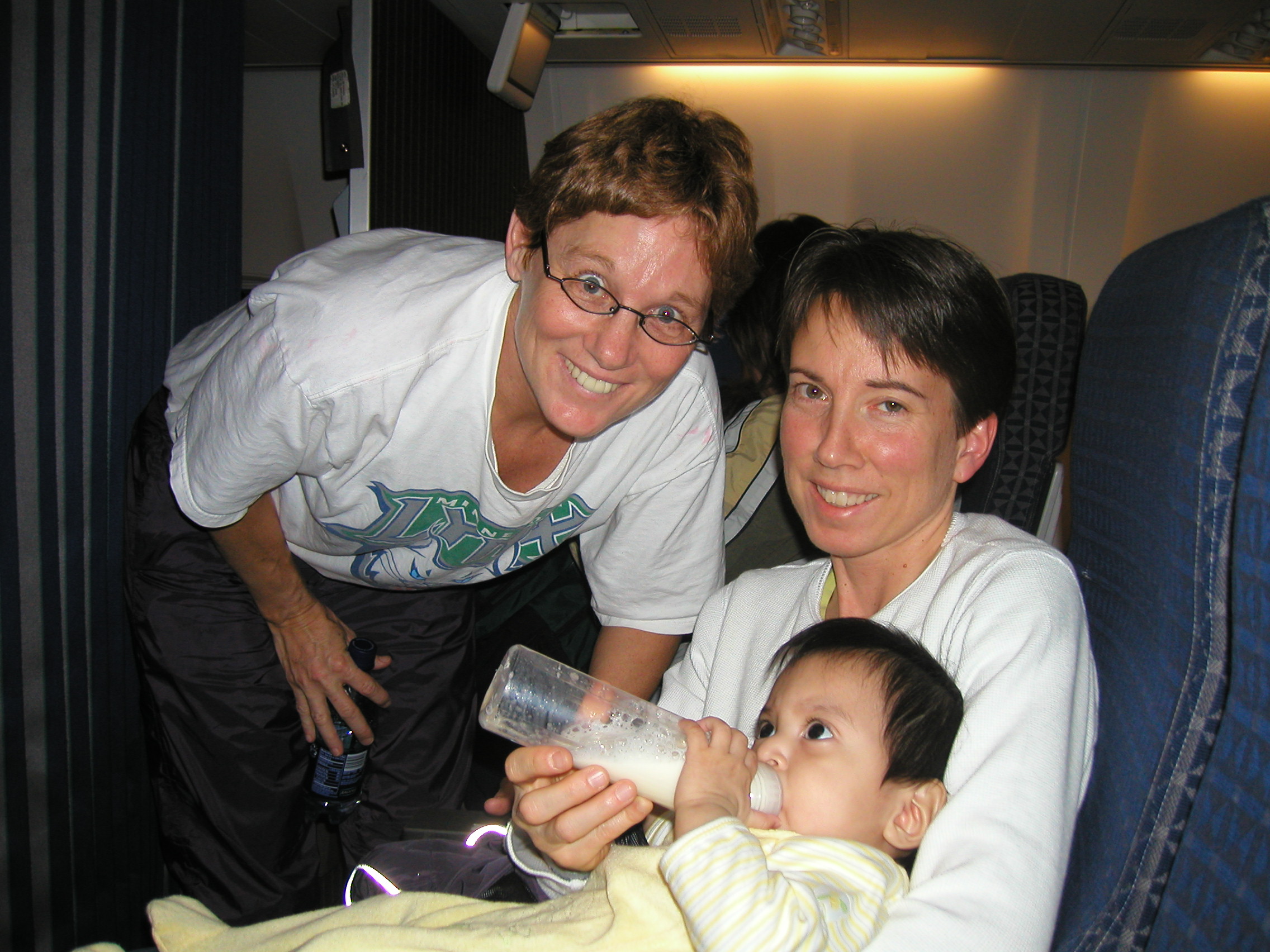
It started when Juan was eight months old. I was sure that at any moment, gun wielding policemen would climb aboard the airplane and snatch our baby from Jody’s arms. We were on the flight home from Guatemala. Everyone on the plane could tell Juan wasn’t our baby. We were white and he was brown. I was in terror that Juan could be taken away from us, even though he was legally ours.
This fear has continued, though it hasn’t stopped our family from traveling. Internationally, we have traveled four times to Guatemala and once to Mexico. In a week, we will be boarding a plane for our third trip to Florida.
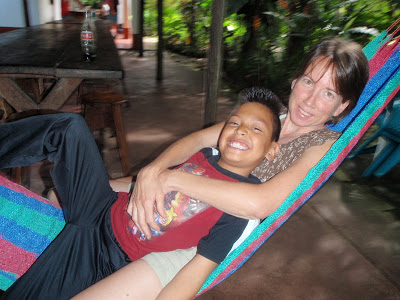
Peten, Guatemala Juan Jose’ age 7
The fear starts about the time we book our flights, whether international or domestic. I start thinking of all the documents to bring: passports, adoption paperwork, name change documents, birth certificates, citizenship papers, and photos of us as a family. All the paperwork that will prove that Juan and Crystel are our children.
We have not been questioned or stopped at airport security. That hasn’t ended my heart from beating furiously as our passports are studied, then we’re looked over, and finally the returned gaze back to our passports.
Cozumel, Mexico Crystel age 10
Even Juan and Crystel have questioned their citizenship. The first time they asked, I was driving them home from grade school. “Are we citizens?” Crystel asked casually. She is usually the one who brings these types of things up. Juan just sits quietly next to her, listening intently all the same. Once we were home, I opened our lock box. Showed them their Certificate of Citizenship documents and the welcome letter from President Bush. I described to them how I had laid out a train of documents on the floor, ten in all, sent them in, to make sure that they would receive their citizenship.
Even though we’ve been on 7 flights, I’m still afraid. My latest fear is that Juan and Crystel could be separated from us and questioned. That would be traumatic for them. For all of us. And, isn’t it our job as parents to raise our kids with the least trauma possible?
Lake Atitlan, Guatemala Crystel Age 11
I was thinking about this with our upcoming flight to Florida. It came to me that there are two additional things that I could do. I could apply for TSA precheck and Global entry. That would be proof to security that Juan and Crystel have already been vetted and have proved their citizenship. I immediately applied online, received our appointments, and took them out of school to meet with the agency. As of this writing, I’ve been approved. Juan and Crystel have not yet even though we applied at the same time and were at the same appointment. Jody has been approved even though she filed several days after us.
Florida, Age 3
When the renewal comes up in 5 years, I hope that we can simply complete a renewal form and pay a fee.
I don’t ever think that it will be easy for Juan and Crystel to travel our world for the simple reason that they are Hispanic. As their parent, I’ll do what I can for as long as I can to make it not traumatic. That’s my job.
When my husband and I travel in the United Kingdom or Europe, we always visit some of the great cathedrals. That may seem odd, since neither of us is very religious. But cathedrals like St. Paul’s in London embody history, politics, and faith in a very visceral way and I’m very interested in history. The experience encompasses the best and worst of human nature.
The Shock and Awe of Churches
The architects and benefactors of great cathedrals intended to create a dramatic impact. And St. Paul’s does. The cathedral is an architectural marvel. The main aisle of cathedral goes on and on—while standing at one end of the church, I can see the other end, but just barely. The arched ceiling and dome soar high above the seats. Everywhere I look there are intricate decorations and many are covered with gold. I immediately feel small and insignificant in face of all the space and history, but that feeling gives way to a faint unease.
Photo by DAVID ILIFF. License: CC-BY-SA 3.0. Wikimedia Commons furnished this photo of the nave. Tourist photography isn’t permitted in the church.
Sightseeing in a Place of Worship
Though I’m no longer a practicing Catholic, that upbringing is ingrained in me. It feels odd to see the whole gamut of tourists wandering around snapping photos (where permitted), peering at inscriptions on statues, ducking into alcoves, zigzagging across aisles in front of the pulpit and behind the altar, talking and pointing. There’s something distasteful about it, although obviously, I’m a tourist doing the same thing.
The premise of sightseeing in church is complicated. Many cathedrals charge admission and I assume the money helps maintain the building. Perhaps the religious authorities are also trying to give ordinary people access to a beautiful and potentially inspiring place.
Tijou gates – Photo by DAVID ILIFF. License: CC-BY-SA 3.0. Wikimedia Commons
Incredible Excess
Cathedrals like St. Paul’s, the duomos in Florence and Siena, and St. Peter’s in Rome, all contain elaborate decorations—intricate mosaics, detailed wood and stone carvings, painted frescoes, golden candlesticks, chalices encrusted with jewels, lavishly embroidered altar cloths. The excess is fascinating but off-putting. I think about all of the money invested, perhaps for the glory of God but also as a demonstration of the power and wealth of the church, whether Anglican like St. Paul’s or Catholic like St. Peter’s in Rome. At first I am awed by the gilt and filigree, but then reminded of the greed, intolerance, and corruption that religious institutions have displayed historically.
Politics and Religion Are Intertwined in St. Paul’s
St. Paul’s was originally built as a Catholic church in 604. In 1087, it was demolished by fire. Rebuilding began in 1087 and the church was reconsecrated as a Catholic church in 1300. The Protestant Reformation, begun by Martin Luther in 1517, in response to the corruption in the Catholic Church, swept through Europe. In 1534, King Henry VIII split from the Catholic Church and established himself as head of the Church of England, so he could marry Anne Boleyn.
Politics and religion remained intertwined and turbulence continued in England until the 1660’s. During this period, St. Paul’s fell into disrepair and was used for a variety of things, including a marketplace. In 1666, King Charles II commissioned architect Christopher Wren to rebuild St. Paul’s, but the Great London fire destroyed the church and work was delayed until 1669. The church was completed in 1710. Now an Anglican church, the new St. Paul’s reflected the politics of the day.
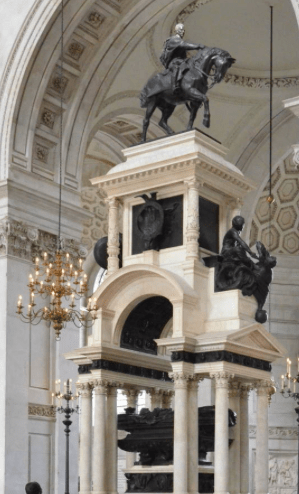
In the dome is a mural with scenes from the life of St. Paul. It was painted in muted colors—a departure from the colorful decoration in Catholic churches. Statues and imagery of saints and angels is limited, in keeping with Protestant philosophy. Instead, statesmen like the Duke of Wellington and Admiral Lord Nelson are ensconced in huge lavish crypts. St. Paul’s remained a more somber looking place until the 1890’s, when Queen Victoria declared that it was dreary and uninspiring and asked to have mosaics installed.
The influence of politics is evident in the lavish decor, which speaks of wealth and power of the monarchs, the Church of England, and England itself. It’s also obvious in the inclusion of statues of political figures instead of religious figures.
I dislike the dichotomy and wish it could simply be an inspiring place of worship. But then I recall the way thousands of people flocked to St. Paul Cathedral at the end of World War II and realize that for many ordinary people, the cathedral is a spiritual place as well as a national symbol.
God in the Details?
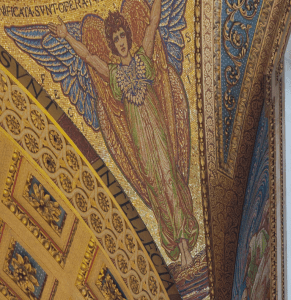
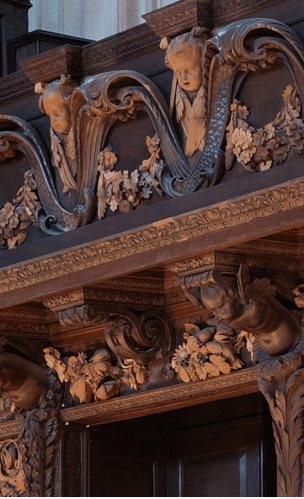
Then I focus on the decorative details and think of the craftsmen who spent years setting tiny tiles to create the mosaics. Or the woodcarvers who labored and fussed over the leaves in the choir stall borders. Or the metalsmiths and artists who made the Tijou gates and the chalices. Hundreds of artisans throughout the church’s history worked to create something important and lasting. I want to believe that devoting years and years of their lives to the work was an expression of their faith. Thinking of the craftsmen restores my appreciation for the cathedral.
Photo by DAVID ILIFF. License: CC-BY-SA 3.0 Detail of quire (choir) mosaics.Photo by DAVID ILIFF. License: CC-BY-SA 3.0. Detail of wood carving in choir stalls.
 Mindful of the red velvet ropes and little fences that kept us from exploring/trespassing, we craned our heads around doorways, peered into corners, and tried to imagine the lives lived there. Despite the tour guides’ colorful stories, sometimes it was hard to breathe life into those rooms. Occasionally, my mind drifted, and I entertained myself by imagining what a future tour guide would say about my home after I’ve achieved some unspecified (and as yet unattained) notoriety.