Category: traditions

  • Traditions Evolve

    Great Aunt Wilma was a fixture at our Thanksgiving gatherings during her latter years. She was widowed with no children, so my parents invited her to join us. 

    Elegant with her silver French twist, stylish earrings and deep brown eyes, she preferred to sit with the guys talking sports or politics (back when that was an acceptable topic). We had plenty of help and cooking wasn’t her forté, so she didn’t don an apron and join the women.

    We gathered at my sister’s home in Ohio. After years of hosting, Mom was ready to let her kids handle holiday meals. Until my parents died, our sons, my husband and I traveled from Minnesota to celebrate Thanksgiving with my extended family. My husband’s family had different Thanksgiving traditions, so we didn’t have to choose.

    For years, my husband and I have been the creators of holiday gatherings like Thanksgiving and Christmas. Days before, we’d clean the house, finalize the menu, make an epic shopping trip, check the table linens, plan the flowers, and start prepping dishes that could be made ahead, then cook and clean up on the actual holiday. As our sons got older, they and their wives also prepared key dishes. However, my husband and I were the event managers who were responsible for making the meal go smoothly. We were happy to do it.

    But family traditions evolve. When our sons married, we began sharing them with their wives’ families. Each year we’ve had conversations about which day to hold our Thanksgiving and Christmas gatherings. After a bit of trial and error, we determined that Thanksgiving dates could be flexible but Christmas was less so. 

    When grandchildren came on the horizon, my husband and I understood our traditions would change again. We are welcome and important, but as grandparents, we are stepping back to a supporting role for holiday gatherings. 

    The focus has shifted to our granddaughters’ needs. Younger babies might be content to be held during a lengthy Thanksgiving meal, but older babies are not. They get bored and want to play. Ideally, both babies should have a quiet place to nap. This year, that will be at the home of our oldest son and his wife, where both babies can be accommodated. 

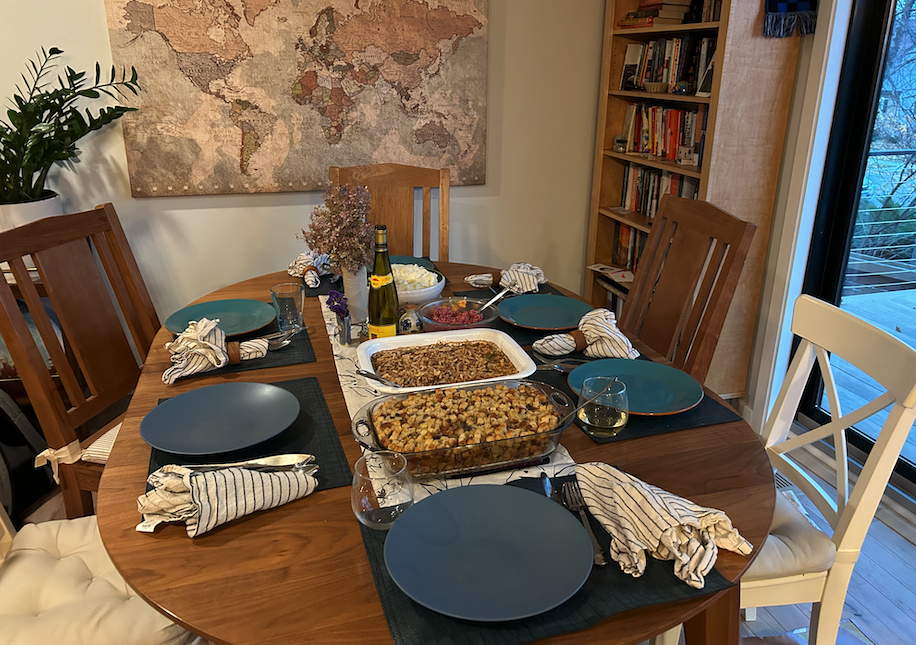
    Shortly before the hungry horde descended last Sunday

    Similar things are happening in the larger circle of my Ohio family. My sister no longer hosts a large family dinner at Thanksgiving. Now she visits two of her daughters who live in a nearby state. My brother and his wife will join friends for Thanksgiving since their children are also hours away.

    My bachelor brother, who used to help my sister and me with cooking and cleaning up at our large Thanksgiving gatherings, is now slated to become a guest at a niece or nephew’s Thanksgiving table. When we spoke of the changes, my brother and I joked that now he has become Aunt Wilma. 

  • One Generation Gives Way to the Next

    When our sons were small, my husband and I invented our own customs for Christmas, because my parents and his lived hundreds of miles away. Making the holiday special was up to us. We missed our extended families, but we were free to do whatever appealed to us—there was no other schedule or tradition to consider.

    A few years ago

    We read “The Night Before Christmas,” filled stockings with candy, assembled big toys like the play kitchen, and added batteries to toy guitars and handheld games. We took a bite out of the cookies left for Santa and scribbled “Thanks!” on the notes our sons wrote (Santa has good manners). 

    As our boys got older and Santa became a sweet memory instead of an actual visitor, our habits changed. The four of us began cooking elaborate meals together—three days of them. Christmas Eve Eve’s dinner would be whatever the group craved—maybe Southern BBQ or cassoulet. An Italian feast (calzones, fagotch*, and homemade pasta) became a required ritual for either Christmas Eve or Christmas Day, and the third meal might be something fancy like Beef Wellington. Later we welcomed our sons’ girlfriends (now wives) into the kitchen.

    When they married, we understood some traditions would have to flex; after all, our daughters-in-law and their families have traditions, too. Changes have already begun. This Christmas the six of us will be together on Christmas Eve. My husband and I will miss our three-day extravaganza, but believe this is the right way forward.

    If we have grandchildren, I envision more changes on the horizon. I’ve watched and learned from friends and family who have married children and grandchildren. They’ve all had to adapt and invent new approaches to holiday gatherings. My brother and sister-in-law spend either Thanksgiving or Christmas with their married child and her family, but not both. Other relatives get together after Christmas, because their child’s divorce means accommodating two separate parents and three sets of grandparents. A friend doesn’t see her children and grandchild until New Year’s Day—scheduling the group at Christmas has gotten too complicated.

    My friends and family don’t relish being alone on Christmas, but they accept the situation and make the best of it. As grandparents, they are no longer the center of holiday celebrations—their adult children and grandchildren are. It’s their turn now.

    I expect changes will continue for my family. As my husband and I age and grandchildren arrive, we’ll adapt again and again. Gracefully, I hope. After all, this is how life is supposed to go. One generation gives way to the next. Inherent in raising children is the assumption they’ll become independent adults, and as a parent, I will be less central. One day, they’ll be responsible for arranging (and cleaning up!) our holiday celebrations, and eventually their children will do the same for them. 

    That’s as it should be.

     *The family’s phonetic spelling for a form of focaccia in which ground meat, tomato paste, fennel seed and other spices are spread on bread dough, rolled up, baked, and sliced into pinwheels.

  • Connections

    Tomorrow I’ll join my extended family for a weekend gathering we jokingly call ShrinerFest. Because of COVID it’s been three years since my three siblings, their children, grandchildren, my sons, and all of our spouses have gathered, although I did see my siblings in person last year. In the intervening time, many important events have taken place off-stage, away from the full circle of family.

    One niece announced her engagement. A nephew got engaged to a woman some of us haven’t had the opportunity to meet. Our two sons married in small COVID-style weddings. A niece and her husband welcomed their first child earlier this year. My second oldest brother and his wife had a rough year. She and their son-in-law experienced bad fractures requiring surgery and rehab. My sister-in-law also had a close family member die of cancer.

    Despite the distance (we are spread across five states) we’ve all done our best to stay connected via text and calls. We’ve congratulated each other about joyful events and commiserated about the hard times. We would have preferred to visit in person, but we did what we could manage, and our connections stayed strong. 

    I expect our weekend together will encompass lots of storytelling, silliness, and good food. Cousins who are scattered across the Midwest and are still getting to know each other will likely bond over fantasy football or the best way to cook a Beyond burger. No doubt we’ll talk about wedding plans and new houses. 

    My two older brothers, younger sister and I will fall into familiar patterns. Although our interests, politics, and religious views aren’t always aligned, we’ll focus on what we have in common and try to avoid topics that jangle nerves! 

    As always in this group of 25, there will be emotional cross-currents. Sometimes grievances might get aired quietly off to the side (Why’d she say___? I can’t believe he did that!) After all, we are still family and although there is a lot of love, there are also strong personalities. 

    As we drive away I expect to be tired, but I’ll let the good moments sink in. We’ll talk over whatever changes—for better or worse—we see in the extended family. I might be shaking my head over some new development. But no matter what, I’ll be grateful we were able to be together again, fostering connections and cementing our ties.