Category: The Writing Life

  • Writing Memoir Is Risky Business

    Last fall I finished revising my memoir manuscript, BRAVADO AND A SKETCHY VISION LED ME HERE, and I shared it with several friends and family members before I started seeking a publisher. All of them were familiar with the basic premise of the book: it’s a coming-of-age-in-the-workplace story that takes place in 1979-1980. As a young woman, I was unsure about how to apply my feminist principles to my own life—What did I believe? How far was I prepared to go in pursuit of a career? How much did having a relationship and a family matter to me? If I wanted all three, how would that really work day-to-day?

    Sharing the manuscript is scary. I’m exposing my personal life. To judgment – (Your life is boring. Your experiences don’t matter.) To criticism – (The writing is amateurish. The book is poorly written.)

    Writing about my own life means I’m also writing about friends and family in my life. Real risky business. They didn’t ask to be in my book or become part of my creative project. They may resent the intrusion. Hate how I’ve characterized them. Even if I don’t intend to, my words can hurt people.

    There’s a risk that my family won’t like what I’ve written. A risk that goes beyond embarrassment or irritation about the portrayals. More like – “I don’t care for memoirs—all that emotional stuff. I’d rather read a spy novel.” OK, I can handle that. Tastes vary. Vampire novels may be great stories, but they don’t appeal to me.

    But if someone dear to me said, “I’m worried that although I love you, I might not like your writing,” that would be hard. I’d have difficulty separating my relationship from my craft, which is my passion and my life’s work.

    I’m exposing my innermost thoughts. Often they’re innermost for a reason—sometimes because they’re painful. Embarrassing. Unworthy. Or stupid. As a writer, I’ve learned that the painful and embarrassing moments are most worth exploring—they’re most likely to yield the material that others really connect with.

    The story I’m telling is only as good as my craft. As a memoirist, I use my writerly skills to shape the stories I tell. I decide which incidents, feelings and insights will create a story arc and which are extraneous details and better omitted. I use my powers of description, write dialog, and mine my memory for details. I’ve learned to check facts instead of trusting my memory (The lecture happened in February, not November as I recalled) so I can present a scene as accurately as possible. My skills or shortcomings as a writer determine the value placed on my memoir.

    Why take that risk? Some memoirists write in hopes that they can teach others. That’s not what motivates me. Instead, I hope others will recognize something about themselves – “That frustrates me, too.” They’ll enjoy a moment of reminiscence – “OMG, that happened to me!” Or they’ll realize that they’re not the only one – “Wow, I’ve thought that, too.”

    Despite the inherent risks, I examine certain periods of my life to find and share meaning. My experiences are worth writing about, not because they’re mine, but because they’re human and other people will see themselves in some of the central truths of my life, even if the particulars differ. For example, other working women have worried about pay and workplace politics. Today, some young women still wonder about how to balance a relationship with a career, just as I did. Other middle-aged women are looking back and considering their legacy.

    If you write memoir—what makes it worth the risk?

    If you read memoirs—why do they appeal to you?

  • Writers Supporting Other Writers–Writing Process Blog Hop

    If you’ve been following WordSisters, you know that Elizabeth and Ellen write the blog on alternate weeks, and occasionally, guest bloggers like Jean Cook and Brenda van Dyck join us. We have been invited by Shannon Schenk to participate in a blog hop (thank you, Shannon!) and so we are writing a shared blog in which we each answer some questions about our writing process.

    From Ellen . . . me on 620

    I feel privileged to call the Twin Cities my creative home. Institutions like the Loft and Hamline’s M.F.A. program, as well as the numerous aspiring and accomplished authors who live here, combine to create an exceptional writing community. Classes, resources, and writers’ groups are plentiful, and that’s how Elizabeth and I came to be in the same writers’ group and to launch this blog. The Twin Cities’ strong supportive writing community helped Shannon (a Hamline M.F.A. alum) reconnect with Elizabeth (another Hamline M.F.A. alum) and allowed me to discover Nodding and Smiling, Shannon’s blog. She has the sensibility of a poet with the insights of a psychologist. At her invitation, we are participating in this writing process blog hop.

    What am I working on? Ellen answers . . .

    I’ve completed a memoir manuscript (BRAVADO AND A SKETCHY VISION LED ME HERE) and I write essays, but currently, WordSisters gets most of my attention.

    In many ways, Elizabeth and I seem like opposites—she’s very athletic, while the only way I’d be ziplining in Guatemala is if there were a gun to my head! She grew up on a farm while I’m a city kid through and through. But what drew us together is that each of us has a longstanding commitment to improving our writing and telling our stories. We also are fierce mamas. She is mom to 11-year-old Antonio and Crystel, and I am mom to Mike and Greg, who are in their early 20s.

    Although our blog topics often vary widely, our commitment to writing is the same. We energize each other. I know Elizabeth is counting on me and I know she won’t let me down either. Together, we’re better. We also both like self-publishing—the empowerment of it and the connections we make. Each week, one of us sends our thoughts and observations out to the world and we connect with all of you. That, too, is very powerful.

    Why do I write what I write? Elizabeth answers . . .

    At the PORTA Hotel Antigua in Guatemala, I’m sitting next to my eleven-year old daughter who visited with her birthmother a few hours ago. My eleven-year old son is nearby, watching the Teen Beach movie in Spanish and English on the television. He also visited with his birthmother today. My partner Jody is working out in the hotel’s gym.

    The focus of my writing is integrating my story with my children’s. I’m a birth mother and an adoptive mother.

    As I hugged Rosa (Antonio’s birthmom) and Mayra (Crystel’s birthmom) goodbye today, I thought about how they must feel giving up a baby for adoption, visiting with their child, saying goodbye again with only the promise that we’ll return in two years. I, too, gave up a son in adoption. I know how it feels to not have a living part always with you—like having a phantom limb. But I’m also the adoptive mom standing on a cobblestone street with their child, while they are climbing slowly into a van to take them back to their casa.

    During the next nine days, I will explore and study the heritage of my children, who are indigenous Mayans—an opportunity made possible because I received a 2014-2015 Jerome Travel and Study Grant. The information gained will be used to improve my memoir manuscript, HOUSE OF FIRE. It will help me finish the last chapter that brings bring the narrative full circle—from the trauma of my childhood sexual abuse and being forced to give away the son I conceived as a result of the abuse, to the healing and joy of my created family, and finally, to the redemption of returning with the children to Guatemala and figuratively handing them back to their birthmothers, their birth country, and their countrypeople – allowing me and the other birthmoms to experience love and forgiveness.

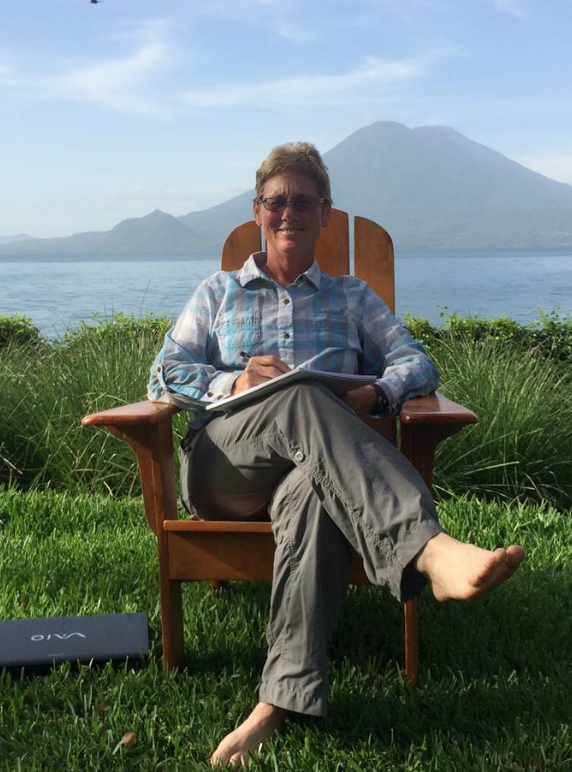
    Elizabeth working on her book in Guatemala
    Elizabeth working on her book in Guatemala

    This new material will help me strengthen my manuscript’s theme that hope, joy, and redemption can prevail over trauma.

    I write what I do because my ultimate goal is to speak publicly throughout the United States and internationally about breaking free from the cycle of violence, the trials of starting my own healthy family and the challenge of creating a home of love, safety, and joy despite being stalked by dysfunctional ghosts and dark memories from the Wisconsin farm where I was raised.


    What is your writing process? Ellen answers . . .

    Often, I start with a phrase that repeats itself in my head until I pay attention and start writing. Sometimes I have a flash of insight that intrigues me and I can’t rest until I work it out on the page. Then I’m off and writing—totally involved with writing the first draft. I love the rush of inspiration when that happens.

    But just as often, I’m not inspired. However, I’ve learned to trust myself—if I show up and sit at my computer, the words and ideas will show up, too.

    My favorite writing spots include my office at home, our sunny porch, and a chair overlooking the lake in Lebanon Hills Park—I’ve revised large hunks of my book there.

    The sound of water lapping and the wind in the trees help the words flow
    The sound of water lapping and the wind in the trees help the words flow

    After I write the first draft of anything, I know I need to let it cool off. I always allow time to look at the piece—whether a blog, an essay, or a newsletter for work—with fresh eyes a while later. Then I begin revising, and the more time I have to revise, the better the piece will be. I rely on other readers to help me see what works and what doesn’t, and Elizabeth and I always share our blogs before publishing. However with blogging, I’ve had to learn to let go of the desire for perfection—sometimes I need to accept that pretty good is pretty good and I should just press Publish.

    Introducing Cynthia Kraack

    Elizabeth and I would like to introduce and recommend Cynthia Kraack, a talented novelist. Her first novel, MINNESOTA COLD, won the 2010 Northeastern Minnesota Book Award for fiction. LEAVING ASHWOOD is being released July 1st. It is the final book of the speculative fiction ASHWOOD trilogy about a family living in post-global depression. She has had short stories published and received professional recognition for her work in writing business simulation games. Cynthia, a graduate of the University of Southern Maine’s Stonecoast M.F.A. Program in Creative Writing, also holds a graduate degree from the University of Minnesota and a bachelor’s degree in Journalism from Marquette University. She is a native of Wisconsin and has lived in Minnesota all of her adult life.

    We feel lucky to live in the Twin Cities—a haven for creative people, especially writers. We hope you’ve enjoyed learning more about a few of us. Be sure to check out Shannon and Cynthia’s blogs!

  • WordSisters Celebrates 2 Years!

    Writing this blog has become second nature. Every other week, we mine our lives and distill our observations into posts. As writers by calling, we take pleasure in the discipline of writing, but connecting with you is even more rewarding.

    I remain astonished by the power of the Internet to bring people together. Today, WordSisters has—

    • More than 500 followers
    • 6,100 views—it knocks me out to see that people from all over the globe—South Africa, Poland, and even Kazakhstan—are checking out our blog.
    The darker the color, the more views that originate from that country.
    More views originate from the countries that have darker colors.

    We’re delighted by the bloggers we’ve met (The Artist’s Road, Boomer Connection, Eliza Waters, Autism Fractal, Mary Carroll Moore, and so many more) and the friendships we’ve cemented.

    Thank you to our many faithful readers! Your comments and Likes keep us going.