Traditions Evolve

Great Aunt Wilma was a fixture at our Thanksgiving gatherings during her latter years. She was widowed with no children, so my parents invited her to join us. 

Elegant with her silver French twist, stylish earrings and deep brown eyes, she preferred to sit with the guys talking sports or politics (back when that was an acceptable topic). We had plenty of help and cooking wasn’t her forté, so she didn’t don an apron and join the women.

We gathered at my sister’s home in Ohio. After years of hosting, Mom was ready to let her kids handle holiday meals. Until my parents died, our sons, my husband and I traveled from Minnesota to celebrate Thanksgiving with my extended family. My husband’s family had different Thanksgiving traditions, so we didn’t have to choose.

For years, my husband and I have been the creators of holiday gatherings like Thanksgiving and Christmas. Days before, we’d clean the house, finalize the menu, make an epic shopping trip, check the table linens, plan the flowers, and start prepping dishes that could be made ahead, then cook and clean up on the actual holiday. As our sons got older, they and their wives also prepared key dishes. However, my husband and I were the event managers who were responsible for making the meal go smoothly. We were happy to do it.

But family traditions evolve. When our sons married, we began sharing them with their wives’ families. Each year we’ve had conversations about which day to hold our Thanksgiving and Christmas gatherings. After a bit of trial and error, we determined that Thanksgiving dates could be flexible but Christmas was less so. 

When grandchildren came on the horizon, my husband and I understood our traditions would change again. We are welcome and important, but as grandparents, we are stepping back to a supporting role for holiday gatherings. 

The focus has shifted to our granddaughters’ needs. Younger babies might be content to be held during a lengthy Thanksgiving meal, but older babies are not. They get bored and want to play. Ideally, both babies should have a quiet place to nap. This year, that will be at the home of our oldest son and his wife, where both babies can be accommodated. 
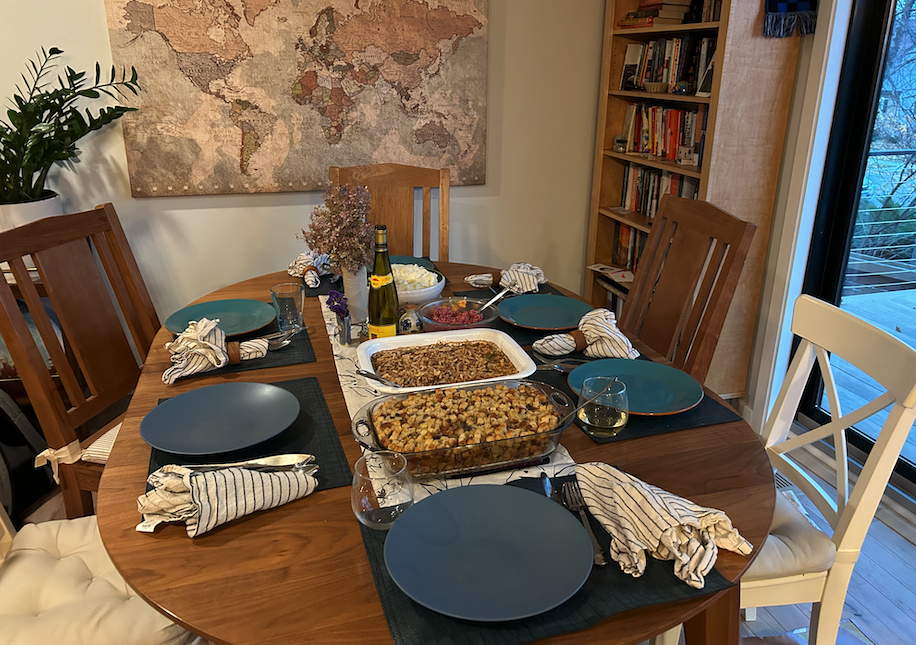
Shortly before the hungry horde descended last Sunday

Similar things are happening in the larger circle of my Ohio family. My sister no longer hosts a large family dinner at Thanksgiving. Now she visits two of her daughters who live in a nearby state. My brother and his wife will join friends for Thanksgiving since their children are also hours away.

My bachelor brother, who used to help my sister and me with cooking and cleaning up at our large Thanksgiving gatherings, is now slated to become a guest at a niece or nephew’s Thanksgiving table. When we spoke of the changes, my brother and I joked that now he has become Aunt Wilma. 

Reflections from My Great Grandmother’s Rocker

Some nights sleep is elusive and I’m up earlier than expected—an experience I share with many people my age. At 6:15, I sit in my great grandmother’s rocker reading a book about baby care, since I will be a first-time grandmother in a month or so.

I try to imagine Anna Kuntz Pleitz and wonder what she was thinking when my grandmother, Helen Wagner Pleitz was pregnant with my mother, Eileen Pleitz Shriner in 1921. I wonder how Anna would view my self-assigned reading.

Anna lived with her son Frank and daughter-in-law Helen and would have been on hand when they were having children. I speculate that her knowledge of babies and mothering was held in high regard. Anna would have known the secrets of nursing and how to soothe a fussy baby. Like I do. In her day there may have been magazine articles and books about the ‘modern’ methods, but I don’t envision her reading them. She and Helen would have been confident of her skills. 

Or maybe not. Throughout the 20th century and into this one, each new generation has had their own take on parenting and baby care. So I volunteered to read the Mayo Guide to Your Baby’s First Years along with the What to Expect website to learn what’s new in the 30+ years since I had newborns. I want to be familiar with what my daughter-in-law and son are learning. 

My mother said my great great uncle, whose name I don’t know, made this beautiful platform rocker and matching footstool for his sister Anna. Making furniture was his trade. Anna’s husband George also made furniture, so perhaps it could be his handiwork. It is in the Eastlake style, so its design and decorations are simpler than ornate Victorian furniture. I don’t know if Anna brought it from Alsace (on the border of France and Germany) when she emigrated from France or if it was made in the U.S. 

It’s a ladies rocker, which means its frame is smaller and lower. It’s very comfortable and fits me perfectly. More than 100 years later, the rocker doesn’t even squeak. A couple of years ago, I had it reupholstered and replaced the antique-looking gold striped fabric my parents had chosen with an off-white tweed with threads of red and gold and blue. I wanted the rocker to be used and not be a museum piece.

I silently rock and think of Anna, Helen, and my mother sending their love and wisdom.

What’s Your Approach?

Earlier this month, I celebrated the 8th anniversary of my retirement at 61. Occasionally, I have floundered, but I’m happy with the shape it’s taken. Many of my friends are retired or nearing it, and I’ve observed a range of philosophies:

Nonretirement – For several writers and artists I know, retirement looks like slowing down, not quitting. They have fewer paid jobs but they’re still working. Or they have a big project underway which might be published or shown later. 

No schedule, no plans – Some people prefer the freedom to choose their activities day by day. For years they were yoked to a commute and an office. They feel they’ve paid their dues and earned the right to do whatever appeals to them on any given day. They hate the idea being locked into a schedule and resist planning too far ahead. I’ve noticed more men choosing this style.

A bit of structure – These retirees prefer several days of planned activities but want lots of free time, too. Their schedule might include workouts or sports, socializing with friends, and weekly volunteer gigs. They also value unscheduled time and are careful not to pile too many events into one day. This approach often appeals to women. I belong to this camp.

Always busy – This group is eager to do everything. All the time. For as long as possible. While the first three groups like to travel, these retirees travel even more. They’re adventuresome and willing to try whatever looks fun, which could be a class, a biking/hiking/kayaking group, a tour or whatever. They’re an enthusiastic bunch and want to be sure they do it all before time runs out.

Aimless – Some people struggle with retirement because they miss the structure work provided (even though they resented the job at times). They don’t know what to do with themselves. With so much free time, their days can feel empty. They have trouble getting projects accomplished because there’s always tomorrow.

Not loving it – Some retirees really don’t like retirement. Often, they are accomplished people who were well-respected in their field. Work provided focus and was integral to their identity. Retirement feels like a loss. The activities they try are pleasant but feel like make-work—time-fillers. They want their pursuits to be meaningful and have purpose, but they haven’t found fulfilling interests yet.

Combo – A person new to retirement may sample several approaches before finding a satisfying mix. Shifting away from paid work can be as confusing and life-changing as starting a career. Many times, people aren’t sure what they want or what will feel like time well-spent.

So much of a person’s approach to retirement depends on their temperament. What do they value most—freedom, balance, drive, accomplishment? Are they self-motivated or do they need outside structure in their days? 

What has worked for you? Or how do you envision your future retirement?

Green Hush Puppies

The Hush Puppies the salesman brought out were grayish green suede. In the 1960s, Hush Puppies weren’t ‘geek chic’ like Doc Martens or Uggs. They were shoes suitable for an old lady, not a 9-year-old. 

The Hush Puppies’ black crepe soles were quiet, but I wanted the click of leather heels that made the wearer sound important, grown-up. The suede was soft and comfortable on my toes—not that I cared. I craved shiny brown penny loafers like my 4thgrade classmates wore. Unfortunately, my AA-width feet slopped around in those B-width loafers, and they slapped my heels with every step. The shoe salesman and Mom ruled them out. 

The idea of wearing those terrible shoes brought tears to my eyes, and I might have begged for a reprieve. Mom was sympathetic but unyielding. I had to have a pair of school shoes that fit properly.

Shoe shopping got easier by 7th grade, when I could wear women’s shoes, which offered a bigger selection. I’ve inherited narrow feet from my mother, and all of her life, she’d faced the same difficulty with finding attractive shoes that fit. Mom and I both trod the path of cute but cruel shoes and endured blisters and corns.

When she was in her 80s, Mom succumbed to wearing plain sensible shoes for most occasions—big white sneakers or boring taupe lace-ups for everyday wear. She hated them but her feet hurt. With dress shoes, she did her best to work a compromise between style and comfort. 

Over the years, I have spent hundreds of dollars—guilt-free—on stylish shoes and sandals to make it up to that sad 9-year-old and delight my grown self. Nonetheless, my closet is full of failed experiments. All too often I’ve discovered pairs which seemed fine but hurt my feet if I needed to really walk, not just stroll into a restaurant or party.

I’m still trying to thread the needle: find shoes which aren’t too ugly but meet my feet’s many picky requirements. However, during a recent vacation my feet hurt every day. So, I bought some brown leather lace-ups reminiscent of Mom’s. I’ve got places to go. I need comfortable shoes to get there. At least they aren’t green suede Hush Puppies.

What Image Do I Want to Present?

Recently, Lauren Griffiths went viral when she replaced her “professional” LinkedIn headshot with one that better reflects her current situation as a human resources consultant who’s working remotely. She proposed that looking authentic is powerful and ultimately more valuable than presenting a “perfect” image. The longstanding ideas about “looking professional” remain powerful, although many people resent and resist those guidelines. Her post led me to consider: What image do I want to project? 

When my career was still active, I was well aware of the need to look polished. Looking younger would be even better, since the working world can be disrespectful of older women. Young was no longer possible (!) but I could manage youthful, especially if I colored my hair and wore attractive clothes and jewelry. Most women my age did the same.

Now, as a 66-year-old woman who’s retired from paid work, I no longer need to present a professional image or look any particular way beyond what pleases me. Griffiths wanted to present a more authentic professional image; women my age confront a similar dilemma. How do we present an authentic image as older women?

When and how do you allow signs of aging to show? Should I try to meet the world’s expectations for “attractive older woman”? In other words, look 55-ish until I’m 75? Do I try to hold the line at all costs? Should I continue highlighting my hair but skip surgery or Botox? Stop coloring my hair? Let go of the anti-aging fuss? 

When Gloria Steinem turned 50, she threw a birthday party and declared, “This is what 50 looks like.” She looked good, which turned the idea being a crone at 50 on its head. 30 years later, she told the world, “This is what 80 looks like” while traveling in Africa—another example of aging well.

In transition: Blonde in front. Silver coming in in back.

My more modest version of her philosophy is to stop highlighting my hair. Pleasing myself will be the point, so I reserve the right to resume hair color if I prefer it. Either way, I will proudly say, “This is what 66 looks like.”