Category: retirement

  • What’s Your Approach?

    Earlier this month, I celebrated the 8th anniversary of my retirement at 61. Occasionally, I have floundered, but I’m happy with the shape it’s taken. Many of my friends are retired or nearing it, and I’ve observed a range of philosophies:

    Nonretirement – For several writers and artists I know, retirement looks like slowing down, not quitting. They have fewer paid jobs but they’re still working. Or they have a big project underway which might be published or shown later. 

    No schedule, no plans – Some people prefer the freedom to choose their activities day by day. For years they were yoked to a commute and an office. They feel they’ve paid their dues and earned the right to do whatever appeals to them on any given day. They hate the idea being locked into a schedule and resist planning too far ahead. I’ve noticed more men choosing this style.

    A bit of structure – These retirees prefer several days of planned activities but want lots of free time, too. Their schedule might include workouts or sports, socializing with friends, and weekly volunteer gigs. They also value unscheduled time and are careful not to pile too many events into one day. This approach often appeals to women. I belong to this camp.

    Always busy – This group is eager to do everything. All the time. For as long as possible. While the first three groups like to travel, these retirees travel even more. They’re adventuresome and willing to try whatever looks fun, which could be a class, a biking/hiking/kayaking group, a tour or whatever. They’re an enthusiastic bunch and want to be sure they do it all before time runs out.

    Aimless – Some people struggle with retirement because they miss the structure work provided (even though they resented the job at times). They don’t know what to do with themselves. With so much free time, their days can feel empty. They have trouble getting projects accomplished because there’s always tomorrow.

    Not loving it – Some retirees really don’t like retirement. Often, they are accomplished people who were well-respected in their field. Work provided focus and was integral to their identity. Retirement feels like a loss. The activities they try are pleasant but feel like make-work—time-fillers. They want their pursuits to be meaningful and have purpose, but they haven’t found fulfilling interests yet.

    Combo – A person new to retirement may sample several approaches before finding a satisfying mix. Shifting away from paid work can be as confusing and life-changing as starting a career. Many times, people aren’t sure what they want or what will feel like time well-spent.

    So much of a person’s approach to retirement depends on their temperament. What do they value most—freedom, balance, drive, accomplishment? Are they self-motivated or do they need outside structure in their days? 

    What has worked for you? Or how do you envision your future retirement?
  • My First Attempt at AI-Powered Writing

    Artificial intelligence is all the rage, so I decided to use it to generate my February Word Sisters post.

    My request: write a rhyming poem for women 50+ about the joys of aging (though I also briefly considered “the realities of aging”).

    First I tried anyword.com, but didn’t love what it generated, so I turned to chatGPT. In less than 30 seconds, here’s what I received.

    As we age, we gain wisdom and grace

    Our wrinkles are lines that tell our life’s pace

    We’ve lived through hardships and moments so sweet

    And we’ve learned that life is a journey, not a defeat

    We no longer chase fleeting trends

    Instead, we embrace our truest friends

    Our bodies may change, but our spirits stay strong

    And we continue to sing life’s sweetest song

    We relish in the simple things

    Like watching the sun set, and what the day brings

    We find joy in a book or a warm cup of tea

    And appreciate the beauty in things we see

    We know that time is fleeting and precious

    So we take moments to pause and reflect, never reckless

    We find beauty in the moments we share

    And embrace every opportunity to show we care

    So let’s embrace this new chapter with pride

    And enjoy the joys of aging with every stride

    For we know that with each passing day

    We become wiser, kinder, and better in every way

    As a career writer, I’m still pondering how I might use AI-powered writing, but there is one thing I do know: I couldn’t have written a poem so quickly. And while I don’t think it’s a great or even a good poem, I do believe there’s value in not having to start with a blank page.

    Have you experimented with AI-powered writing? If so, what tools have you used and what’s been your experience?

  • The Clock is Ticking for All of Us

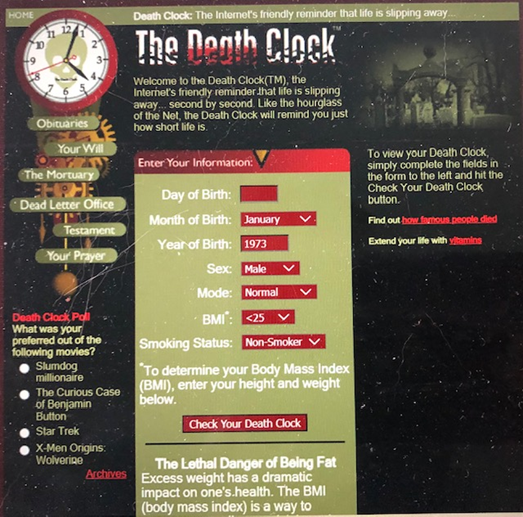
    Monday, November 10, 2036.

    That’s the day I’m expected to die according to DeathClock, billed as “the Internet’s friendly reminder that life is slipping away.”

    While I don’t believe my death will occur on that particular day and do hope I’ll live quite a bit longer than age 79, I find myself thinking both about the quantity and quality of the years I have left, no doubt prompted by the fact that I will turn 65 in a month.  

    On the short end of my projected lifeline, I think of my parents, both of whom died at age 70, my dad after a year-long battle with lung cancer (no surprise as he smoked for 50+ years) and my mom in an instant from a heart attack linked to Vioxx, the drug she was taking to help manage her arthritis (a drug reported to triple the risk of heart attack). If I die at their age, I have five years left.

    On the other hand, if I live as long as my maternal grandmother and my paternal grandfather, I have 25 years left.

    Either way, I hope to stay mentally, physically and emotionally healthy so that I can spend my time doing things I enjoy and making a difference in the lives of others.

    The desire to do so has got me thinking back to one of the best books I read in 2020: Die with Zero: Getting All You Can From Your Money and Your Life by Bill Perkins. Thanks in large part to it and to a financial coach I recently hired to help me shift from saving for the future to enjoying my money—and my life!—now, I am finally beginning to do so.

    So whether my death comes next year, in 2036 as predicted by DeathClock or, as I hope, years after becoming a healthy centenarian, I am determined to hear the ticking clock as a call to action rather than a countdown to my final days. I hope you are as well as I’d love to have you and all Word Sisters along for the journey.