In response to queries about what I might like as a holiday or upcoming birthday present, I am wondering if I have hit “that age” or developed a stronger sense of being part of the universe?
With the evil spreading in our country that has stripped families apart or made the simple costs of food, shelter and other necessities too expensive for others, how can I want anything? If I need to think about creating a list for days, I think I know the answer
First, my deepest wishes: food, safe shelter, healthcare and education to be accessible in our country. People with compassion, wisdom, morals, the ability to use real language when talking, willingness to listen, commitment to collaborative decisions to lead government at all levels, in all nations. Narcissistic strong men be removed from positions of influence or power.
On the personal level: A giant gift would be securing my family’s futures so that those of us aging don’t burden the younger, the middle generation continue to live the modestly comfortable lives they have achieved, the children reach maturity in a country that has found its way back to peace and prosperity while honoring the Statue of Liberty‘s invitation. It would be grand to find a small house for our last decades and free our family home for a family.
But if my stumbling over the gift question is about approaching “that age” and actual physical items must be named, my gift list is simple: warm socks, two books, a box of English Toffee, framed photos, individual time with each family member in the coming year, donations made to food shelves.
Add new pajamas and a couple of white long sleeve polo shirts, this might have been my father’s list twenty years ago when he was the age I am now. And he is a good reminder of what holiday presents should include. He was someone who gave to others at holidays: food boxes we packed, a canned ham, cookies we baked, wrapped toys, sweaters and pajamas for others’ children, cash in a card, and because it was Wisconsin sometimes a bottle of brandy.
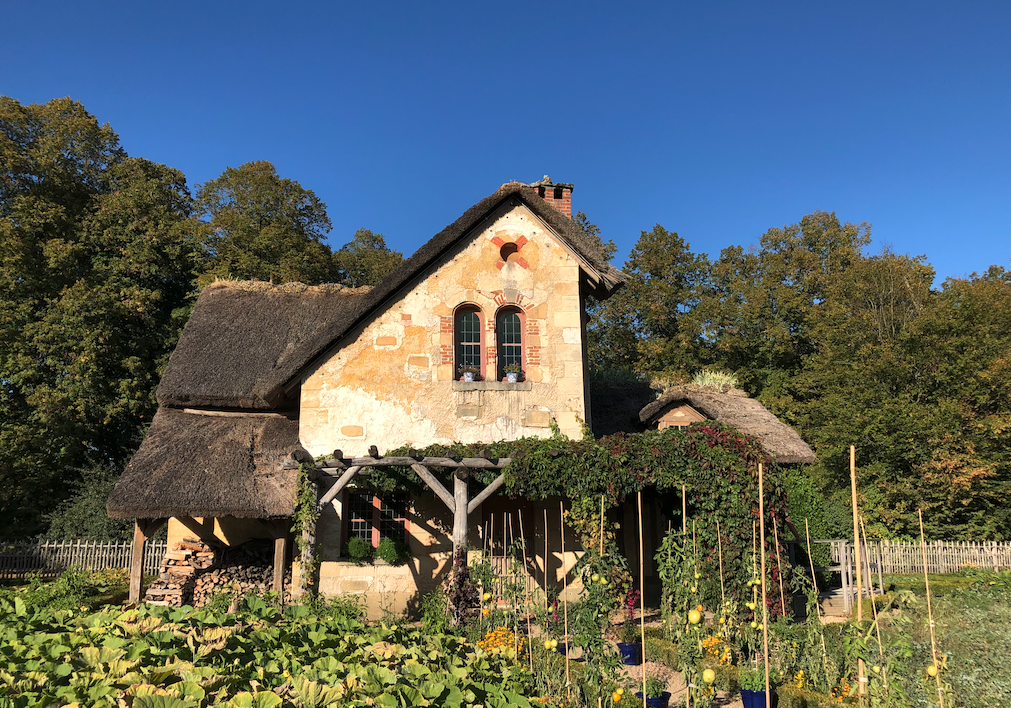
Marveling at Marie Antionette’s crazy little cottage at Versailles. Dancing to Aretha Franklin with my youngest son at his backyard wedding reception. Collaborating with my husband on creative projects like the bed frame he crafted and the quilt I designed. Sharing a Thanksgiving feast with family at the home of my oldest son and his wife. Spending summer mornings reading and writing on the porch. Enjoying hugs and giggles with my granddaughters. That’s what I hoped retirement would look like when I gave up paid work 10 years ago, and often it has.
When the chance to launch this phase came at 61, I eagerly jumped even though my career as a marketing communications copywriter and occasional college writing instructor had meant a lot to me. I’d come of age when women in those roles weren’t a given, and I’d made sacrifices to find my place in that world.
I expected my identity would evolve and be redefined by retirement—sometimes by me, more often by strangers who are dismissive of retirees. I rejected their stereotypes and for a time, when people casually asked at parties, “What do you do?” I answered, “I’m a writer.” Accurate, but incomplete. Now I don’t bother with that artifice. I know I’m a badass. Whether others see it or not is irrelevant.
Since retiring, my personal life has developed in predictable and happy ways. We welcomed daughters-in-law, and they and our sons bought houses and had children. We’ve loved being part of those changes. What I didn’t see coming was Trump in 2016, COVID and George Floyd’s killing in 2020, and Trump again.
Today the world beyond my personal circle feels dramatically different than it did in 2015. There were problems aplenty then, but the government was still functional. This year DOGE slashed congressionally-approved funding for federal services including national parks, FEMA, NIH, USAID, and more. The executive branch disregards constitutional rights and federal laws without consequence. I could continue with my list of troubling changes, but I won’t depress you with it.
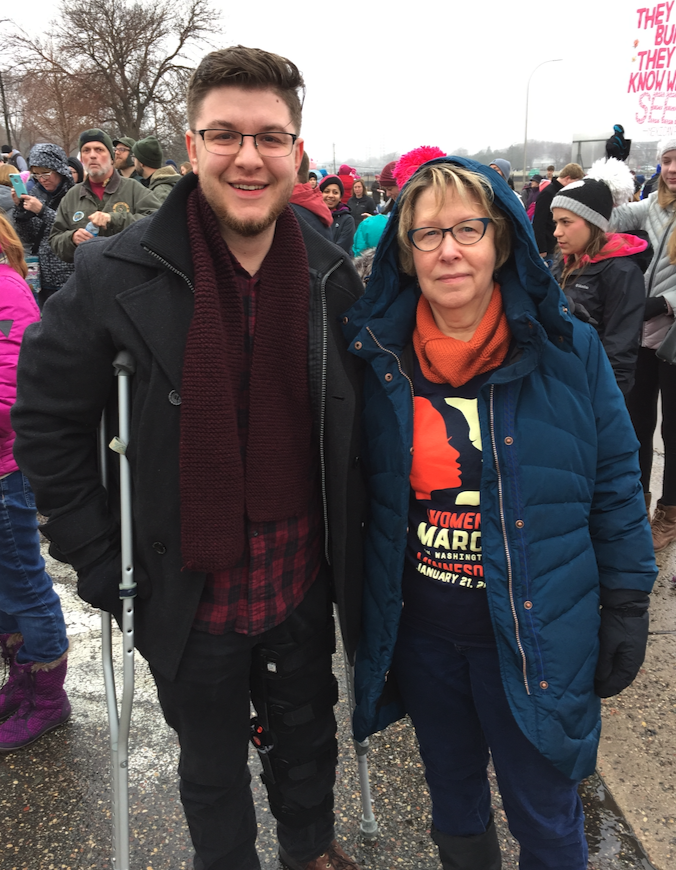
In the past decade I’ve become more politically aware. More outraged. More impassioned. I began taking part in protest marches—something I never imagined doing. The whole idea sounded scary. Nonetheless, in 2017 I marched alongside my husband and our youngest son, who joined us despite being on crutches while recovering from a traumatic bike accident. Seeing so many like-minded people in the streets was heartening. Since then I’ve continued participating in marches, selectively.
I recognize the limits of protests, but it’s important to me to show up. I also began writing actual letters and emails to political leaders (vs. the forms political organizations provide). I doubt either effort does much good, but I hope the sheer size of the protests will get through to politicians. I have to do something. This isn’t the world I want. This isn’t what the United States is meant to be.
I anticipate during the next 10 years of retirement, my personal life will evolve even further in expected ways.
But I fervently hope the political pendulum swings back from this destructive trajectory and re-centers on sanity, decency, and a functioning democracy.
Adventure and the unknown drive me. Quickens the beating of my heart. My senses are awakened and my yearning to feel alive fed.
Most often my experiences turn out different than I have imagined.
First an idea forms from conversations, reading, or research. My spirit takes note. I imagine the possibility. Interest becomes excitement. I rapidly move forward toward commitment.
Jody is along for the ride, a supportive enthusiastic travel partner.
Biking the Great Allegheny Passage (GAP), took root in March of 2023. I was chatting with a couple from Delaware in our shared Florida courtyard. The retirees had recently completed the old railroad trail that follows waterways and mountains yielding stunning views of waterfalls, gorges, river valleys, and farmlands.
That same day, I began researching the 150-mile nonmotorized path that starts in Cumberland, Maryland and ends in downtown Pittsburgh. According to the website, traveling the Great Allegheny Passage is a sought-after, “bucket list” adventure that delights local users as well as tourists from all 50 states and over 40 countries annually.
I ordered the TrailGuide, the official guidebook for traveling on the GAP and had it shipped to our home in Minnesota. It would be waiting for me in our stack of mail when we returned from our five-week Florida stay.
With the thumbs-up from Jody, a date to bike the GAP—all 150 miles—was set. Lodging at three Bed and Breakfasts along the route were reserved.
Biking the GAP would fulfill several of our wants. An adventure, a statement of active retirement, and a proclamation that we were keen for the next phase in our life: traveling and planning excursions without our adult children.
• •
C&O Canal Towpath
“What happens when you drive through a toll gate, damaging the arm barrier?” I googled from the passenger seat. Jody couldn’t stop laughing. She backed the car up, jumped out of the driver’s seat, dashed to pluck the toll gate ticket from the kiosk, then tossed it on the dashboard. “That’s what you are supposed to do,” she said, still guffawing.
“Now, you’re following directions?” I asked, astonished. I had a notion to video the bent toll arm that wouldn’t close, her grabbing the ticket and fleeing, but I hadn’t caught up to what had just occurred. Her laughter was a little disconcerting.
A loud voice over the intercom telling us to pull over and wait for the police didn’t come. Jody continued onto the Ohio turnpike. I adjusted my seat to an upright position. “There is probably a video of you,” I warned. “By now, the police have a description of our van and our license number.”
Jody couldn’t stop laughing. Hitting a toll booth arm would be expected of me. Not rule-following Jody. According to my Google search, driving through toll booth arms has also happened to others, rule-followers or not.
What goes on in Ohio stays in Ohio? As of today, we haven’t yet received a fine.
• •
GAP trail
Cumberland, Maryland was our starting point for biking the GAP. Jody and I were eager to start. We had already altered our plans at Jody’s suggestion. The weather in Cumberland ranged from lows of 40 to highs in the low 60’s. Instead of biking the entire 150-mile length, pedaling from one B&B to another and carrying our gear, we would plan day trips on the trail and drive to our lodging. This would allow us to start later and bike during the warmest part of the day.
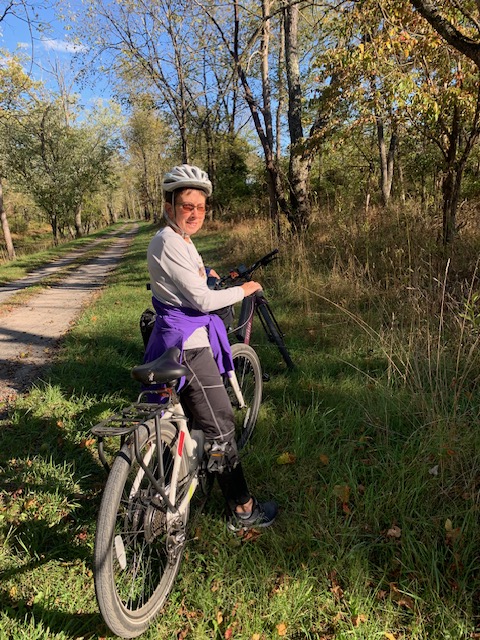
After asking directions for the trail at a bike shop, we headed out for a 30-mile afternoon ride. Jody and I pedaled single file on the narrow dirt path with me leading the way. The afternoon sun warmed our backs when it poked through the tree canopy. Deer, snakes, squirrels, and chipmunks were spotted and dodged. Occasionally we skirted a pothole filled with water and rumbled over bumps. I was happy to be using an e-bike. It made the impossible possible and the not so fun … fun.
The next morning, at The Inn on Decatur, our hostess served a delicious and abundant breakfast of pancakes, pastries, scrambled eggs, bacon, sausage, Canadian ham, hashbrowns, and fresh fruit. She encouraged us to pack the leftovers.
“Was it a narrow path?” she asked. “You went the wrong direction,” she explained. “The GAP is flat and wide with a crushed gravel surface. You were on the C&O Canal Towpath.”
I looked at our map. It started to make sense to me: the locks and lockhouses we passed, the river on our right. I had even taken a photo of mile marker 170, our turnaround spot. This was clearly marked on the C&O Canal diagram.
This, I would do. Go in the wrong direction.
C&O Canal Towpath and the Great Allegheny Passage intersect at Cumberland, Maryland with the towpath running 185 miles to Washington, DC following the Potomac River while the Great Allegheny Passage is a 150-mile trail in the other direction to Pittsburgh, Pennsylvania.
The towpath was originally built for the canal mules to walk beside the canal as they towed the canal boats through the waterway. Jody and I can now say that we’ve biked a portion of the trail. Thank goodness we were biking out and back. We could have been in Washington, DC before self-correcting.
• •
At Meyersdale, we entered the GAP trail and headed north two miles towards the Salisbury Viaduct. The GAP trail was what I had expected. It is similar to the crushed limestone Luce Line State trail in Minnesota. Amazing that yesterday I accepted the forest dirt trail as the GAP.
The Salisbury Viaduct, 101 feet above the Casselman River, is the longest trestle on the GAP. Forests dressed in their fall colors, farmland, and wide views surrounded us. We turned around at a small family cemetery and headed south towards Frostburg and the Eastern Continental Divide (Highest Point on the GAP), Big Savage Tunnel (longest tunnel, ¼ mile) and the Mason & Dixon Line.
The hard packed trail surface follows the old Pennsylvania and Lake Erie Railway. A small mountain creek, Flaugherty Run, flows alongside the trail for six miles before disappearing at the Eastern Continental Divide, where it runs into the Casselman River. The GAP crosses the creek 10 times on short wood-decked former railroad bridges.
Just past the divide is the Big Savage Tunnel. Before going through the tunnel, Jody and I turned on our headlamps. As soon as we entered the tunnel a cold damp gripped us. A wide sweeping view of rolling mountains and valleys greeted our exit. We stopped to soak in the warmth of the October sun and enjoy the scenery that was dotted by wind turbines lining the ridges.
The GAP trail crosses from Pennsylvania into Maryland at the Mason-Dixon Line. This famous area snuck up on Jody and me. We noted the markers and stones from our bikes and continued onward.
Frostberg, our turnaround point, is a small college town. To reach it we biked a steep paved trail into town. The Toasted Goat Winery seemed a fitting place to stop for lunch before our 16-mile return to Meyersdale and our car ride to our next B&B, Hanna House of Breakfast near Confluence, PA.
• •
The falls at Ohiopyle State Park
In the fast-flowing whitewater of the Youghiogheny River, a kayaker had not emerged from the turbulent falls. Jody and I believed we were witnessing a death. Two kayakers had successfully made it over the 18-foot drop at Ohiopyle Falls in Ohiopyle State Park. This one was in trouble. He was a cigar bobbing up and down in the powerful water unable to escape the whirlpool. The three kayakers had slipped into the river upstream ignoring the signs saying, “No water access.” Jody was filming the kayaker and didn’t shut her video off until his head surfaced.
The name Ohiopyle is thought to have derived from a combination of Native American Indian words which mean “white frothy water.” We had walked to an observation deck to view the falls and the rapids leading up to them.
Ohiopyle State Park, was our planned rest break. That morning we had parked our car at the main visitor parking area near downtown Ohiopyle and biked ten miles to Confluence before returning.
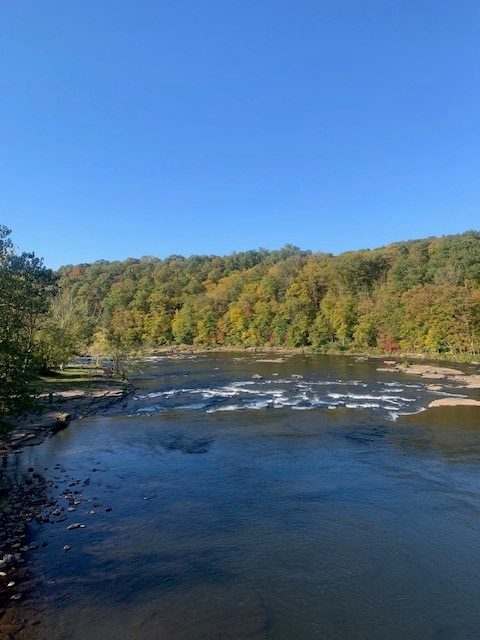
The town of Confluence is at the convergence of three waterways: the Youghiogheny and Casselman Rivers and Laurel Hill Creek. “Where mountains touch rivers,” is the town’s motto. This was definitely evident on the bike trail. On one side of us was a mountain and on the other a river. Confluence is surrounded by some of the highest ridges in Pennsylvania. The Middle Yough, Laurel Hill Creek, and White’s Creek are considered some of the best trout waters in the region. From our bikes we could see fishermen casting their lines.
After taking a breath and reviewing the video of the kayaker, Jody and I continued our bike ride north over the curving 620-foot Ohiopyle low bridge and the 663-ft Ohiopyle high bridge. From our bikes we took in Ohiopyle Falls, Ferncliff Peninsula, and the Youghiogheny River. Our turnaround point was 10 miles further near Sheepskin Trail.
• •
Jody and I considered our biking options from the front porch of our final lodging destination, Bright Morning B&B, West Newton, PA. West Newton is a trail town along the GAP. The Youghiogheny River flowed flat and calm in front of the inn.
Downtown Pittsburgh, PA, the end of the GAP, was 30 miles north. Jody and I had biked 105 miles of the 150-mile GAP trail. We both came to the decision that the end of the GAP for us would be here.
Driving the scenic backroads of Maryland and Pennsylvania to reach our B&B’s provided Jody and I with a fuller experience than only biking on a flat railway bed. Curvy mountainous roads. Narrow valleys. Hardwood forests. Rivers. Small farms. Amish. Valleys and hillsides were a beautiful shade of green to vibrant reds, oranges, and yellows.
The next morning, we would start the trek home.
Our next adventure? Our next unknown?
In January, Jody and I will be attending National RV Training Academy in Athens, Texas for a one-week class in RV Fundamentals. Learning objectives include, Understanding electrical systems, AC/DC systems, Propane and Water Systems, Air Conditioners & Refrigerators and Water Heaters & Furnaces.
We don’t own an RV … yet.
Right now, we need to clean the dust off our bikes and get them ready for the next ride.

 Adventure and the unknown drive me. Quicken