Mom had a soft ivory afghan her cousin Kathleen, my godmother, crocheted. When they were younger, Mom and Kathleen were close. They didn’t see each other as often when they got older, but that connection remained. The afghan is made of intricate lacy stitches and generously sized so your feet and shoulder and hip will still be covered if you turn over. It’s a work of art and a gift of love.
But Mom rarely used it. She cherished Kathleen’s beautiful handiwork and wanted to preserve it. It was too good for every day. Instead, when she napped on the sofa—I’m just going to close my eyes for 20 minutes—she used the one Aunt Bertie crocheted, which was skimpier and had scratchy yarn.
When did Mom start taking naps? In her 60s? 70s? My age?
Now I assume she napped when didn’t she sleep well at night. But my younger self just took Mom’s naps for granted. I never asked or even wondered what kept her from sleep.
After Mom died, her afghan from Kathleen came to me.
This morning I woke up predawn. Hot. Restless. My brain whirring with stray busy thoughts. I moved downstairs to the sofa and pulled the afghan from Kathleen over me in hopes I’d be lulled to sleep. I wasn’t. But on the day after Mother’s Day, the memory of Mom and my godmother covered me like a blessing.
I have very few memories of the man I knew as my grandfather (Mimmie, my great aunt and Pa, my great uncle raised my father). Pa was a white-haired smiling presence during our weekly visits to Mimmie and Pa’s duplex. He was a quiet man, but many 77-year-olds would struggle to find something to say to a 5-year-old. During one conversation, I recall him teasing me about having “strawberry blonde hair.” I was sure he was mistaken. I had “yellow” hair.
He also fed squirrels on their wide front porch. Pa would make a clicking sound similar to a tsk to call them, and the squirrels would take shelled walnuts from his open palm. Apparently, he was unaware or unconcerned about squirrel bites or rabies. He taught me to make the clicking sound but told me never to feed the squirrels without him. He’d gotten in trouble with Mimmie when a squirrel slipped into the house and climbed the drapes. After that he was more careful.
I’m not sure how I came to have his peach seed monkey—whether he gave it to me because I liked it or if it came to me after he died when I was 8. It’s a peach pit carved in the shape of a monkey and it has tiny red eyes. As a girl I was sure they were rubies, my birthstone. That peach seed monkey was forgotten in a drawer of keepsakes until recently, when I read The Peach Seed by Anita Gail Jones (a novel I recommend).
Before the novel, I didn’t know carving peach pits was a thing. I used to assume Pa carved it, but now I speculate about its origin. Born in 1882, he’d lived through WWI, the Great Depression, and WWII by the time I knew him. Was the peach seed monkey a bit of tramp art he bought during the Great Depression to help somebody who needed a handout? Did he pick it up as a novelty at a county fair? Did a friend show him a peach seed monkey and Pa decided to carve one? He might have.
Pa liked making things. He was a firefighter stationed in a neighborhood that had few fires. To pass the time during slow shifts, he made a small burgundy afghan using a technique that was a cross between weaving and braiding. Mimmie, and later, my mother used the afghan when they took naps.
I’m left with this odd artifact, scattered memories, and a lot of questions. I keep it in my office along with other mementoes that bring to mind my parents and grandparents.
I still prefer to believe the monkey’s eyes are rubies.
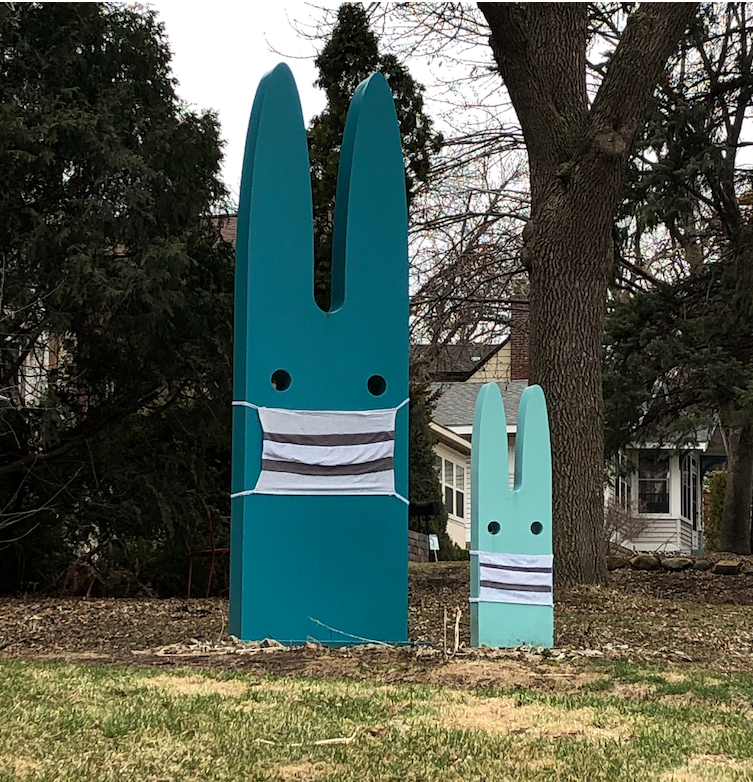
In May, I stopped wearing my KN95 mask. The last time I’d worn masks in earnest was in April at the airport, in museums, and on public transportation in Amsterdam. I was definitely a minority, but I didn’t mind. My goal was to avoid COVID while we vacationed in Europe. For three years I wore or carried a mask with me. Now discontinuing masks feels odd. COVID was a harsh teacher and the early days of the pandemic are still vivid.
Like everyone else, I’d heard healthcare and other frontline workers didn’t have enough PPE. Even cloth masks would help. The whole mask-making enterprise felt ludicrous and desperate. I struggled to understand: the government had no coherent plan for a pandemic? We were on our own for protection? The world seemed out of control. Anything could happen.
A Facebook friend, who’s a physician and quilter, posted a mask pattern and later I found another design online. I had lots of quilt fabric remnants and was willing to sew masks if it would help.
When Abbott Northwestern Hospital put out a call for homemade masks, I sewed floral fabrics women might like and abstract patterns men wouldn’t mind. I flannel-lined a few for softness before I realized they would be hot.
On a dark wintery day, the streets and hospital parking lot were eerie and empty when I delivered the masks. I texted the contact and rolled down the passenger window as instructed. A hospital employee took the bagful and thanked me profusely.
My sister (a respiratory therapist in a respiratory pandemic) asked for some. My homemade masks were a talisman that made her feel loved. At first, she wore a cloth mask over her one and only N95. She was expected to store the N95 in a brown paper bag so she could re-use it. Later she gave the extra cloth masks to her Ohio hospital’s Housekeeping staff, who didn’t have any protection.
I sent some to my son and future daughter-in-law, a medical resident who treated COVID patients in a Bay area ICU. She had an N95, but she could wear cloth masks away from work.
My sister suggested I give some to younger relatives who worked at a psychiatric hospital in Illinois. Although the local hospital and my sister had appreciated the homemade masks, I felt self-conscious about sending them. I worried the masks would be cringeworthy (Crazy Aunt Ellen made us these useless masks and she expects us to wear them?) but my relatives were gracious—they understood the sentiment.
Masking began with a jolt of fear, but unmasking happened gradually. I’d grown accustomed to eating out. My interactions in stores, clinics, and the pottery studio were even more distanced. The CDC’s decision to call off the emergency didn’t really figure into my thoughts. I’d concluded my risk was manageable although COVID is still out there. One day I’ll get it, but I probably won’t be seriously ill and die. Long COVID concerns me, but three years after the pandemic began, that fear no longer haunts my days.
A KN95 mask is in my purse, but I think I’ll be OK without it.