To people living in the lake-effect snow areas, Tuesday night’s seven and three-quarters inches of white stuff that landed in Door County is insignificant. Except the weather professionals predicted a dusting. Opening the door at six in the morning to send an old, thirteen-inch-tall dog with arthritis in his hind quarters required intervention by an owner still in cotton knit pajamas and slippers.
The flip side of this story is that one of the most intensely awesome sunrises distracted attention from noting the snow depth. Bare tree branches etched black lines against nature’s red, orange, yellow, saffron into beauty that could not be painted, photographed, described. Walking along the back windows of the house behind the small dog, my eyes never slipped below the horizon.
Sunrise colors seem shorter as the solstice approaches. By the time boots were located and a snow-covered dog rescued, the sky had turned a warm pink then faded into regular daylight. Winter weather arrived surprising me with the gifts of sunrise, snow in the trees, wet pants and bare feet discovering small cold puddles where the furry one shook.
In a time of deep emotions ranging from the continued happy surprises of family to dread of the immediate political future, from satisfaction in completing a complex writing project to sadness about a relative’s illness, it is easy to not notice what is simple and beautiful. Life’s gifts and losses cannot be tabulated. A stranger’s smile might change an icky morning into a better day.
May your holidays bring calm, happiness, and the beauty of a winter’s day even when your feet are cold or wet.
A big misconception about retirement is that it’s slow-paced and carefree. I’m busier than ever. Although I no longer fret about work problems, other concerns take my attention. Managing family dynamics and planning family get-togethers (like a recent baby shower) are the business of my days—where much of my mental energy goes. What matriarchs do.
‘Matriarch’ sounds grandiose, but the dictionary characterizes us as powerful older women in charge of a family, or female leaders. Respected.My definition is adjacent: we’re strong, influential older women who use our talents and love to strengthen our families, friends, or other groups. Not queens or rulers. Ordinary women. We may be grandmothers—the two roles can overlap—but women don’t have to have grandchildren to be matriarchs.
Examples come to mind readily. One friend juggles half a dozen complicated schedules to plan holiday celebrations. When her adult child fractured an arm, my friend stepped in with meals, groceries, and good cheer. Periodically, she has done daycare and shown up to care for a sick grandchild. Beyond child care and grandmothering, she mediates behind the scenes when adult children are at odds.
One woman regularly drives to another city when one of her married children needs help. She has provided relief post-surgery, offered support after a death in the family, and made getaway weekends possible for her adult children. She is wise and comforting, but above all, she shows up.
Another matriarch I know focuses on maintaining ties among friends, former students, and godchildren scattered across the country. She writes the notes, makes the calls, sends the gifts, and organizes the visits that sustain those relationships.
For years, I have organized a yearly reunion with my side of the family, fostered connections with my husband’s extended family, and coordinated gatherings with my sons and their wives. In addition to the practical details of all those events is the need to consider participants’ feelings and circumstances.
Matriarchs’ work doesn’t have to involve a crisis and it is often invisible. We operate in the background to care for and support our people: do shuttle diplomacy among various personalities, advise about jobs, and organize celebrations.
Being in the background means our efforts aren’t always obvious, but when I look around, I see plenty of matriarchs who are enriching lives within their circle of influence. There’s so much we can’t change out in the big world. Our focus is making a big difference in the smaller—but more important—world of family and friends.
“You are such a good mom.” Ah, I leaned in, these words meaning more to me than my friend could know.
I had been talking about the latest challenges with my young teen, where everything felt new, unfamiliar, and uncomfortable. I took a minute to let the words sink in. It was the kind of thing my mom used to tell me.
My mom and I talked frequently when my baby was a baby, me needing to hear the calm of her voice, steadied by years of mothering. She seemed to meet with ease all the challenges of raising four kids close in age. Or at least that’s the way it seemed to me.
By the time I became a mother, my mom had been a grandparent to nine already, the oldest in college and the youngest just into the double digits. I was late to the game and met motherhood with a fair amount of hand-wringing. Those early days were especially fraught-filled. Was my baby sleeping enough? Eating enough? Hitting all the right growth markers? There was so much to worry about.
My mom didn’t always know how anxious I was, but I would call her just to hear her voice. In my postpartum funk, I couldn’t tell her I was scared and lonely—I don’t know why—but I might instead give her a mundane update of how the day was going with my infant, hoping she could intuit my struggles. I was afraid of my own fear and questioned everything I did.
As my child grew, my mom was a steady source of reassurance and always wanted to know what my little one was up to. I would tell her some tale of my busy toddler, then preschooler, then elementary student. The stories were mostly amusing, but sometimes I was exasperated or uncertain. “You’re doing a good job, Brenda,” she would say. I’d always think, “Really?” It never felt that way. But she knew what I needed to hear.
~
I miss that. My mom is no longer here to comfort or commiserate, to offer hope for parenting through the teen years. She passed away right before the pandemic and right as my child was entering the tween years. Now I find myself among the many motherless daughters out there, feeling my way along. While I know that I am lucky to have had my mom for as long as I did, I still miss her and her unconditional support. And I really want to know how she made it through parenting four kids from infancy to adulthood—especially through the teen years.
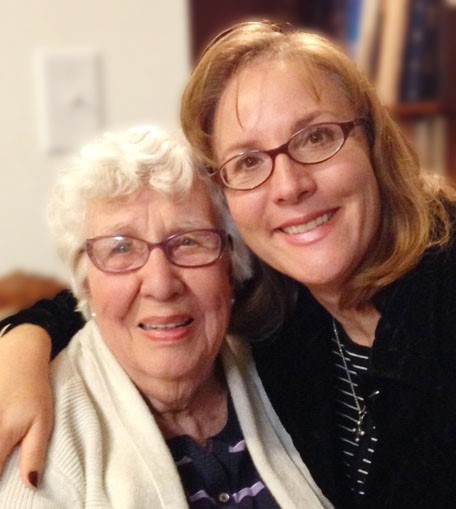
The author and her mom Lois.
She used to say that she had a lot of help, especially from my dad when we were all younger. And that having a lot kids close together was just what people were doing at the time. Now she would probably tell me she did the best she could and that she was far from perfect. And that she was also buoyed by a loose network of family, friends, neighbors, and others.
~
I wonder now what she would say about the precocious child who has turned into a strong and independent teenager. I imagine telling her of the latest tale and hearing her say, “Oh, Brenda,” lowering her voice on the “Oh” to add to the sense that she knew it was hard. Or maybe she’d shake her head and murmur words of commiseration. My child is much like one of my siblings, whose teenage years were punctuated by frequent conflict with my parents. Would my mom tell me she could understand the challenges of parenting an iron-willed but sensitive child? Or would she think of herself as a teenager, wishing that she had been nicer to her own mother? I never imagined my mom as a teenager but only as my mom and was surprised when she told me she regretted clashing with her own mom when she was young.
So perhaps this tells me that we never quite get it right and despite the anxiety, the self-doubt, the struggles, and even the loneliness, we are making it through.
My mother leaned on her own sisters, neighbors, friends, colleagues, and I am, too. I am banking on the collective wisdom of this vast community of mothers I am part of. They look like the friend who laughs with me and the one who offers a listening ear or a word of advice and then the one who just tells me I’m doing a good job.