
Category: Organizing

  • Alex Jeffrey Pretti – January 24, 2026

    The air is heavy in Minneapolis. With anger. Grief. Shock (although we are growing harder to shock). Uncertainty. What will any of us see on the street, at the store, at schools, at clinics? Who will be harmed next, whisked away to undisclosed locations only to be released without explanation or apology? Who else will be beaten or murdered? All to prove that ICE is in charge. 

    Our outrage has grown. So has our resolve. This vicious invasion and desecration of our constitutional rights must not stand. Our resistance takes many forms. We all do what we are able. Perhaps the surge will moderate, but fear will linger for weeks, maybe months, so the need remains. And if ICE leaves Minneapolis, they will go terrorize some other community.

    Please take action:

    Call your representatives. 

    • Insist they restrain ICE, cut their funding.
    • Insist they call out the lies and speak the truth relentlessly. 
    • Insist they demand investigations and accountability for the murders and many instances of excessive illegal force.
    • Insist they address the horrendous conditions inside the detention centers.
    • If your representatives don’t act, vote them out.

    If you’re in Minnesota, join a mutual aid group to get food and supplies to families who are unable to work and pay rent, grocery shop, pick up kids from school, or go about normal life, because whether citizen or not, they could be snatched away. 

    Keep showing up in whatever way is right for you—at protests and vigils. Community support efforts. Bridge sign brigades and school parent groups. Speaking up to friends and family.

    Donate

    A clearinghouse of Minnesota mutual aid groups

    Stand with Minnesota

    ACLU-MN

    I never envisioned the situation people of the Twin Cities and greater Minnesota are in or the way many informal networks have sprung up to support neighbors and fiercely advocate for constitutional rights. Like thousands of others in Minnesota I have been catalyzed to act. These are exceptional times.
  • Thoughts on the Urge to Purge

    Loads of articles encourage retirees to declutter our possessions and purge decades of accumulation. My generation is repeatedly reminded our kids won’t want our stuff. True. They’ll want it after we’ve given it away. Or never. 

    Purging sounds so virtuous.

    The philosophy of decluttering or purging goes like this—discard what you don’t need. Pare down your belonging to the essentials. Ideally, give your stuff to someone who can use it. The process is also supposed to offer emotional benefits:

    • Get rid of what weighs you down—the boxes full of old files, the clothes that don’t fit, the shopping mistakes. Let go of the emotional weight of caring for all these things. The sense of responsibility and guilt are bad for you. 
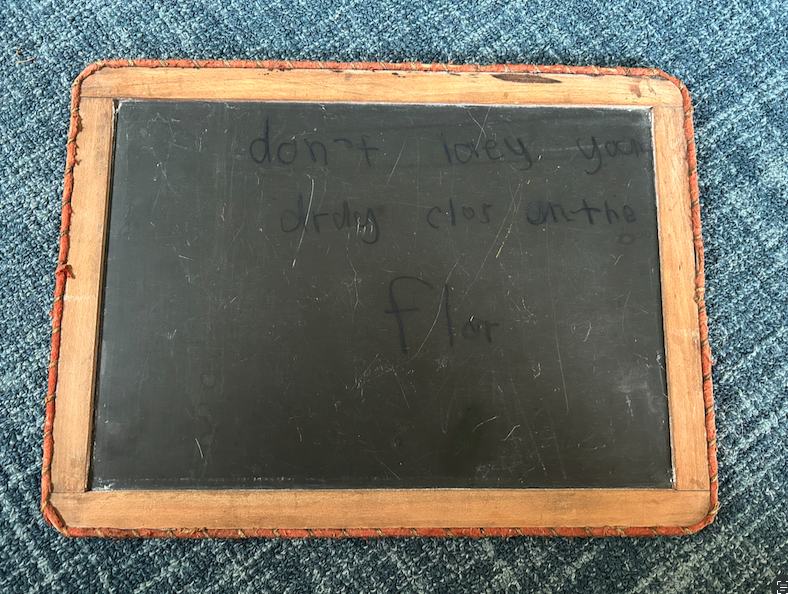
    • Think how light and refreshed you’ll feel when you have less stuff. Less to take care of. A clean slate. (Who the heck even knows what a slate is? Well OK, I do. It’s a personal chalkboard students did schoolwork on. I have one in my office closet that belonged to my grandfather. I’m not even that attached to it. Would a history museum want this artifact? Probably not, since my brother crayoned on it.)

    The decisions and matchmaking are what short circuit the urge to purge. 

    Neighborhood Buy Nothing groups make it easier. You feel good about the matchmaking. The groups are well suited to offloading housewares and furnishings you no longer use. When we got a king bed, someone wanted our queen size mattress and bed frame. All I had to do was snap a photo and post the items. The neighbor who wants your stuff picks it up. No more loading up the car for a trip to Goodwill and driving bags and boxes around for weeks until you do the drop-off. No more staging a tedious garage sale only to find you still have to dispose of what didn’t sell.

    Local Buy Nothing groups do a brisk trade in kids’ clothing, toys and equipment. I recently acquired a second booster seat for family dinners and I often scan posts for age-appropriate toys. My granddaughters’ wardrobes are supplemented with barely-worn-before-they’re-outgrown clothes and shoes from active Buy Nothing groups. The amount and quality of free stuff is astonishing. 

    People of my generation used to take things to Goodwill or similar charitable organizations. Sometimes I still do—mostly clothes. Recently, an energetic friend’s clean sweep inspired me to pack up a load of clothes and old purses I don’t use. Won’t use. I do feel a bit virtuous. 

    But right now, I’d like to purge any additional demands to declutter. Unload all those reminders and the associated guilt. It’s yet another thing that would be good for me . . . that I don’t feel like doing. Besides, the slate doesn’t take up much room in my closet.

  • Keeping Track

    I come from people who keep track of everything: groceries to get, bills to pay, upcoming events, the day’s experiences, and past events.

    As a young woman, my mom kept a diary that noted what mattered in her days: starting a novena and that a guy she was dating was kind of full of himself (they were happily married for 67 years anyhow). WE’RE AT WAR! she wrote in December 1941. Later in life, she recorded the weather daily on small pads of paper she kept next to the sofa. At her funeral, my cousins told me my uncle (her brother) had also kept meticulous notes—some about his garden, others about the weather. We marveled at the shared habit.

    When my mother-in-law recently moved, at least 20 years’ worth of journals turned up. I was aware of her habit because she often asked how to spell something we’d served for dinner. Cioppino or ratatouille. She enjoyed keeping notes about what we ate and did during visits.

    I’ve gotten an extra measure of documenting genes. Off and on since high school, I’ve kept personal journals in which I work out confusing feelings. I also make entries in a gratitude journal to remind myself of what’s good and right in my world despite the pandemic and trying political times. I document garden plans—what’s planted where and ideas for next year’s garden. I have lists of books I want to read along with books I’ve already read and what I thought of them. When dieting, I keep track of my exercise and meals.

    I’m not alone in those habits, but for me, it doesn’t stop there. I have a ridiculous number of notes in my phone app. Supposedly 194 of them, but that can’t be right! Poems I like, blog ideas, writing tips, ideas for pottery projects, a list of lawn chemicals that won’t harm birds and pollinators, the steps for starting the snow blower. The notes go on and on!

    My reasons can be practical. I want to remember something or find it quickly, and my phone is always with me. I tell myself I’m being efficient and orderly . . . but maybe ‘obsessive’ would be more accurate! Other times, keeping track is an emotional impulse. My personal and gratitude journals help me maintain equilibrium.

    The habit of keeping track intrigues me. I think there’s something universal, something beyond the practicality of grocery lists, receipts, and calendars. The same impulse that leads people to document their lives on Instagram or Facebook, keeps me writing extensive notes and ongoing journals. It’s what caused my relatives to make daily diary entries.

    As far as I know, my mom didn’t consult her weather notes after the fact. My uncle might have looked up which kind of tomatoes did well. I don’t know if my mother-in-law refers to her notes to remind herself of a previous year’s Christmas dinner. I suspect she doesn’t.

    I believe the impulse to keep track is a way of saying, “I was here. My life matters. To me.”

    What do you keep track of?