Category: Motherhood

  • To parents of college-bound kids


    Whether you’re taking your first or your last child to college this fall, my advice is, “Hang in there, you’ll all be OK in a while.” I’ve done both and lived to tell the tale.

    But admittedly, undoing all the underpinnings of daily parenthood is a very odd process. You’ve spent nearly 20 years building the structure of parenthood—teaching them to dress themselves, holding them close when they’re sick or sad, cheering the speech they give and the goal they score, nagging them about homework and chores, worrying about their friends and who’s driving—but now you’re supposed to quickly dismantle all that daily caretaking. You’re supposed to gracefully move into the next phase—occasional bursts of intense parenting—which is what being the parent of an adult consists of. I almost wrote “parent of an adult child.” That paradox explains how weird it is to send a young adult out into the world. Your son or daughter is and isn’t an adult, is and isn’t a child, but you’re always a parent. Sigh. It’s confusing.

    Becoming a parent was a major adjustment for me, even though I’d longed to be a mother and was delighted when I became pregnant. Learning to share my body and change my eating and drinking habits—more protein, less junk, no caffeine, no alcohol—was hard but worth it. Assuming the role of responsible parent was even harder. I always had to think about someone else and bring the equipment he’d need—food, diapers, pacifier. I had to learn to plan ahead, make sure there was gas in the car and money in my purse—no more flying by the seat of my pants when I had a baby with me. Staying out partying didn’t make sense anymore when we had to drive a babysitter home late, and I’d just have to get up with a baby at 6:00 a.m.

    Soon I became accustomed to being responsible and it no longer felt like a sacrifice. Soon it was second nature to put the kids first—making sure they got fed something relatively nutritious before they got too cranky, scheduling my plans around naps and bedtime at first, and later, around homework and extracurricular activities. Juggling work, daycare, and the kids’ schedules. My life was crazy-bizzy, but good.

    When my kids were young, the biggest challenge of parenting was having the stamina to do it all. Later, the challenge became thinking through the best way to handle a kid’s emotional and moral development—teaching them how to handle mean kids, how not to be a mean kid, deciding how long they needed to keep practicing something they weren’t good at, teaching them how to be their own person, how take care of themselves, how to take care of others, and so on.

    By the time my kids were teenagers, I could hear the warning bells—ACT tests, talk of colleges, college visits. I knew their departure was coming, and I knew it was how their life was supposed to go. But it was hard to wrap my head around the reality of them leaving. These people I love so much, who have been the center of my life, are really going? I could hardly bear to think about how big a hole they’d leave in my life, and yet and I had to help them go, because that’s what was right for them. Occasionally they were annoying, so was easier to think of letting them go. It helped to remind myself that the goal of parenthood is to raise a person who’s capable of being independent, that I should measure my effectiveness as a parent by their ability to be OK without me—but after nearly 20 years of worrying about them daily—well, old habits die hard.

    But each of our sons left and I lived through it.

    Soon I learned that they still needed me but in a different way—not daily, but occasionally, in intense spurts. Their problems were harder—how to deal with all the drinking in the dorms, how to handle roommates who wreck your stuff and are late with the rent, how to find the right career path.

    My husband and I lived through a number of jangling adjustments: from being alone to having them back, from being delighted to see them and their friends to wishing they’d pick up the pop cans and pizza boxes, from acknowledging their independence to setting ground rules for the courtesies a house full of adults needs.

    They have turned into adults I genuinely like and enjoy as people. I have turned into a mom who rarely says, “It’s supposed to be hot/cold/snowing, don’t you think you should wear shorts/pants/a jacket?”

    In fact, I’ve gotten so used to my youngest being gone, that the night before he returned to college this year, to my profound embarrassment, I forgot to cook dinner. I don’t mean I neglected to cook a special goodbye dinner, but I didn’t remember to cook any dinner whatsoever (bad Mommy). So we ate nachos, leftovers, and frozen pizza. And it was fine. Because now we’re all adults, and I don’t have to be in charge of meals. 

    But my youngest still welcomed the box of cookies I stayed up late baking the night before.
     

  • A Ring, Not Such A Simple Thing

    It occurred to me on my drive to work that this was going to be Jody’s 50th birthday. I hadn’t come up with an idea for a present but I was happy that I realized it was her 50th.  The significance of her birthday suddenly hit me. Her 50th birthday!

    I was grateful that the significance of this milestone occurred to me, because often significance could hit me on the head and I still might not get it. I have a very good friend that knows this about me and she checks up on me around Jody’s birthday and our wedding anniversary.

    I was pleased with myself. I had thought of the significance all by myself and I still had a few weeks to come up with a SIGNIFICANT present.

    Jody’s birthday is around Mother’s day. Maybe that is where I got the idea that a bracelet or necklace with all of our birthstones would be nice.

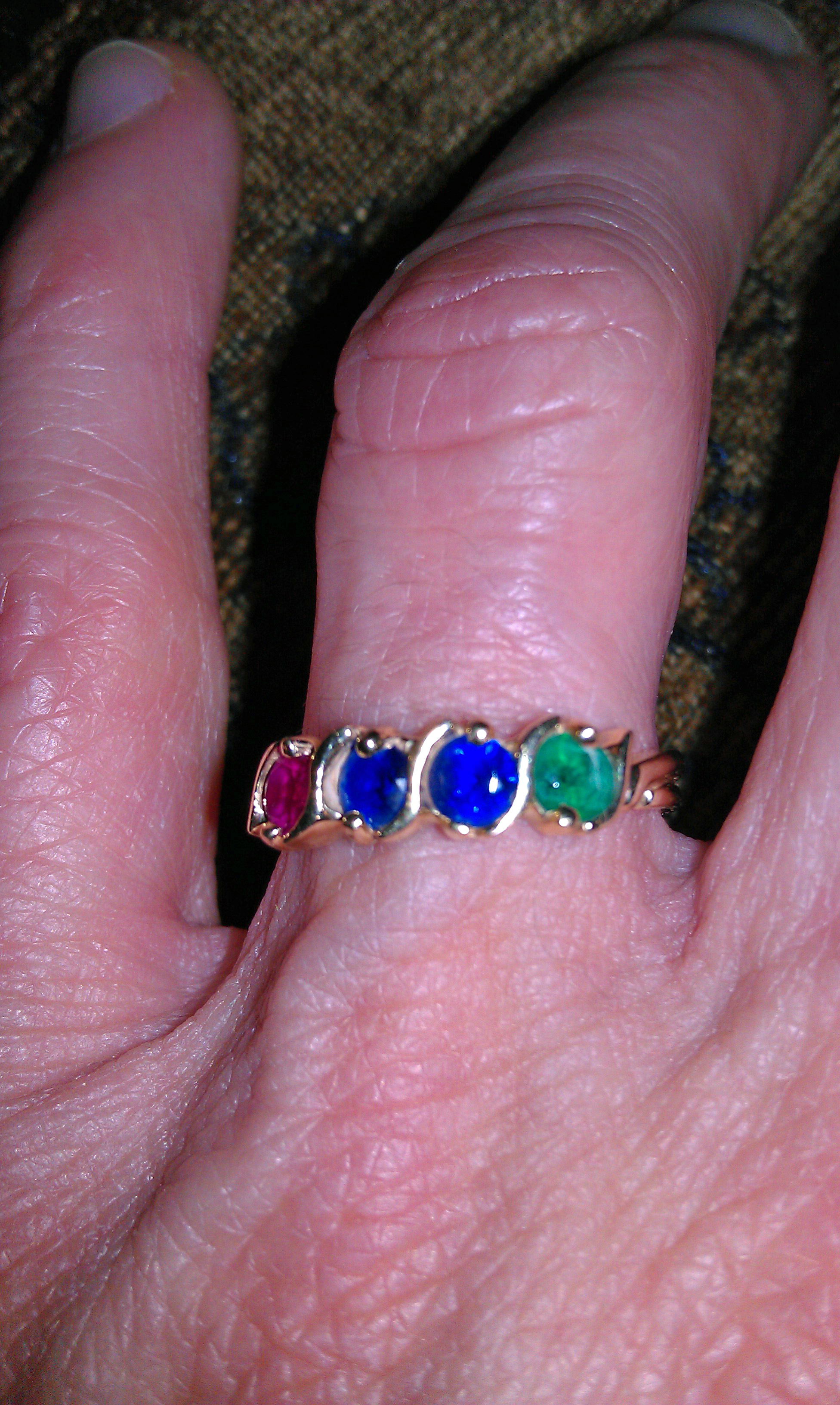
    Crystel, our nine-year-old daughter, was with me at Jared’s. Antonio, our other nine-year-old was across the parking lot at SchmItt’s for his drum lesson. Crystel and I only had a short amount of time to make a decision before Antonio’s lesson would be over. While I was looking at bracelets with the personal attendant, Crystel was examining rings. She called me over and pointed out a ring that she liked. I thought about it. The ring could have the number of stones we needed and Jody was more apt to wear the ring all of the time.

    I changed course and had the gal price a ring for me with an emerald, ruby, and two sapphires. When it came time to decide the order of the stones I asked Crystel. She said the emerald, two sapphires, and then the ruby. I thought her order would be good. Jody being a sapphire would be next to each child depending on what sapphire the kids decided Jody was.

    But … the next few days I puzzled over the order of the stones. I had an unsettling feeling. Jody was Emerald, not Sapphire. Antonio was Ruby. Crystel and I were Sapphire. Crystel’s order put Sapphire next to Emerald. Now on the face of things this is no big deal. But, symbolism is very important to nine-year-olds. The stones would be Jody, Crystel, Beth, Antonio. Antonio would be next to me if the first Sapphire was Crystel and not next to the birthday mama.

    I checked online and the ring hadn’t yet shipped. I stopped into the jewelry store to check on the possibility of changing the order of the rings to sapphire, emerald, ruby, sapphire. This would put Jody next to each child.

    This time Antonio was with me at Jared’s. He said that he thought the stones should match the order of the birthdays, emerald, ruby, sapphire, sapphire. I raised my eyebrows. The stones would be Antonio, Jody, Crystel, Beth. His order would place Ruby next to Emerald.

    I was told that the ring had already shipped but that they could change the order of the stones for a price. I thought about it, and economically, this didn’t make sense. I told the gal that the order of the stones was perfect and explained to Antonio on the way out of the store how the ring was round, never-ending, inclusive, just like our family. I put my arm around him and said, “Each stone is important, a representation of us all.”

    Jody’s birthday has since passed. Antonio thinks the ruby stone representing him is pretty, Crystel proudly announced that she chose the order of the stones, and I talked about the SIGNIFICANCE of the ring.

  • A Parental Dilemma

    by Ellen

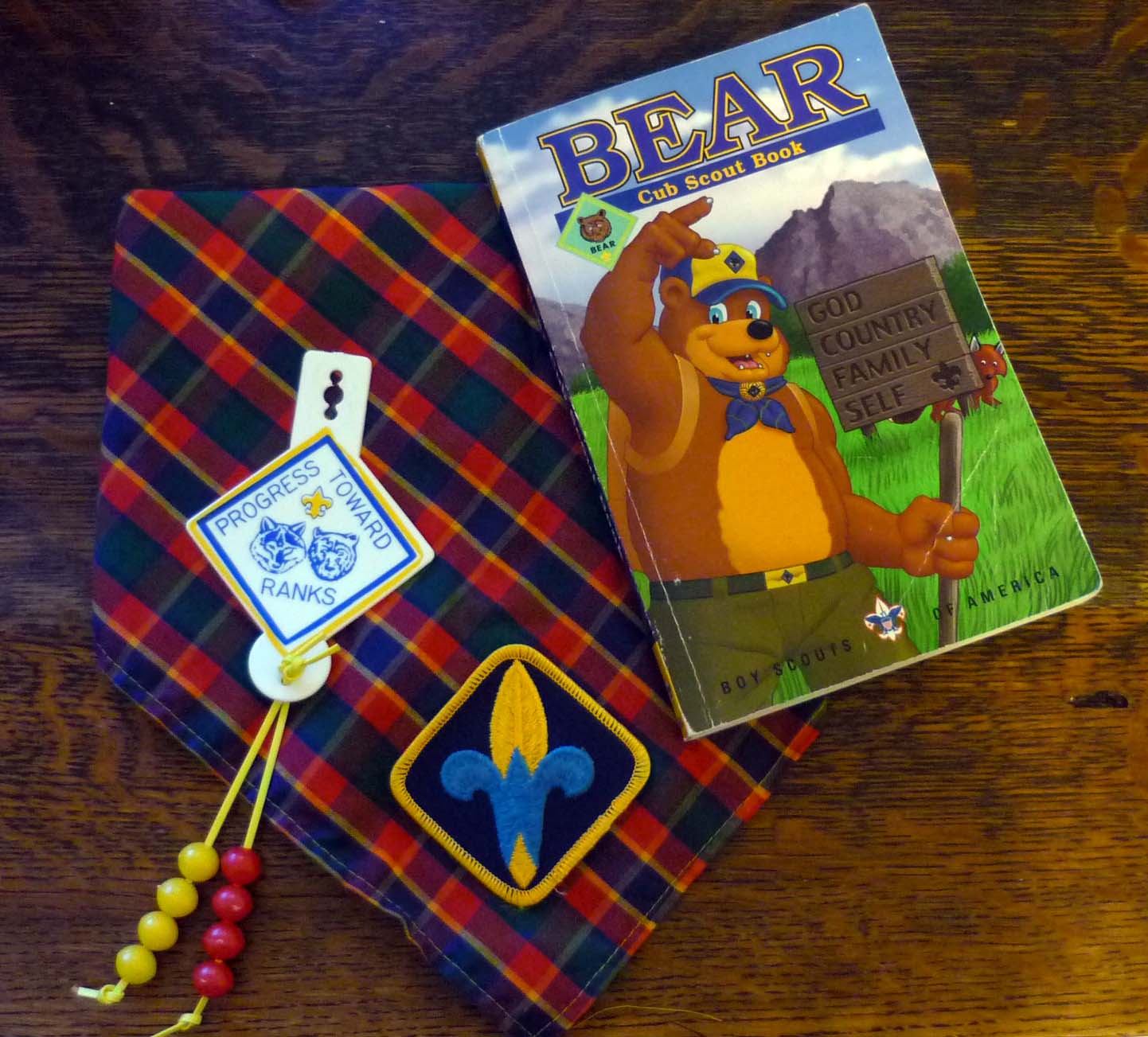
    In 2000, my son Greg was a 9-year-old Cub Scout. He liked hanging out with the other neighborhood guys, going on field trips, and earning badges. He especially loved the camping trips, which took place nearly every month. THIS was the big reason Greg had joined scouts. We camped as a family, but our trips were pretty tame compared to hanging out with other guys, stuffing yourself with s’mores, telling fart jokes and ghost stories until all hours of the night.

    But when the Supreme Court ruled on a case that allowed the Boy Scouts of America (BSA) to exclude gays, my husband John and I were upset. The BSA contended that being openly gay is contrary to the organization’s values; however, the BSA says it teaches scouts to respect all people. To me, “respect” and “exclusion” are contradictory terms (respectful exclusion?!?).

    Even more troubling was the unstated, but widely accepted, assumption that excluding openly gay leaders would keep our boys safe from sexual abuse. The related assumption was that heterosexuals are less risky around children than openly gay men and lesbian women. Because of the BSA’s fears, rather than the facts, they excluded a lot of good people from scouts unnecessarily. John and I both had worked with gays and lesbians through each of our jobs—people we liked and respected. We were so angry about the policy that we considered quitting the pack in protest.

    So we sat Greg down to explain our views. He understood that we opposed the ban, and he could see that it was unfair, but it was all very abstract to him—he didn’t know any gays or lesbians. He said he didn’t see how anything he could do would make a difference. He was only a nine-year-old kid.

    Finally, John and I understood that we’d stumbled into a common parenting trap—we were filled with political angst, but Greg was not. He was just a kid, and he wanted to have fun with his friends. In fact, he wasn’t all that clear about what it meant to be gay (men who love men, we’d said). And his grasp of sex and reproduction (learned just the year before) was pretty vague, too.

    We realized that quitting scouts would have no impact on the national BSA leaders—it would only punish Greg—so we decided not to leave, but simply to make our views known within the pack. Greg continued to enjoy scouting until high school, when he dropped out because of competing demands on his time.

    And the ultimate irony?

    In 2009, one of the pack leaders, who’d appeared to be heterosexual and who had cleared the background checks, was charged with sexually abusing some of the scouts Greg knew. He was subsequently convicted and imprisoned. We were all angry that a person the pack had trusted had hurt the boys. We worried about them and the emotional harm the pedophile had done. But we never really felt the pack could have prevented the problem—the pedophile, who had no criminal record, had fooled all of us.

    It’s pedophiles we needed to protect our children from, not openly gay men and lesbian women.