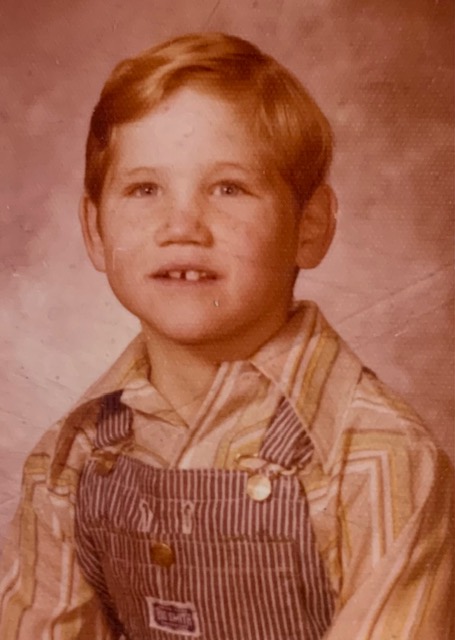
Thinking of Mom

Sun pours in our bedroom, a converted attic. When I make the bed, I pull the sheet and quilt back together and snap them like Mom used to do. They settle into place with a tiny poofing sigh. The golden wood floor is warm as I circle the bed and fluff the pillows.

Coming in from the car, my sack of groceries is heavy. I shift hands to lock the garage door, shift again to unlock the back door. I ponder dinner possibilities and think of Mom facing this daily challenge. Although she was a good cook, plenty of times she wasn’t inspired either.

Some nights, I gather up our crumb-laden tablecloth after dinner to shake out on the back step like Mom used to do. Nobody does this anymore. Not tablecloths. Or shaking out crumbs. But I like it. Before dinner I clear the dining room table of clutter and set the table the way she always did—forks, knives, spoons, and napkins. We often put away the spoons unused but it pleases me to do it her way.

Minutes after we sit down, I hop up to blow my nose and dab my eye. Whenever I start to eat, they run just like hers did. Some neurological blip we share.

In the evening, my husband reads the news on the sofa and I read in my chair. We comment on the day’s events, share something about our sons and their families or tomorrow’s plans. Ordinary things, but we’re so content and companionable. I think of Mom and Dad doing the same.

Mom was 67 and already a grandmother to my brother and sister-in-law’s three, when our oldest son was born. When our youngest son was born she was 70. Even though we lived four states apart, we talked often, so she was familiar with our sons’ personalities and milestones. 
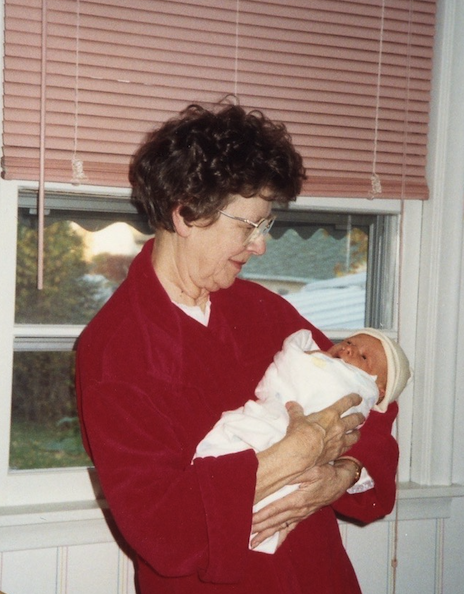
Mom with our oldest

I think of the way she got down on the floor to play with them. I do the same with my 10-month-old granddaughter, who crawls over me to get a toy or bounces in time to the music I play for her. When a diaper change upsets my 8-week-old granddaughter, I lean in close and say, “It’s OK little one. You’ll be alright,” in a low quiet voice, the same way Mom soothed our youngest.
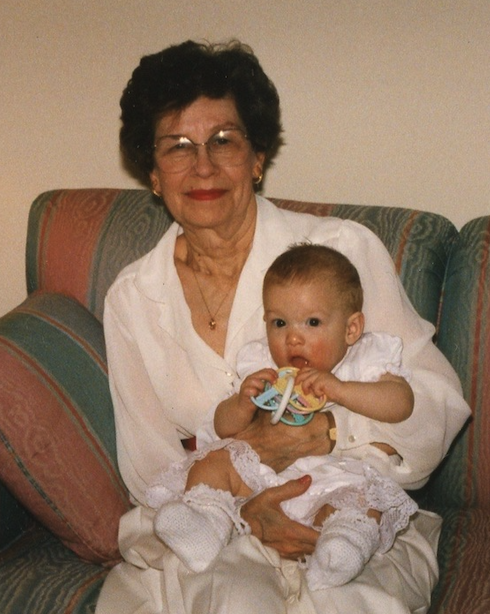
Mom with our youngest

Mom comes to mind often and I wonder how she felt going about her days. At 70, was she achy in the mornings like I often am? Was she happy and looking forward with pleasure to most of her days? Was she carefree? Nah, my life is good but not carefree—hers wouldn’t have been either. 

How often did the specter of aging shadow her? She had to be aware that one day her health would decline, friends and family would grow ill and die, and she would probably outlive Dad. Could she keep all that in the background? Did she think—like I do—that “I’m still healthy and capable. These are the good years”?
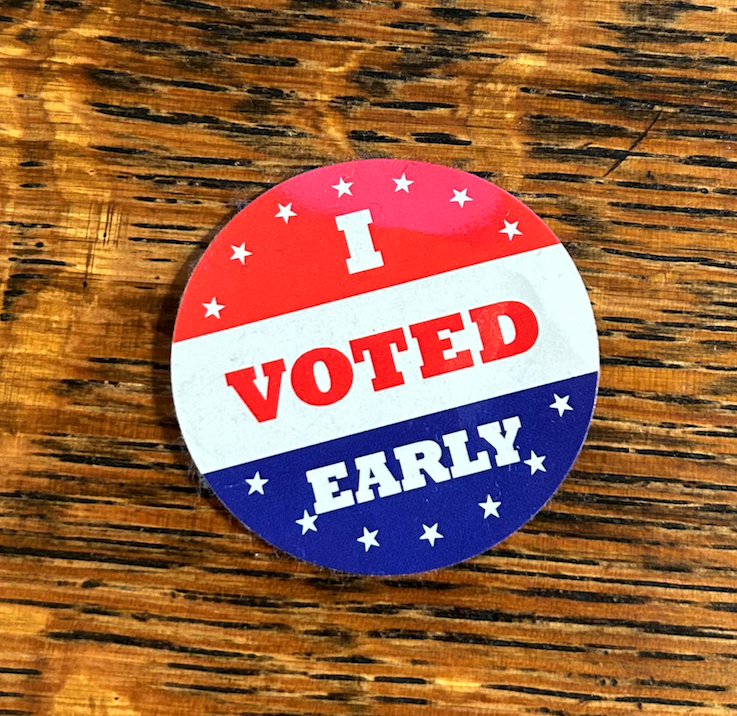
Mom died 10 years ago on Election Day, the only time I didn’t vote. Instead, I got in the car to begin the long drive to Ohio for her funeral. It wasn’t a presidential election, but I felt bad about missing the vote. Mom and Dad were part of the Greatest Generation. They were fierce believers in democracy. Dad fought and Mom sacrificed during WWII so democracy could thrive throughout the world. Please support democracy with your vote.

Work is Work

This past week I drove a loved family member to cancer radiation treatments, a first for me. One round of appointments was completed which, with agreement of the patient, was celebrated. Staff wearing silly headbands clapped as the patient rang a large bell. Lots of hugs and high fives were exchanged as music chosen by the patient played. Some folks danced. I took pictures for my relative’s wall. 

Thankfully the media carried Kamala Harris and Tim Walz sharing smiles and high hopes in their political campaign because a lot of people need to see other people enjoying their labors, even twenty seconds of joy. I wouldn’t want their jobs unless something truly despicable was the alternative. I would love to spread some of their positive energy across all whose work is unseen or unknown. Work is work.

This Labor Day weekend I wish I could embrace every person who works where the emotions and decisions are so immense. For those who hug, shake hands, wear sparkly hair baubles, bring cold water, sit in the quiet of difficult times, may you also find comfort. For people carrying hard news to virtual strangers or closing the doors of valued places, know that emotions projected by the impacted are not personal. It is hard to be on either side of that work.

For the caregivers, the news bearers, everyone working to keep family alive, building tall buildings, fixing tires, mopping, cooking, gathering eggs whatever honest labor you do, thanks. Even the writers. We’re in this together. Happy Labor Day. 

Mama-Sister

“You don’t know anything about me.”

My brother was right. I didn’t. I didn’t have any idea where he had gone. What he did. Who he knew. His incarceration record. Jails. Prison.

The 23-year-old sitting with me and a staff member at the halfway house had called me mom until he was 8 years old. He was the last of my parents’ 12 children. I took care of him the best a teenager could.

“I’m afraid you’re going to die, Johnny,” I said. “That I won’t see you again. I’ll get a phone call saying that you’re dead.” I sobbed.

The fight left him. He softened. Maybe he was remembering the times I tried to locate him when our parents put him away in homes for troubled kids. Homes, plural.

“I wish I could have taken you with me,” I said. “I couldn’t. I had to save myself.”

One time I did find him. He was 13. I called and set a date with the residential facility without my parent’s knowledge. Sitting next to him on the couch, I explained to him and the therapist what it was like in our family. Tried to give Johnny the words for the things he saw. The violence, the sexual abuse. “It’s not you,” I said. “This was what it was like in our home.”

SISTER NO CONTACT was the result of my visit. I wouldn’t see Johnny for years.

My children are 21 going on 22 years old. Maybe that’s why I’ve been thinking of Johnny. Though I think of him all the time. A loss that never leaves. There is always the thought – if I could have just taken him with me. Impossible. I didn’t have any money. I didn’t have a home. I was only 19 years old. I keep replaying it in my head, wanting it to be a movie. Girl saves baby brother. Mama-sister and kid brother leave home, grow up together. Safe. Happy.

My son and daughter are safe. They aren’t worried about where they’re going to rest their heads tonight. Johnny was long gone by their age. It was typical to be kicked out of our house when you graduated high school. Johnny didn’t get that grace. He was gone by 13. He never graduated. Never got his GED. Finally left for Alaska and the fishing boats.

All morning I’ve been looking down the basement stairs towards Juan’s bedroom. Looking for light, movement. Finally, I text: Are U alive down there? Need food? Fresh air? Water? Don’t make me come open your door for a health check.

I relax when he texts: I am alive lol. I have my water bottle. I was about to change and come up for food. Smiley face emoji. I’m invested in a show, worst roommate ever.

Crystel is building her life in Hawaii, knowing she has a home in Minnesota. Our weekly phone calls are as much to keep up with her as they are to support her.

Twenties are for exploration. My time and energy were consumed with living at a halfway house, AA, and therapy. AA raising me. Teaching me values. Honesty. Truth. How to belong to a group. I hung on for dear life and learned everything I could.

All you have to do is grow up and get out. I left the farmstead believing Johnny would survive. I can still feel our last hug. This 19-year-old woman hugging the 8-year-old boy.

He never got free.  Even after our parents’ death.

 He died of a heroin overdose at 29.  His home – a makeshift shelter in The Jungle, a strip of woods in Seattle. He had his brothers and sisters’ contact information on a scrap of paper in his jeans.  

It’s been 24 years since my brother’s death. The movie is about a girl-daughter-sister-mother who lost her brother. Who loved him deeply but couldn’t take him with her. A loss that doesn’t go away. And, even now, when the sister drives by freeway underpasses and scraggly underbrush she scans for places her brother might have called home.

I didn’t know his story, the places he laid his head. I knew his spirit.

In the Company of Mothers

“You are such a good mom.” Ah, I leaned in, these words meaning more to me than my friend could know.

I had been talking about the latest challenges with my young teen, where everything felt new, unfamiliar, and uncomfortable. I took a minute to let the words sink in. It was the kind of thing my mom used to tell me.

My mom and I talked frequently when my baby was a baby, me needing to hear the calm of her voice, steadied by years of mothering. She seemed to meet with ease all the challenges of raising four kids close in age. Or at least that’s the way it seemed to me.

By the time I became a mother, my mom had been a grandparent to nine already, the oldest in college and the youngest just into the double digits. I was late to the game and met motherhood with a fair amount of hand-wringing. Those early days were especially fraught-filled. Was my baby sleeping enough? Eating enough? Hitting all the right growth markers? There was so much to worry about.

My mom didn’t always know how anxious I was, but I would call her just to hear her voice. In my postpartum funk, I couldn’t tell her I was scared and lonely—I don’t know why—but I might instead give her a mundane update of how the day was going with my infant, hoping she could intuit my struggles. I was afraid of my own fear and questioned everything I did.

As my child grew, my mom was a steady source of reassurance and always wanted to know what my little one was up to. I would tell her some tale of my busy toddler, then preschooler, then elementary student. The stories were mostly amusing, but sometimes I was exasperated or uncertain. “You’re doing a good job, Brenda,” she would say. I’d always think, “Really?” It never felt that way. But she knew what I needed to hear.

~

I miss that. My mom is no longer here to comfort or commiserate, to offer hope for parenting through the teen years. She passed away right before the pandemic and right as my child was entering the tween years. Now I find myself among the many motherless daughters out there, feeling my way along. While I know that I am lucky to have had my mom for as long as I did, I still miss her and her unconditional support. And I really want to know how she made it through parenting four kids from infancy to adulthood—especially through the teen years.

The author and her mom Lois.

She used to say that she had a lot of help, especially from my dad when we were all younger. And that having a lot kids close together was just what people were doing at the time. Now she would probably tell me she did the best she could and that she was far from perfect. And that she was also buoyed by a loose network of family, friends, neighbors, and others.

~

I wonder now what she would say about the precocious child who has turned into a strong and independent teenager. I imagine telling her of the latest tale and hearing her say, “Oh, Brenda,” lowering her voice on the “Oh” to add to the sense that she knew it was hard. Or maybe she’d shake her head and murmur words of commiseration. My child is much like one of my siblings, whose teenage years were punctuated by frequent conflict with my parents. Would my mom tell me she could understand the challenges of parenting an iron-willed but sensitive child? Or would she think of herself as a teenager, wishing that she had been nicer to her own mother? I never imagined my mom as a teenager but only as my mom and was surprised when she told me she regretted clashing with her own mom when she was young.

So perhaps this tells me that we never quite get it right and despite the anxiety, the self-doubt, the struggles, and even the loneliness, we are making it through.

My mother leaned on her own sisters, neighbors, friends, colleagues, and I am, too. I am banking on the collective wisdom of this vast community of mothers I am part of. They look like the friend who laughs with me and the one who offers a listening ear or a word of advice and then the one who just tells me I’m doing a good job.

Mortal

Daffodils and forsythia are in bloom here. Egrets and ducks have returned to the pond. We all made it through another winter, a difficult season with plenty of cold, snow, and ice. 

When I was in my forties, I wrote a short story about a woman whose first serious high school boyfriend was drafted to serve in Vietnam. He would die in battle and be remembered as perpetually nineteen. She went on to college, married, had children. As her son prepares for junior prom, she is reminded of Bernie. On the anniversary of his death, she writes him a letter about what it has been like to age decades beyond her teens.

Late in 2022, I prepared for serious surgery. The surgeon called me a ‘low risk’ patient and young for my physical age. Tests showed no other options. All was successful, except emotionally I landed in part of the world described in Atul Gawande’s Being Mortal.  He writes that we tend to consider aging a failure, or weakness, rather than a normal process. As we live longer and longer, medical processes becomes part of our experience. Doctors know how to preserve life, but not how to help patients cope with how life continually changes.

Like most surgery nothing looks different to others, but I know where the scars are and what each means. I know the medications that support carrying me through a normal life expectancy. I am also learning their downsides. I haven’t returned to tap dancing because the studio floor is slippery, and I am still fighting to return to my prior rock-solid balance. Down dog is back on my aspirational list, but for different reasons than undeveloped muscles.

In the weeks between the first time a doctor said, “maybe six months, certainly not more than a couple of years,” and the night before surgery, I thought about not seeing my granddaughters grow up, about the writing projects that might not be published, about my unwillingness to let life go. When I stopped pushing to be the person folks expect, my fatigue was immense. With surgery on the schedule, I slept a lot, read a lot, thought even more. Because I am used to being productive, I labeled that week practicing recuperation. 

I have had friends die of cancer without the medical miracle surgery offered me. I am humbled and so respectful of how they faced the eventuality of their passing. 

This spring I wonder how to make these next many years meaningful. A wise friend told me the body needs at least six months to recover from major surgery then encouraged me to give my emotions the same time. A good plan. I’ll enjoy the daffodils and forsythia, then the tulips and lilacs. The demands of regular life are close enough.

With love to my brother, Darrell J. Frisque, who passed too young on April 14, 2007.