Category: Learning

  • Seeing Forward and Back

    I’ve cared for enough older women in my family to see the frailties I may have in the coming years. I’ve learned to be patient with their slower pace. I accept the extra steps they take to stay in charge of their lives—switching glasses and putting them away carefully and doublechecking locks. I already do that. I’m accustomed to the effort invested in maintaining dignity—looking where I’m walking, dressing comfortably, but well. So far, I’ve managed to avoid the flat bedhead spot so many older women seem unaware of!

    Some days I feel exactly how old I am. My hip twinges a little. Or I can’t think of a word and it comes back five minutes later. I have a wealth of experiences and insights but the wisdom to know I should refrain from giving too much unasked-for advice. At this stage of life, my outlook is measured. Realistic.

    Other days I feel like I’m fifty. Nothing aches. I’m energetic, ready to tackle big projects, and confident they’ll turn out well. The future is off in the distance and looks bright. I’m optimistic.

    My thirties are also vivid—relived through the lives of my daughters-in-law. Revived by their pregnancies and new motherhood. I remember how fascinating my changing body was and how much it mattered to have a few maternity clothes I really liked. 
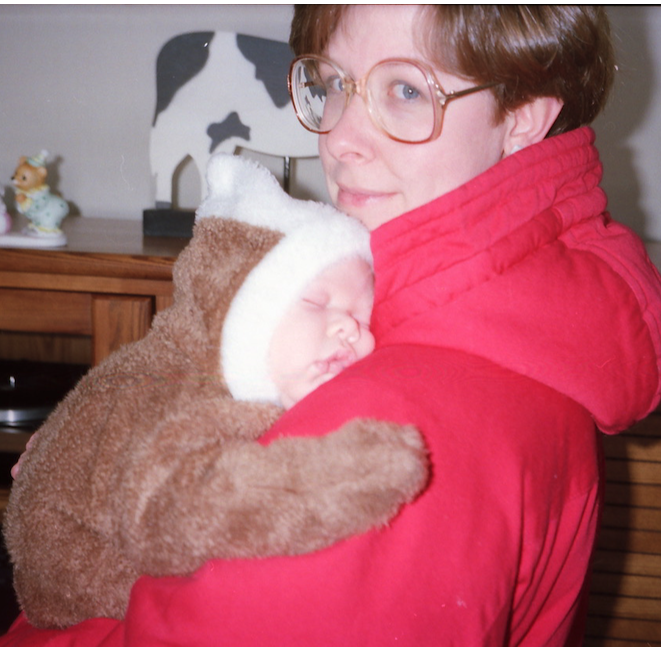
    1989

    I haven’t forgotten the fog and overwhelm of life with a newborn. How every little thing worries you. I also know you can grow bored by the long repetitive days, no matter how much you love your child. How ready you can be to use your brain for something besides calculating the hours since the last feeding. But the sweetness of cuddling a sleeping baby tempers that restlessness.

    When my son hands me his baby, our past, present, and future converge.

  • Reflections from My Great Grandmother’s Rocker

    Some nights sleep is elusive and I’m up earlier than expected—an experience I share with many people my age. At 6:15, I sit in my great grandmother’s rocker reading a book about baby care, since I will be a first-time grandmother in a month or so.

    I try to imagine Anna Kuntz Pleitz and wonder what she was thinking when my grandmother, Helen Wagner Pleitz was pregnant with my mother, Eileen Pleitz Shriner in 1921. I wonder how Anna would view my self-assigned reading.

    Anna lived with her son Frank and daughter-in-law Helen and would have been on hand when they were having children. I speculate that her knowledge of babies and mothering was held in high regard. Anna would have known the secrets of nursing and how to soothe a fussy baby. Like I do. In her day there may have been magazine articles and books about the ‘modern’ methods, but I don’t envision her reading them. She and Helen would have been confident of her skills. 

    Or maybe not. Throughout the 20th century and into this one, each new generation has had their own take on parenting and baby care. So I volunteered to read the Mayo Guide to Your Baby’s First Years along with the What to Expect website to learn what’s new in the 30+ years since I had newborns. I want to be familiar with what my daughter-in-law and son are learning. 

    My mother said my great great uncle, whose name I don’t know, made this beautiful platform rocker and matching footstool for his sister Anna. Making furniture was his trade. Anna’s husband George also made furniture, so perhaps it could be his handiwork. It is in the Eastlake style, so its design and decorations are simpler than ornate Victorian furniture. I don’t know if Anna brought it from Alsace (on the border of France and Germany) when she emigrated from France or if it was made in the U.S. 

    It’s a ladies rocker, which means its frame is smaller and lower. It’s very comfortable and fits me perfectly. More than 100 years later, the rocker doesn’t even squeak. A couple of years ago, I had it reupholstered and replaced the antique-looking gold striped fabric my parents had chosen with an off-white tweed with threads of red and gold and blue. I wanted the rocker to be used and not be a museum piece.

    I silently rock and think of Anna, Helen, and my mother sending their love and wisdom.

  • What’s Your Approach?

    Earlier this month, I celebrated the 8th anniversary of my retirement at 61. Occasionally, I have floundered, but I’m happy with the shape it’s taken. Many of my friends are retired or nearing it, and I’ve observed a range of philosophies:

    Nonretirement – For several writers and artists I know, retirement looks like slowing down, not quitting. They have fewer paid jobs but they’re still working. Or they have a big project underway which might be published or shown later. 

    No schedule, no plans – Some people prefer the freedom to choose their activities day by day. For years they were yoked to a commute and an office. They feel they’ve paid their dues and earned the right to do whatever appeals to them on any given day. They hate the idea being locked into a schedule and resist planning too far ahead. I’ve noticed more men choosing this style.

    A bit of structure – These retirees prefer several days of planned activities but want lots of free time, too. Their schedule might include workouts or sports, socializing with friends, and weekly volunteer gigs. They also value unscheduled time and are careful not to pile too many events into one day. This approach often appeals to women. I belong to this camp.

    Always busy – This group is eager to do everything. All the time. For as long as possible. While the first three groups like to travel, these retirees travel even more. They’re adventuresome and willing to try whatever looks fun, which could be a class, a biking/hiking/kayaking group, a tour or whatever. They’re an enthusiastic bunch and want to be sure they do it all before time runs out.

    Aimless – Some people struggle with retirement because they miss the structure work provided (even though they resented the job at times). They don’t know what to do with themselves. With so much free time, their days can feel empty. They have trouble getting projects accomplished because there’s always tomorrow.

    Not loving it – Some retirees really don’t like retirement. Often, they are accomplished people who were well-respected in their field. Work provided focus and was integral to their identity. Retirement feels like a loss. The activities they try are pleasant but feel like make-work—time-fillers. They want their pursuits to be meaningful and have purpose, but they haven’t found fulfilling interests yet.

    Combo – A person new to retirement may sample several approaches before finding a satisfying mix. Shifting away from paid work can be as confusing and life-changing as starting a career. Many times, people aren’t sure what they want or what will feel like time well-spent.

    So much of a person’s approach to retirement depends on their temperament. What do they value most—freedom, balance, drive, accomplishment? Are they self-motivated or do they need outside structure in their days? 

    What has worked for you? Or how do you envision your future retirement?