Category: Friendship

  • On Giving

    Recently, I became acquainted with a young Afghan refugee who has been resettled in the US. She’d only been in the US a few days when I met her on a bitterly cold day in February. I had no idea what she might have or need, so I brought a scarf and warm mittens, some toiletries, tea and snacks. The resettlement agency had given her appropriate winter clothes. Within a few weeks they’d found an apartment for her and given her basic furnishings.

    Despite our age difference (she’s 24 and I’m in my sixties), we got on well. She had worked with the US embassy and her English is good. I’ve tutored immigrants learning English for years and am aware of some common cultural disconnects. So much of teaching English involves explaining American history and culture as well as grammar and punctuation. My intention is to be a friend, someone she can trust with questions about confusing customs.

    When I mentioned meeting her, a number of women I knew immediately asked what household items she might need. Like me, they’ve accumulated a lot of stuff over the years and would be happy to give it to someone who can use it. We all have so much. We’d never miss an extra end table, coffeepot, or winter coat. I had the same impulse, but thought I’d wait to see what she wanted and needed. 

    Her apartment’s furnishings seem sparse by American standards, but she was delighted by her things. She’s accustomed to sharing the kitchen with several families and told me she’s never had so many clothes. I recalibrated my instinct to offer her a bunch of stuff. Should I push my aesthetic on her? Maybe she prefers simplicity. Would the donations from my friends and me make her feel inadequate or signal that she seems poor by American standards? 

    I’m aware I often overthink things. Maybe she’d love to have more for her apartment. The simple generous reaction friends have had—how can I help—is a good one. Why wouldn’t we help when we have so much? Shouldn’t we?

    Yet I know the dynamic between givers and receivers can feel unbalanced. Uncomfortable for the recipient. I’ve already seen my new friend’s deep sense of hospitality. When I visited her and another Afghan family she’s friends with, they insisted on serving me a full meal. Although I wasn’t hungry, I knew it would be rude to refuse, so I ate with them. Similarly, when I gave her the handful of things culled from my closet and kitchen at our first meeting, she gave me a new pair of earrings she had, something I suspect she’d bought for herself.

    I try to think how I’d feel if the roles were reversed. Would I simply be grateful, because I needed things and someone cared enough to help? Or would I feel awkward about the charity? In time would my pride be pricked so I became resentful? Trying to be sensitive, not stingy is confusing.

  • Ink on Paper

    We opened most of the Christmas cards around January twenty-eighth. That’s not a tradition or a day of any significance. I just stopped procrastinating about opening the rest of the cards and putting away the last bit of the holidays. 

    As cards arrived, we always look at the envelopes and talk about connection with each individual or family. Not so much connection with our HVAC contractor, eye doctor, car service place and insurance agent. I am family ‘owner’ of holiday cards, so I own that each day I planned to open the cards after dinner and enjoy pictures or notes. We had produced a virtual card to most of our list with a video of a holiday song which kind of changed the rhythm of our traditional card handling.

    I hadn’t noticed one holiday card addressed to me alone during my daily shuffle. My amazing daughter-in-law had sent me a card with a note that fed my heart. The best Christmas gift. The best. Maybe even better opened in the quiet of winter after the rush.

    An unexpected Valentine postcard from a friend, an untraditional card sent to my on my birthday, certain travel postcards from friends and relatives inspired me to design a decorative wide ribbon where I could hang these treasures in my office. Some of the ribbon is in my credenza along with a bag of tiny brass clips, but the completed project remains in my mind. The treasures are in a tray along with letters from my mother-in-law and one from my father before I was married.

    Kind emails and texts mean so much often because the message is unexpected. The gift of a caring personal message in ink, on paper, which is then mailed delivers a flush of happiness followed by days or weeks of remembering each word. Coming from the era of pen pals and mailed greeting cards for every special day from Valentine’s Day to Easter to Halloween and Thanksgiving, I appreciate the effort taken to shop, write, and mail. 

    Though we’re all past the age of decorated shoe boxes to hold our Valentines, I hope you find happiness in sending a text, an ecard, or paper card to a person you value, or a whole lot of friends and family members who might need a smile.

  • Do-Over

    Have you ever been unable to forgive yourself for a past action? Your do-over was never enough? Your action, or in my case inaction, continued to pain and haunt you? Prayers and wishes didn’t subside the memory.

    I had one such pain.

    Aunt Kate asked me to meet her at a funeral home. A dear friend of hers had passed away. I told her I would. I didn’t show. I had plenty of good reasons. I was in my early twenties, had worked all night. I was just plain tired. I needed sleep. I could hear the sadness and disappointment in her voice when she said, “You didn’t come.” I pictured her sitting by herself waiting and waiting for me.

    Of course, I told her I was sorry. I could never get over not showing up for her. She never asked for much, if anything, from me or anyone else. I had more fondness for Aunt Kate than I did my mother. Her constant love continues to sustain me although she’s been dead for over 32 years. It’s her that I want to greet me on the ‘other side’ when I die.

    I know she forgave me. I never forgave myself no matter how many little pieces of paper I threw into the flames on Solstice or New Year’s Eve.

    Until now.

    Every day, I do a do-over. And, it finally feels good enough. It didn’t start out as that. It started out as one neighbor helping another.

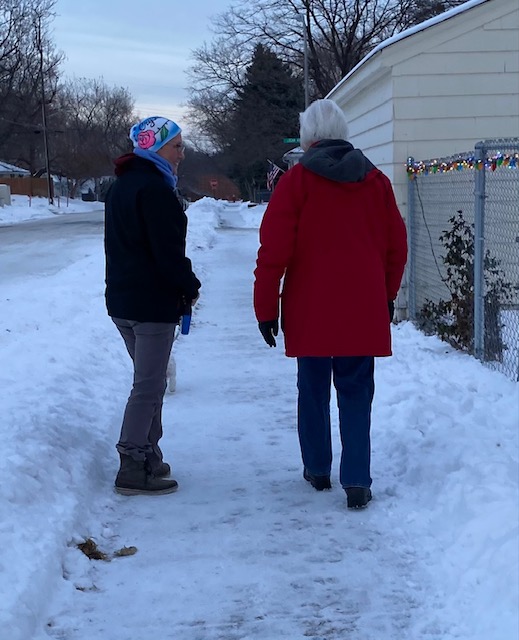
    On Halloween, sitting around the fire bowl on our block, I listened as our neighbor said he’d be driving north for a week to his cabin. His wife, who is in her eighties, would be by herself. I imagined her falling in her kitchen and no one knowing. I asked her if she’d like to start taking a daily walk.

    She often told me on our strolls that I was the only person she had talked to that day. COVID-19 had pushed her further into isolation. She didn’t like to walk by herself and wouldn’t, but she would walk with me. Sometimes, I’d bring our two dogs and hand her one leash while I grasped the other. The dogs began to greet her like family. At other times, Jody would walk with us while the neighbor and I chatted.  

    Our conversations were generally the same: the weather, the home and garage projects in the neighborhood, and what our families were doing. I never tired of it.  

    After her husband came home our walks have continued. She has become my companion.

    We don’t talk politics. We don’t talk religion. There is so much more to bind us.

    I sense Aunt Kate’s spirit when we walk. I know she’s pleased. I know she’s happy. I have a different image in my mind. She’s not sitting alone in the funeral home waiting for me. She’s walking beside me.