Thank You for Being a Friend

There may have been times in my life where I’ve wished for more friends, but surveying the landscape of the years, I’ve been pleasantly surprised at the growing richness of friendship around me. These friendships are both comforting and surprising. As a lifelong introvert and a bit of a loner, it’s taken me a while to find my footing with my friends. 

I’m surprised, perhaps, because sometimes I’ve taken friendships for granted or maybe even realized that I may not always have been the best friend. I have forgotten birthdays, or let too much time go between phone calls, or even missed responding to texts. My well-crafted reply to an email or text often gets lost in my head. This does not reflect my affections. When I think of my friends, I smile internally recalling ways that I’ve met people, our histories and ways we’ve time we spent together, even if it was a long time ago. 

When I was young, I had visions of popularity, thinking that popular people had the most friends, and who doesn’t want a lot of friends? I quickly learned that my quiet, introverted nature often set me apart as being shy or just too withdrawn to make easy connections with others. I longed for real connections and conversations, but didn’t know how to get there. 
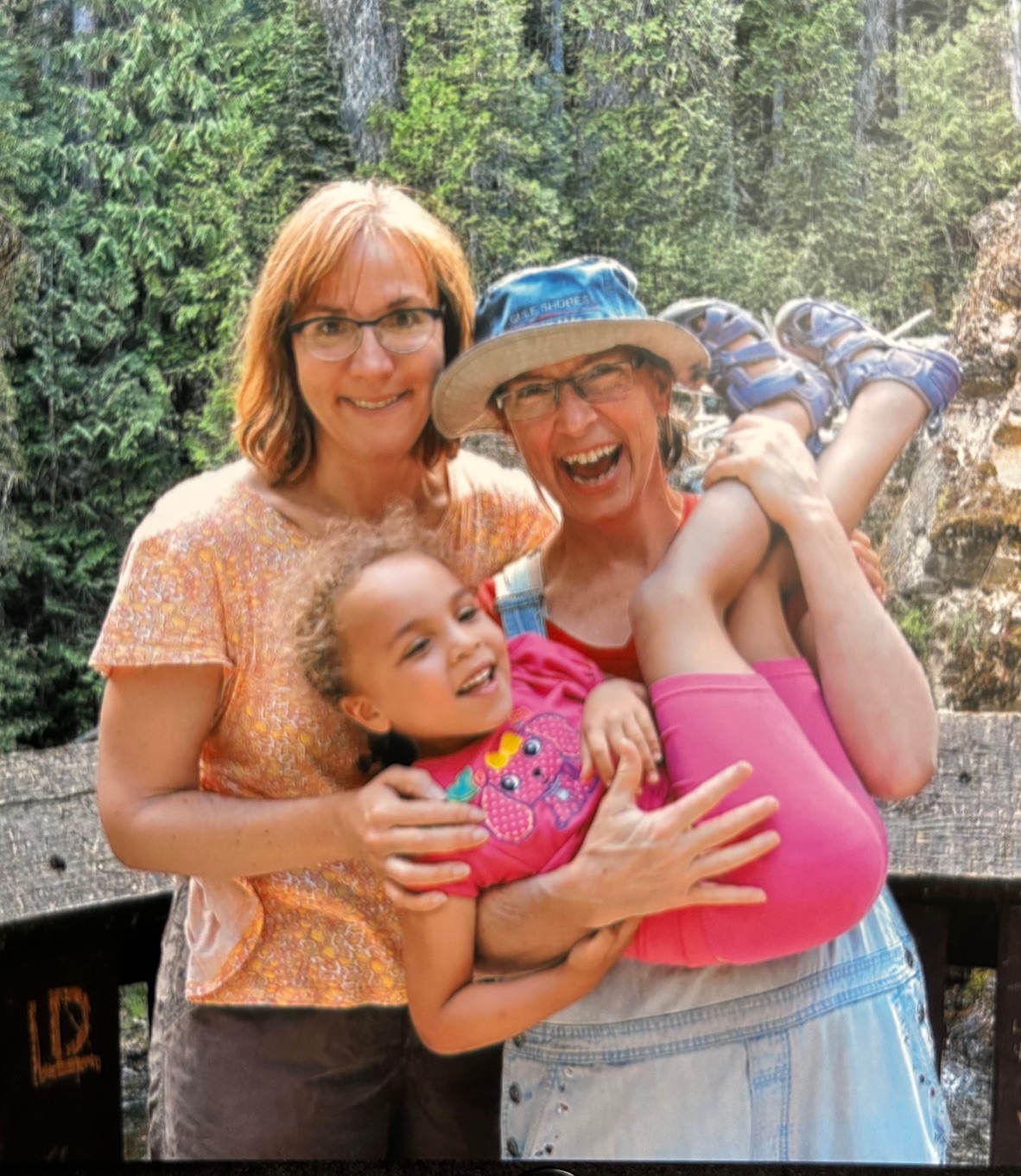
The author with her daughter and former roommate (and friend of 30+ years).

The insecurity of adolescence has annoyingly stuck with me, although it’s less of an issue now than it used to be. But it is still a force that keeps me in the shadows more than it should. 

In my 50s now, I still want to connect with people and find that I can still get in my own way when I worry about whether someone will like me or when I feel self-conscious. It is all too easy to pull into myself when faced with a group of people I don’t know very well.

When I do make a friend, it usually sticks. I’ve been fortunate to make meaningful connections with people through the years, and despite my occasional inattentiveness, somehow those connections have lasted. Often those friendships unfolded over time and with a shared history; other times my connection was immediate and easy. 

I’ve been lucky to be a part of a writing group that has been going for 20 years, where we’ve grown to know each other in unique and vulnerable ways through our writing voices and so much more. I’ve been equally fortunate to be part of a knitting group that has been meeting for even longer, bonding over knitting, conversation, and laughter. And I’ve made individual connections with people here and there: A friend I used to work with who shares my love of reading and always laughs at my jokes. A former roommate who saw me through some tough times and is the one that still generates loud and frequent laughter in me. Another friend I met at a neighborhood park when our kids were preschoolers. Other friends I’ve made through my daughter.

Writing Besties: Brenda, Ellen, Jill, and Elizabeth

I haven’t always had the time or energy to maintain friendships over the years. One of my sisters has friendships from elementary school, and she regularly sees others from her high school days. I can date my longest friendship to a friend I made in college, when we met in journalism school and quickly connected over books and writing. Blessedly, we are still connected despite being separated by more than a thousand miles and one time zone.  

Developing and maintaining friendships takes time and intention, and it’s something I’ve found harder to do in my middle age years. Marrying in my mid-thirties and then becoming a mother in my early 40s put me out of sync with many of my peers. Early motherhood was often fraught with anxiety, and I found myself wishing for more connection. And then the pressures of working and caring for family made it harder to carve out time for friendship. I can still find myself feeling lonely at times, as my daughter grows more independent and will soon be out of the house. 

I think the answer to that is to lean into the friendships that I have and nurture them a bit more. So, if you are my friend, please forgive me for missing your birthday or not calling more often. Know that you still hold a place in my heart. And expect to hear from me soon. 

Holding the Lantern High

When I first suggested that the WordSisters should road trip to Michigan in Beth’s still-a-dream motorhome, I didn’t really think it would happen. But now, more than a year later, I pull into the campground five miles from my new home in Michigan to see Beth sunbathing in front of a 28’ Winnebago. With the help of her wife, Jody, they’ve driven 10 hours from Minneapolis to visit me in tiny Byron Center, Michigan. Soon Ellen and Brenda emerge from the rig and I’m near tears. They’re here. They’re really here. The power of a 20+ year friendship is made manifest.

L: Sunbathing, R: Beth & Jody

A lot has happened over the two decades that we’ve known one another (no one can say precisely when we first met). I came to the writing group last (as I remember, but it might have been Brenda). There were other writers in the group then, friends and fellow writers who went their separate ways over time until the four of us remain, bonded by the love of writing, a mutual respect for the craft, and compassion for one another’s lives. We’re no longer just writing group acquaintances, but friends. Through our writing we’ve exposed ourselves to one another in ways we don’t to others. 

A lot has happened, too, since that day in May 2023 when the idea of a road trip first took root. My husband and I emotionally dismantled three decades of living in our Minnesota home to move to a townhome in my home state. Ellen became a grandmother. Brenda’s daughter (who we met when she was an infant) successfully navigated her first year of high school. And Beth and Jody bought a motor home, which now sits before me in all its glory.

During the past year I also read Tom Lake (stay with me here) and had the privilege of seeing Ann Patchett at the Fitzgerald Theater in St. Paul, Minnesota, talk about the book, writing, and life with Kerri Miller for MPR’s Talking Volumes Series. At the end of the night, Miller surprised the audience by bringing Kate DiCamillo on stage. For a group of writers and readers, a surprise visit by the hometown star was, I suspect, the same feeling that music fans had back in the day when Prince used to show up unexpectedly at First Avenue. The crowd roared.

The dedication to Tom Lake reads: “To Kate DiCamillo who held the lantern high.” Patchett explained that while writing the book she and DiCamillo would exchange a short email in the morning and again at night. “She would always say, ‘I’m going down the rabbit hole. Good luck in the orchard today,’ and at the end of the day she would say, ‘It’s time to come out of the orchard. I’m holding the lantern up. Just walk towards the light.’ ” 

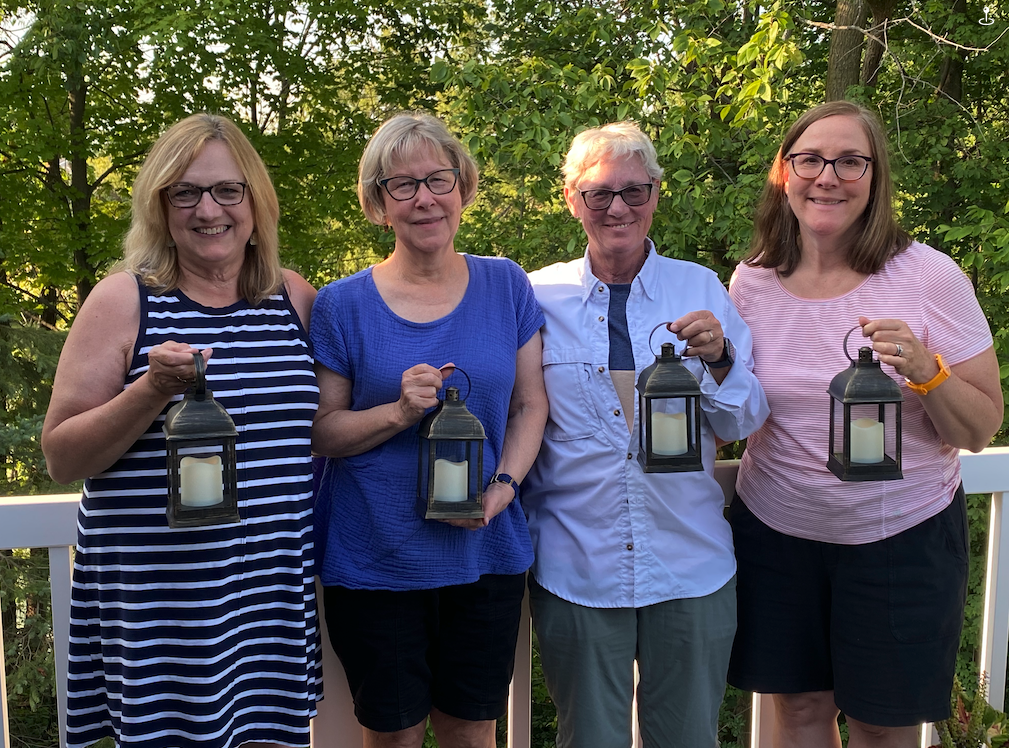
I sat in the balcony of the Fitzgerald next to my book club members (another group of wonderful women I’ve known for over 15 years) and fought back tears. All I could think of then were Ellen, Beth, and Brenda standing at the edge of my proverbial orchard for two decades guiding me with their light. It’s who we are and what we do for one another as writers. So, on the last night of our way-too-short visit, we sit in my sunroom, and I give each of them a lantern. I want them to remember me, which I really don’t fear will be an issue. And I want to remind them to always “hold the lantern high.” I’ve bought one for myself as well, to hold for them as they make their way out of Guatemala, or the ER, or a spiritual labyrinth or one of the many places our life journeys will take us. I want them to know that I will always be there for them holding the light.

Jill, Ellen, Beth, Brenda

Letting Go Gracefully, Without Regrets

Contemplating my 50th high school reunion got me thinking about friendships, acquaintanceships, and people I’m no longer in touch with.

I’m a person who stays connected. I make the calls, send the emails, arrange the visits, and keep up the connections. For years. But I wonder, When should I simply loosen my grip and let a friendship or acquaintanceship slide? Couldn’t I say to myself, We were friends for a certain moment in time and now that time has passed? It’s OK to let go gracefully without regrets.

I think I’ve done that with my high school friends. 

I’m mildly curious about a few people. There was the cute redheaded guy I daydreamed about in math class. We ran in the same circles, but never dated and with time I became infatuated with other guys. He later became an architect and developer and now is one of the wealthiest members of the class. 

I might enjoy talking with a brainy basketball star who was a good friend for a few years. She sat near me in several classes because our Catholic high school seated students alphabetically. However, even during college while I still lived in Toledo, we’d grown apart.

A dark-haired acquaintance who had a big voice and an even bigger laugh also comes to mind. We hung around together during school musicals—she was a performer and I was the costumer.

I’m curious about another dark-haired classmate in my advanced English class who became a nationally known journalist. We ran in different crowds (hers cooler than mine), but it would be fun to talk politics with her now, except she isn’t attending either. 

I felt a pang to see a close girlhood friend listed among the deceased. We parted in 6th grade when she moved to a different neighborhood and got interested in boys. I was still shy and awkward then, not ready to date. We’d let go long ago, but I was sorry to read she had been in poor health for years and was no longer married.

A friend who went to a different high school said her 50th reunion was the last one she’ll attend, because future reunions will involve classmates needing walkers and talk of who’s in the early stages of Alzheimer disease. 

Her insight bolstered my decision to skip my 50th reunion. I’d rather remember my classmates as we were—young, high-spirited, and barely aware of life’s harder realities.

On Giving

Recently, I became acquainted with a young Afghan refugee who has been resettled in the US. She’d only been in the US a few days when I met her on a bitterly cold day in February. I had no idea what she might have or need, so I brought a scarf and warm mittens, some toiletries, tea and snacks. The resettlement agency had given her appropriate winter clothes. Within a few weeks they’d found an apartment for her and given her basic furnishings.

Despite our age difference (she’s 24 and I’m in my sixties), we got on well. She had worked with the US embassy and her English is good. I’ve tutored immigrants learning English for years and am aware of some common cultural disconnects. So much of teaching English involves explaining American history and culture as well as grammar and punctuation. My intention is to be a friend, someone she can trust with questions about confusing customs.

When I mentioned meeting her, a number of women I knew immediately asked what household items she might need. Like me, they’ve accumulated a lot of stuff over the years and would be happy to give it to someone who can use it. We all have so much. We’d never miss an extra end table, coffeepot, or winter coat. I had the same impulse, but thought I’d wait to see what she wanted and needed. 

Her apartment’s furnishings seem sparse by American standards, but she was delighted by her things. She’s accustomed to sharing the kitchen with several families and told me she’s never had so many clothes. I recalibrated my instinct to offer her a bunch of stuff. Should I push my aesthetic on her? Maybe she prefers simplicity. Would the donations from my friends and me make her feel inadequate or signal that she seems poor by American standards? 

I’m aware I often overthink things. Maybe she’d love to have more for her apartment. The simple generous reaction friends have had—how can I help—is a good one. Why wouldn’t we help when we have so much? Shouldn’t we?

Yet I know the dynamic between givers and receivers can feel unbalanced. Uncomfortable for the recipient. I’ve already seen my new friend’s deep sense of hospitality. When I visited her and another Afghan family she’s friends with, they insisted on serving me a full meal. Although I wasn’t hungry, I knew it would be rude to refuse, so I ate with them. Similarly, when I gave her the handful of things culled from my closet and kitchen at our first meeting, she gave me a new pair of earrings she had, something I suspect she’d bought for herself.

I try to think how I’d feel if the roles were reversed. Would I simply be grateful, because I needed things and someone cared enough to help? Or would I feel awkward about the charity? In time would my pride be pricked so I became resentful? Trying to be sensitive, not stingy is confusing.

Ink on Paper

We opened most of the Christmas cards around January twenty-eighth. That’s not a tradition or a day of any significance. I just stopped procrastinating about opening the rest of the cards and putting away the last bit of the holidays. 

As cards arrived, we always look at the envelopes and talk about connection with each individual or family. Not so much connection with our HVAC contractor, eye doctor, car service place and insurance agent. I am family ‘owner’ of holiday cards, so I own that each day I planned to open the cards after dinner and enjoy pictures or notes. We had produced a virtual card to most of our list with a video of a holiday song which kind of changed the rhythm of our traditional card handling.

I hadn’t noticed one holiday card addressed to me alone during my daily shuffle. My amazing daughter-in-law had sent me a card with a note that fed my heart. The best Christmas gift. The best. Maybe even better opened in the quiet of winter after the rush.

An unexpected Valentine postcard from a friend, an untraditional card sent to my on my birthday, certain travel postcards from friends and relatives inspired me to design a decorative wide ribbon where I could hang these treasures in my office. Some of the ribbon is in my credenza along with a bag of tiny brass clips, but the completed project remains in my mind. The treasures are in a tray along with letters from my mother-in-law and one from my father before I was married.

Kind emails and texts mean so much often because the message is unexpected. The gift of a caring personal message in ink, on paper, which is then mailed delivers a flush of happiness followed by days or weeks of remembering each word. Coming from the era of pen pals and mailed greeting cards for every special day from Valentine’s Day to Easter to Halloween and Thanksgiving, I appreciate the effort taken to shop, write, and mail. 

Though we’re all past the age of decorated shoe boxes to hold our Valentines, I hope you find happiness in sending a text, an ecard, or paper card to a person you value, or a whole lot of friends and family members who might need a smile.