Holiday Presents

In response to queries about what I might like as a holiday or upcoming birthday present, I am wondering if I have hit “that age” or developed a stronger sense of being part of the universe?

With the evil spreading in our country that has stripped families apart or made the simple costs of food, shelter and other necessities too expensive for others, how can I want anything? If I need to think about creating a list for days, I think I know the answer

First, my deepest wishes: food, safe shelter, healthcare and education to be accessible in our country. People with compassion, wisdom, morals, the ability to use real language when talking, willingness to listen, commitment to collaborative decisions to lead government at all levels, in all nations. Narcissistic strong men be removed from positions of influence or power.

On the personal level: A giant gift would be securing my family’s futures so that those of us aging don’t burden the younger, the middle generation continue to live the modestly comfortable lives they have achieved, the children reach maturity in a country that has found its way back to peace and prosperity while honoring the Statue of Liberty‘s invitation. It would be grand to find a small house for our last decades and free our family home for a family.

But if my stumbling over the gift question is about approaching “that age” and actual physical items must be named, my gift list is simple: warm socks, two books, a box of English Toffee, framed photos, individual time with each family member in the coming year, donations made to food shelves.  

Add new pajamas and a couple of white long sleeve polo shirts, this might have been my father’s list twenty years ago when he was the age I am now. And he is a good reminder of what holiday presents should include. He was someone who gave to others at holidays: food boxes we packed, a canned ham, cookies we baked, wrapped toys, sweaters and pajamas for others’ children, cash in a card, and because it was Wisconsin sometimes a bottle of brandy. 

Time to get busy.

Thoughts on the Urge to Purge

Loads of articles encourage retirees to declutter our possessions and purge decades of accumulation. My generation is repeatedly reminded our kids won’t want our stuff. True. They’ll want it after we’ve given it away. Or never. 

Purging sounds so virtuous.

The philosophy of decluttering or purging goes like this—discard what you don’t need. Pare down your belonging to the essentials. Ideally, give your stuff to someone who can use it. The process is also supposed to offer emotional benefits:

  • Get rid of what weighs you down—the boxes full of old files, the clothes that don’t fit, the shopping mistakes. Let go of the emotional weight of caring for all these things. The sense of responsibility and guilt are bad for you. 
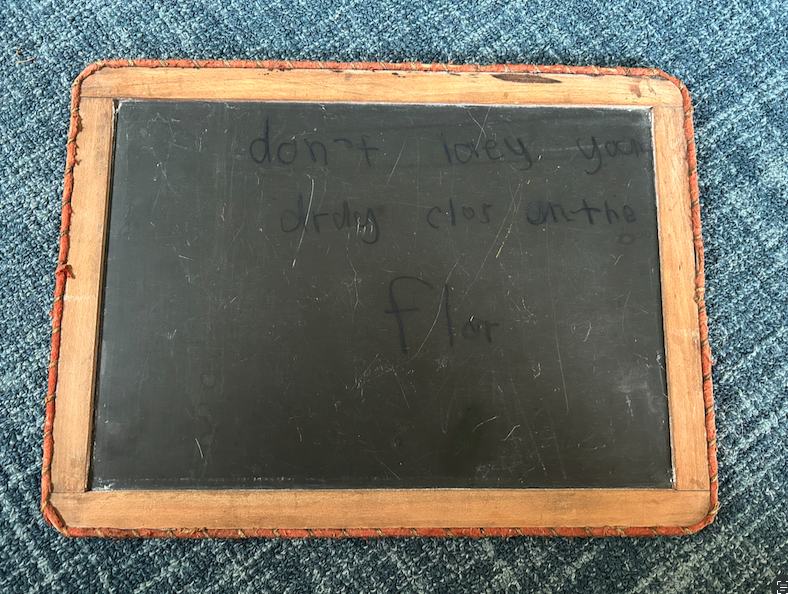
  • Think how light and refreshed you’ll feel when you have less stuff. Less to take care of. A clean slate. (Who the heck even knows what a slate is? Well OK, I do. It’s a personal chalkboard students did schoolwork on. I have one in my office closet that belonged to my grandfather. I’m not even that attached to it. Would a history museum want this artifact? Probably not, since my brother crayoned on it.)

The decisions and matchmaking are what short circuit the urge to purge. 

Neighborhood Buy Nothing groups make it easier. You feel good about the matchmaking. The groups are well suited to offloading housewares and furnishings you no longer use. When we got a king bed, someone wanted our queen size mattress and bed frame. All I had to do was snap a photo and post the items. The neighbor who wants your stuff picks it up. No more loading up the car for a trip to Goodwill and driving bags and boxes around for weeks until you do the drop-off. No more staging a tedious garage sale only to find you still have to dispose of what didn’t sell.

Local Buy Nothing groups do a brisk trade in kids’ clothing, toys and equipment. I recently acquired a second booster seat for family dinners and I often scan posts for age-appropriate toys. My granddaughters’ wardrobes are supplemented with barely-worn-before-they’re-outgrown clothes and shoes from active Buy Nothing groups. The amount and quality of free stuff is astonishing. 

People of my generation used to take things to Goodwill or similar charitable organizations. Sometimes I still do—mostly clothes. Recently, an energetic friend’s clean sweep inspired me to pack up a load of clothes and old purses I don’t use. Won’t use. I do feel a bit virtuous. 

But right now, I’d like to purge any additional demands to declutter. Unload all those reminders and the associated guilt. It’s yet another thing that would be good for me . . . that I don’t feel like doing. Besides, the slate doesn’t take up much room in my closet.

To Louis and Octavia

An enthusiastic three-year-old ran craft materials to the kitchen table. She had a project in mind, a puzzle to build out of tongue depressors. 

I was not enthusiastic about the project which, as many projects, would lead to painting which might lead to painting herself. In fact, I was tired and working hard to be gentle as she taped sticks together. When a washcloth became necessary, I got it damp at the sink, looking at her head bent over a row of painted wooden sticks. 

The oak table where she worked on a protected area was made in 1902 when Louis Cravillion married Octavia Orde, my paternal great grandparents. How I miss my Grandma Tavy. My grandmother died following childbirth, so Octavia cared for her grandson. As a woman of the age, I am now, she cared for me. I sat on one of these chairs while she braided my hair, ate meals she cooked, or colored. My mother worked in town.

After my great-grandfather died, we had moved in with her. My parents remodeled the kitchen and dining area storing this oak table for a new Formica and metal model. Eventually an apartment was finished upstairs so she would have her own place. The table returned. Eating breakfast in my designated chair, it was possible to watch everyone come to the new post office across Main Street. Patterns were cut to make clothes, cookie dough rolled out, homework completed.

After her death, the table was refinished and set up as my parent’s game table. As they downsized, it came to be mine. Our children ate and did homework and projects on a glass surface that protected the oak. Today’s artist is one of their children. 

Stories of six generations of my family have been exchanged here. Men have returned from wars to a first home meal, baptisms and weddings celebrated, hard decisions made, children loved. Great grandma’s quiet and calm presence participated in half of its history. I see her hands now show in mine; her brown eyes look back from our mirrors. I can only hope I carry some of her wisdom to those who sit at this table, her blood mixed in their veins. I am not so tired.

The Everlasting Charm of Cardboard Boxes

I’ve never met a cardboard box I didn’t like. As a result, I have a dedicated box closet in my basement. This humble, unfinished space is not just for storing boxes; instead, it’s a testament to being able to find the perfect box only a flight of stairs away.

Each one I’ve saved tells a story and invites me to recall a package delivered, an appliance purchased, a gift received. Each one also awaits its turn as the perfect box in which to return a book, send a present or hold my recycling.  

There’s also a practical reason why I save so many boxes.

Two decades ago, a neighborhood punk broke into my house and stole two TVs, a couple of kitchen appliances, my monitor and a number of other things. In filling out the police report, I was asked to provide pictures of the items as well as their serial numbers. Alas, with the items gone—as well as the boxes they came in—so was proof of my ownership. (And yes, I could start snapping pictures, writing down serial numbers and recycling boxes, but I like seeing visual proof of things I purchased and gifts I received. When shipping a package, I also like knowing I have a closet full of boxes of various dimensions from which I can choose.

Yes, cardboard boxes hold an undeniable magic for me that transcends their seemingly mundane nature. This is especially true since the start of COVID, when I, like many others, opted to order everything from groceries and office supplies to pet food and electronics, rather than test fate by going out to shop.

In a world sometimes obsessed with grandeur and complexity, the cardboard box stands strong in its corrugated simplicity, a reminder of the importance of both form and function and how, when combined, even the ubiquitous cardboard box can be a thing of beauty, a way to do what I’m trying to do more of: celebrate the seemingly mundane.

Aspirational Clutter: Not Yet Time to Let Go

Two years ago a friend introduced me to Clutter Chronicles, a podcast that features a woman named Mary and her “unusual relationship with stuff.” Ever since, I’ve been working hard to rid myself of my clutter, as well as all sorts of other stuff I no longer need or use.

I’ve made good progress. I’ve tossed reams and reams of client files from a four-drawer, 48-inch-wide file cabinet. I’ve donated hundreds of books, a dozen bags of clothes, several sets of linens and my favorite china.

Parting with most of that stuff turned out to be easier than I thought thanks to another friend who encouraged me to stop dragging my anchor behind me and instead toss it out in front of me.

But I’ve since come to realize that there’s a category of clutter I’m still having trouble letting go of: aspirational clutter.

I’d never even heard of aspirational clutter until a third friend introduced me to Apartment Therapy, a home and décor site that defines aspirational clutter as “anything you’re keeping for a future version of yourself.”

As a lifelong goal-setter with all sorts of imagined future selves and plenty of storage space, I’ve accumulated a great deal of aspirational clutter, most of which revolves around hopes and dreams related to creative pursuits such as writing, drawing, painting, sewing and knitting, all things I used to love doing as a kid but gave up decades ago.

Some of my aspirational clutter is electronic, like the list of words I keep on my computer, words I aspire to one day not only remember the meaning of but also use in a short story. The list includes noctilucent, opsimath, sere and wheedle.

There’s also a list of clever headlines, as well as lists of books to read, movies to watch and podcasts to listen to, all in line with my aspirations to develop compelling creative content in a variety of forms.  

But what about the things that do take up physical space? A shoebox filled with recipes. A plastic bin of yarn. An untouched set of oil paints I received for my 40th birthday. A six-inch high pile of pages I’ve torn out of magazines in preparation for making collages.

Despite the fact that some of these things have sat dormant for decades, tossing or giving them away is harder than I would have imagined. And that’s exactly how my more creative future self would want it to be.