Write Anyway

Every birthday I consider what the past year has brought and what I hope the upcoming year will bring. This year as I entered a new decade, my focus was also tempered by the awareness that my time isn’t unlimited, and I want to use it well. What will the coming days and years consist of? Family and friends, health upkeep, travel, fun and for me, writing. 

At first, asking what role writing will play in my life seems silly. Creative writing isn’t something you have to retire from. I can write as long as the words and ideas come. But the deeper question is—What are my expectations about publication?

Widely published authors like Stephen King and Joyce Carol Oates can continue publishing as long as they care to. It’s a different matter for the writers I know, who have a modest number of publications. Like it or not, the marketplace may decide for them. Because it’s a personal and potentially painful decision, writers don’t always discuss the dilemma.

In the past 20 years, I’ve written two book-length memoirs, but I’m not seeking publication for either of them. I learned what I could about writing books, but it wasn’t enough. The real gift is what I discovered about myself through the writing process. I’m proud of myself for doing the work. I’m at peace with the idea the books won’t be out in the big world. 

Instead, I’m focusing on writing short memoirs, essays and blogs. My talents and skills are better suited to short pieces. Most years I publish one or two. Not a breath-taking record, but enough for me. Knowing my words and ideas find an audience in an anthology, literary journal or blog is plenty. 

Publication plays a small part in my commitment to writing. I write because it helps me make sense of my world.

Two quotes sum up my outlook. The first comes from a blog by Amy Grier who was struggling with her writing and the state of the world in November 2020. Her thoughts are still relevant:

Writing tethers me to the world in a way nothing else does . . . I don’t know who will be president, what’s happening to my country, even what will happen to me. But I’m going to write anyway. It’s my remedy for despair. It’s how I will survive.”

The next comes from an interview with Margaret Atwood, who offered a few rules for writers. After making practical writerly suggestions, she also said this:

“Nobody is making you do this: you chose it, so don’t whine.”

For as long as it pleases me I will honor my creative nature and write anyway.
Quilting My Way Out of COVID

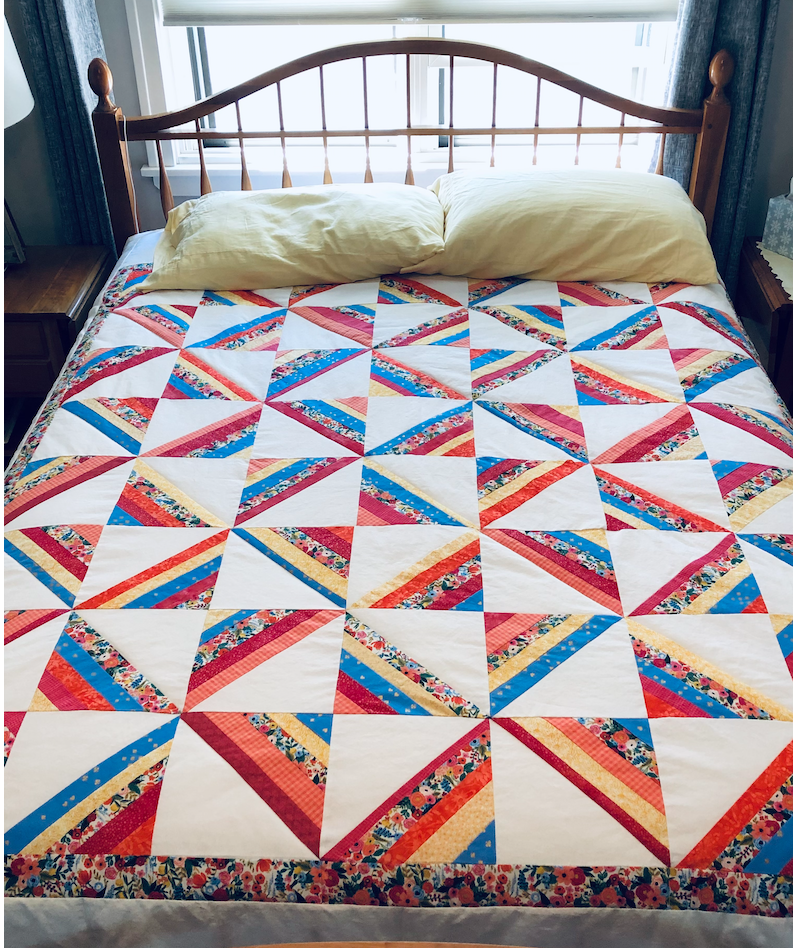
In February, I started planning a queen-size bed quilt. I waited until after the holidays so I’d have a big time-consuming project to help me get through the long uncertain months while COVID still raged. Who knew when I’d be vaccinated or when we’d be safe? 

I’d grown accustomed to the restrictions. Aside from grocery store clerks, the only people we saw were our sons and only for a few minutes. When they visited, they hovered near the front door never taking off their winter jackets—all of us masked. With everyone else, it was phone calls or Zoom visits.

Time was heavy on my hands. Cutting and arranging little strips of color one square at a time was how I’d keep sane until spring when we could see friends and family outside. 

At one level, I was immersing myself in a creative process involving color and texture—a visual challenge that has always attracted me. But part of the appeal this time was creating order, making sense of something when so many things outside my four walls didn’t make sense. Day by day I completed squares and made visible progress when the sense of progress out in the big world was tenuous. 

As March gave way to April, more people became vaccinated, including me. Winter eased up and I could be outside with friends again. In May and June, I began cautiously approaching a more normal life: seeing vaccinated friends, gardening, walking, and socializing.

I had less need of my quilting project, but it wasn’t finished. Like COVID, the project had lasted too long. I was so ready to be done. 

During the past week as I quilted the pieced top, batting, and back, I became intimately familiar with every inch and all the places where a seam wandered or a square didn’t align. But as my dad used to say when my husband fretted about a home repair’s small imperfection, “A guy riding by on a motorcycle probably wouldn’t even notice that.” 

If you’d asked me a week ago, I would have said the best thing about this quilt is that it’s DONE. 

Today, I’m again pleased with the cheerful colors. 

The quilt project served its purpose and its history will fade with time. A year from now, I hope only pleasure in the quilt’s color and pattern remains vivid. 

Treasure Hunt

Periodically, a writers’ group I belong to has a writers’ retreat. This weekend we stayed at The Anderson Center in Red Wing, Minnesota.

The Anderson House in February 2015

It’s an inspiring place—a stately old home set on acres of land with a sculpture garden on the grounds. There’s a sunny library filled with novels, volumes of poetry, memoirs, histories, and art books. Many were written and contributed by the Center’s guests. In each of the bedrooms, there are journals in which previous visitors (including some well-known writers) commented on their stay. Often they mentioned a breakthrough and expressed gratitude for the Great Things they accomplished . . . which was a bit intimidating.

IMG_2353

Contemplative view from my window, minus the other treasure hunter

On Saturday morning, I sat at my desk and stared out the window.

Outside, a young guy in a hoodie and camo pants moved among the trees, sweeping a metal detector across the lawn. He squatted, dug up something with a trowel, then repacked the dirt, and smoothed it out.

What could he possibly have found—a bottle cap? A quarter? The Anderson House is nearly 100 years old. Maybe a long buried artifact had worked its way to the surface.

Inside, I too was treasure hunting. I sifted through files, piles of words, scraps of images, mining my mind for a memory or a line to spark inspiration.

We both worked doggedly at our tasks.

I hoped to uncover an idea that would justify my presence there, so I’d feel worthy of the gift of time.

Quickly I covered up that wasps’ nest of self-doubt and tamped down my frustration. Smoothed over my prickly worries. Don’t be so driven. That’s not how inspiration works.

I reminded myself: Just spend the time. Do the work.

It will come.

The Magic of Keeping a Journal

Recently, a request for volunteers to decorate personal journals caught my eye. The organization requesting help—The Family Partnership—says journaling is helpful to their counseling clients. I’ve kept a personal journal off and on since I was a teenager, and it certainly improves my mental health. Journaling also provides useful material for my writing projects.

Writers are always advised to keep journals. In high school, when I first realized I wanted to be a writer, I drafted poems and stories in spiral-bound stenographer’s notebooks. In graduate school, I made notes about some of the encounters I had as an ER clerk.

One of my early journals

One of my early journals

From the beginning, my journals also included impassioned blurts—here’s what’s bothering me and why. Finding words for my surging feelings made them concrete and more manageable. The process of writing calmed me. Often I felt like, “There. Now I understand what upset me and I feel better, so I can move on.” I thought the insights might be useful someday. If I ever feel so concerned about XYZ again, I can return to this hard-won insight and get feeling better, faster.

That’s funny now. I’m never going to be 19 again. Why would I need to look up the entry about fighting with my parents?


The journals became historical as well as therapeutic.

Journaling reminds me about how I got to this place in life, and that’s useful. I’m not still a heartbroken 24-year-old graduate student or an overwhelmed 34-year-old mother. Seeing that I’ve grown and changed is reassuring. I do figure things out. Things do get better.

Asking why and wondering about the meaning of certain events, comes naturally to me and is central to the essays, memoirs, and blogs that I write. I’m making sense of the big world as well as my own world.

A friend hand made this journal, which I used while teaching at UMM

A friend hand made this journal, which I used while teaching at UMM

When I was in my late 30’s and early 40’s, I began writing essays and memoir in earnest. Then the old journals offered valuable documentation about what happened when I was 24 or 27 and what I thought of it.

Rereading passages from old journals can be cringe-inducing. When skimming old journals, I understand why some people view them as the height of self-involved navel-gazing. Who is that whiny awful person? But that’s the magic of keeping a journal—within its pages, I can be my worst self on my worst day and spare the rest of the world a lot of my angst, anger, depression, and tedious analysis.

That’s also the danger of keeping a journal. The words and feelings included there would necessarily be taken out of context by anyone reading them. I journal when I’m confused or distressed. Good times don’t require explanation and analysis. I want to keep the journals for my use, but at some point I will need to get rid of them, since I won’t always be around to say, “I was having a bad day when I wrote that. I don’t still think that.”

My recent journals are much smaller-- 5x7, in this case

My recent journals are much smaller– 5×7, in this case

But the writer and philosopher in me resists. I’ve been writing about my life for 20 years. There might be some good material in there. I hate to dump it now!

If you keep a journal, how do you use it? Will you get rid of them at some point?

Why I Want a Coloring Book for Christmas

Screen Shot 2015-12-10 at 8.46.13 AM  I can’t pinpoint what makes visual pursuits like paper projects, quilting, and flower gardening so refreshing to a bizzy dizzy mind, but I have a few theories.

One is that I read and write words all day, so shifting to nothing but color, shape, and design relaxes me. I engage a different, less used part of my mind. With visual pursuits, I’m not explaining, persuading, or struggling to find meaning, as I must when I’m writing.

It’s also playful.

As a writer, I need to do a respectable job with whatever I write. But with visual pursuits, nobody but me cares how well I do. If I make holiday cards, I’m strictly pleasing myself. For me, fooling around with bits of paper is fun. I never get bored with the possibilities for color and texture: ridged green paper, lime checkerboard tissue, bronze matte vellum.card

I have to concentrate hard enough that everything else gets crowded out.

Because I’m not as visually talented as my graphic designer friends, I have to try out the combinations to see what works and what doesn’t. When quilting, what happens if I put this red fabric next to the gold? Repeat that color and create a pattern? Does this fabric work or is it too busy?quilt


Designing flowerpots and gardens also involves color and design, but now the shapes are 3D, so I have to think how tall and wide each plant variety will get. This leads to a lot of standing around thinking at the garden store and again in my yard. What if I put a lot of shades of purple with white? I shuffle bedding plants around until I have an arrangement that seems to works. Even so, after a few days, I may uproot and relocate a zinnia or geranium if it doesn’t look right.

IMG_1649


While I’m solving a visual puzzle, I can’t think or worry about anything else. I’m completely absorbed. So often our days call for doing things to meet other people’s specifications, so there is real pleasure in envisioning something and then creating it to my specs.


I suspect that’s one of the reasons why adult coloring books are popular now. What colors you select are up to you. Only you. I imagine it’s soothing. Filling in a little section is completely under your control, unlike so many things in life. Plus coloring is mindless. No big commitment of time, materials, or brainpower is required. Coloring isn’t earthshattering or important, but it looks like fun and fun is good. I intend to find out.