Category: Citizenship

  • Navigating Life’s Turbulence: Lessons from a Country Walk

    Candidate signs and Halloween decorations needed clearing November 7th along the country road where I walked. My feet moved slower than my thoughts of how to accept election results. 

    Five hundred feet ahead, at least a dozen large, wild, turkeys covered the road as well as both shoulders. They can be mean in a standoff. Future concerns fell to immediate safety. Should I turn around, my clap hands, swing a fallen branch to clear a path? Yelling and singing haven’t worked in the past. My walk was over.

    Two deer bounded out from woods on one side of the road, gracefully crossed the asphalt, and entered deeper tree growth in beautiful synchrony. The turkeys scurried behind the white tails. Here, then gone. The walk cleared.

     “Awesome” I said out loud at the display of natural beauty. Unattractive turkeys had been swept into a brief glimpse of something amazingly natural on another day of unpleasant election rhetoric and deep discord.

    Decades ago, St. Mary’s in Luxemburg, WI began my Christian orientation. Small towns, filled with relatives, made it easier to accept a set of beliefs and traditions. What I still carry is a careful relationship with God. Call it spirituality or faith, old-fashioned or unnecessary, I value the foundation. At the turkey and deer moment, I followed the spoken word with a silent “Thank you, God” for a reminder of good possibilities.

    In November, regardless of voting on the winning or losing side, many people remain thankful for family, friends, freedom to have a public opinion. I dread how politics and powerful men with money will affect the quality of life. 

    Fear feels like too powerful a word at a time when caution is critical. Fear was two years ago when I had major surgery to save my life. I knew what I feared that day. I could balance fear and hope. Today I can’t name what to fear beyond unpleasant changes. Fear and dread appear in definitions of each word, but fear has a more expansive description. 

    I’d love to be one of those deer easily running through the woods. I can accept moving closer to the speed of the wild turkeys shuffling through fallen leaves or awkwardly flying up to their nightly roost. During the day I will keep looking for ways to move the threatening turkeys out of the way of my walk and yours.

    Two years of thankfulness. More to come.

  • Wishing and Hoping

    We know better. Outdoor party plans don’t guarantee sunshine and soft breezes. We can hope for the best, but best be prepared for rain and thunder. We can wish that just this one time, the weather gods will spin the right number so our guests can enjoy walking and talking in the gardens.
    
    Feels like wishing and hoping might be what’s left as what regular people can do about more and more truly large decisions or actions that impact their lives. With masks and vaccinations, many hope to escape sneaky Covid variations.  Powerful men chose to scrape other people from the face of the earth although everyone hoped the threat was just that. Partisan hatred locks decision making amidst the people we elected hoping they might work together. They tie up the executive branch where folks are wishing things would start improving. Then what was once the most solemn of our nation’s institutions spits out a hateful decision on all those who hoped the laws of the land would be upheld or wished for a miracle from the stacked bench.
    
    Sure seems like miracles have followed the Easter Bunny, Tooth Fairy and Santa Claus to fantasy land. Appeals for contributions to protect the environment, protect freedom of speech, protect women’s health, or many other threatened values mostly keep people employed in the gigantic rat race called the great democratic experiment with no guarantee of positive results. 
    
    So many groups stand outside, disenchanted and disenfranchised, hoping for a sunny day in Washington, D.C. when the politicians and policy makers might come out of their buildings, shake off whatever protects them from the stuff normal folks deal with and breathe in some real air. 
    
    I’m wishing they would come live with regular people for a couple of months, sit in a public school classroom for a full day, plan two weeks of meals before grocery shopping on a budget, deal with the endless impersonal bureaucracy everywhere from making a doctor appointment to asking about a bill. That’s just a start. And hope they could walk city streets safely among those tired of disappointment in government and feel the strength and anger of their action. 
    
    Not hoping for daily sunshine and soft breezes or wishing for more than our fair share. Just reminding those who govern that it is at the will of the people who expect some respect for what we hold as truth. 
    
  • Why March?

    I’m as surprised as anybody that I’ve begun marching in support of causes I care about. I have never been an activist. For years, I was quietly passionate about my politics and causes – emphasis on quietly. I spoke about them among friends, sent letters and checks, but that was it.

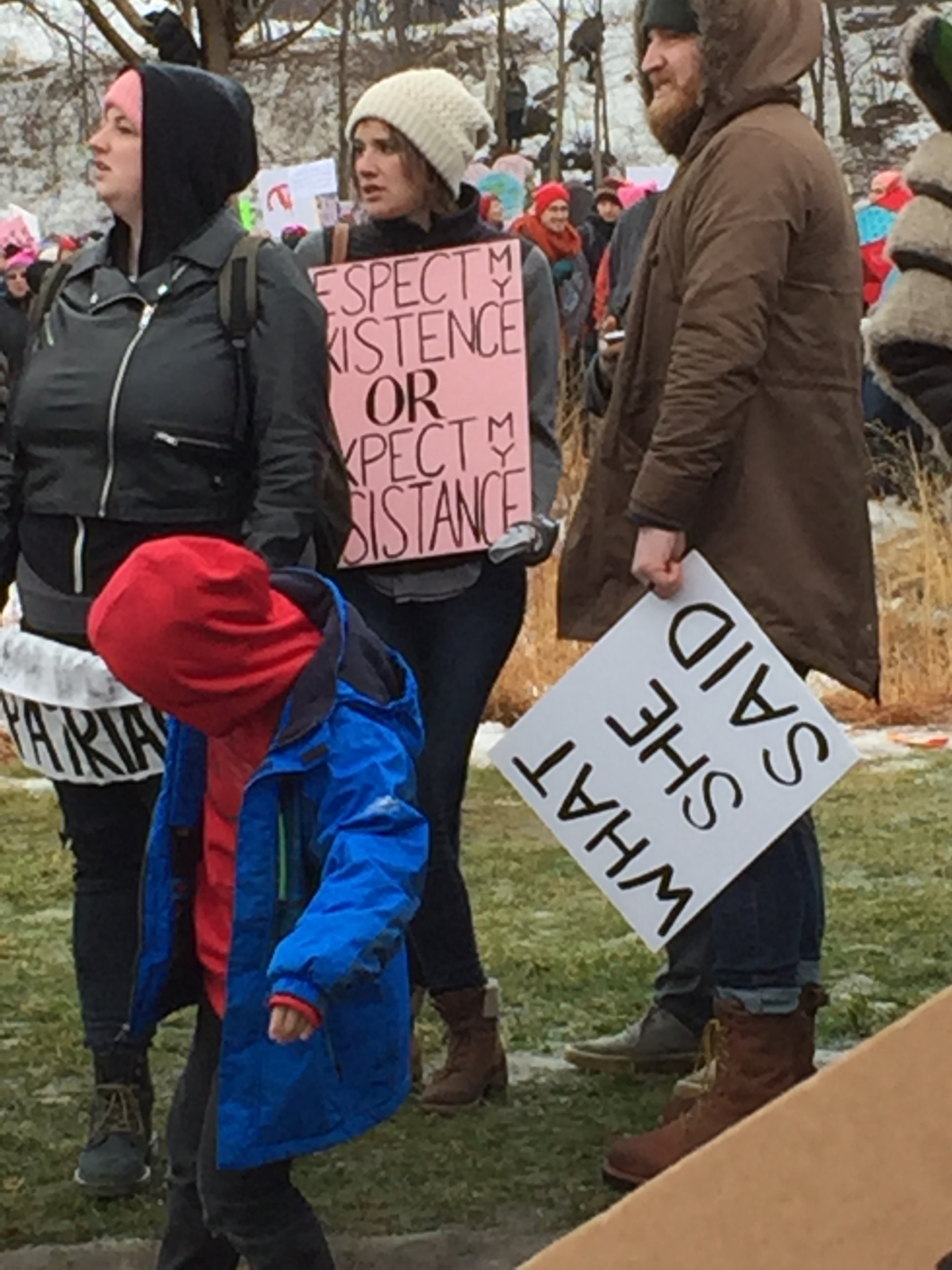
    Signs at Women’s March – MN

    My upbringing discouraged political activism.

    I was 12 in 1967 when race rioting began in Detroit and Toledo, my hometown. My father was a fire chief and reported that rioters were throwing rocks and bottles at firefighters. He was angry and I was scared. Although I didn’t agree with the violence, looting and burning, the civil rights movement made me aware that blacks were often treated unfairly, which might prompt them to anger and rioting. Despite that insight, at 12 years old, I was more worried about my father’s safety than anything else.

    I was 15 on May 4, 1970, when, after days of Vietnam War protests, four students were killed and nine were wounded by National Guardsmen at Kent State University several hours from my home. As a WWII veteran, my father disagreed with the war protests, and at dinner on the evening of the shootings, he denounced the campus lawlessness. My mother staunchly agreed with him. My college-age brother and younger sister didn’t comment. I was in sympathy with the protesters, but kept silent.

    My primary impression of protests and marches was that they could easily turn violent—something I wanted no part of.

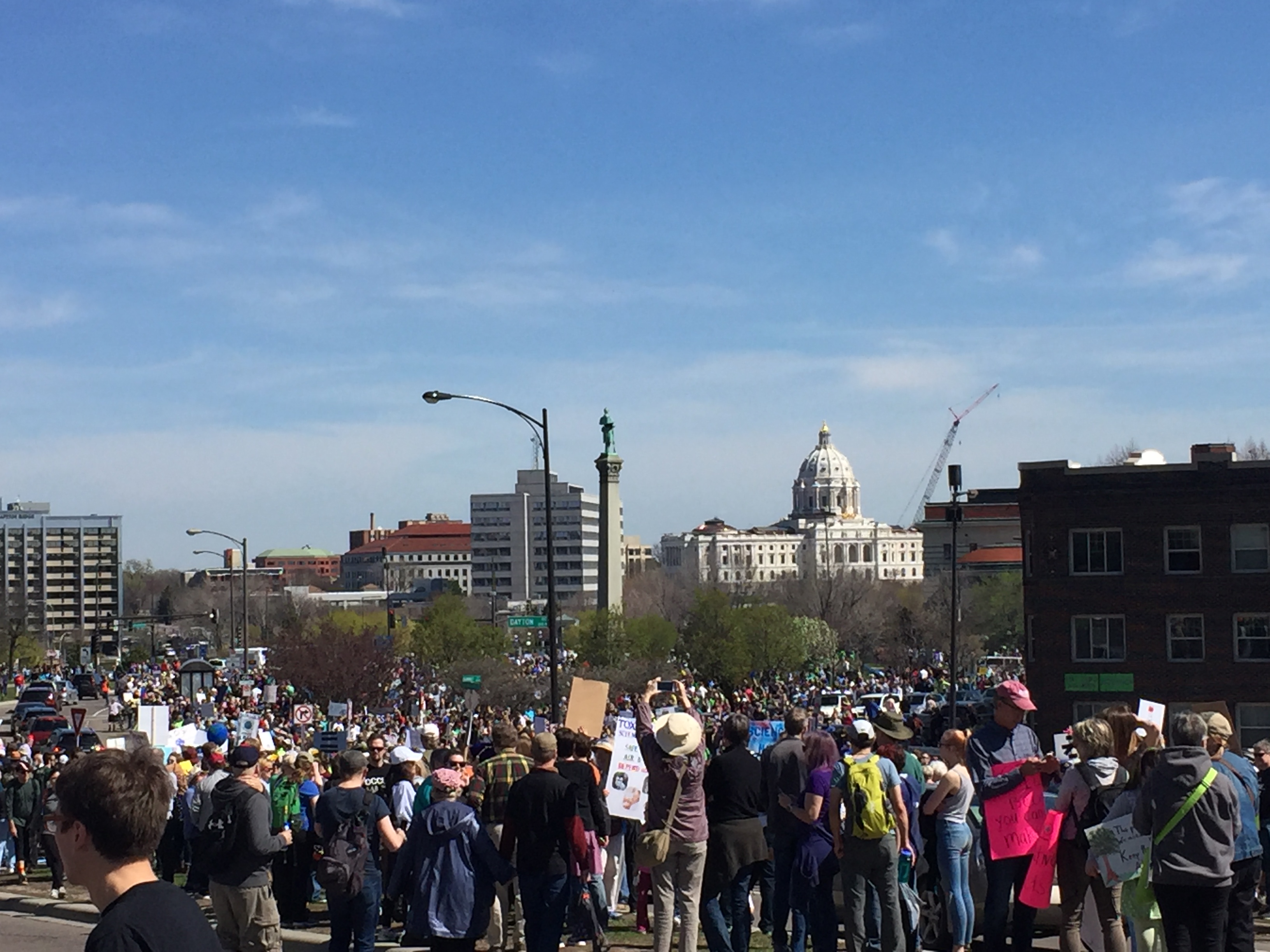
    So why at 62, did I join 100,000 like-minded people at the Women’s March in St. Paul in January? And 10,000 people for the March for Science -MN on Earth Day?

    Because I can’t bear to see 40-50 years of progress—on civil rights (race, gender, religion, and country of origin), women’s rights, and environmental protections—disappear.

    This just can’t be my generation’s legacy.

    I know full well that marching by itself doesn’t change anything. It’s just gesture, and that gesture has to be followed up with a sustained effort to create change. I’m prepared to do that, too.

    I believe that seeing the sheer numbers of marchers puts politicians on notice—we are a force to be reckoned with, and they serve us, not the other way around.

    A sea of marchers on at the Women’s March – MN on 1/21/17, including my son who was on crutches


    Earth Day March for Science – St. Paul


    I hope that other people who share my views and values will be heartened and moved to take action too.

    Marching makes me feel less powerless, more hopeful.