As we file federal taxes, think about how our leaders chose to spend our money. Not on highways or better schools or improved health, but on 3,000 armed and masked government agents sent into multi-cultural communities with near complete freedom to hunt for people who might be in the U.S. illegally. Wearing expensive military equipment. No warrants needed. No explanation of how their lists are assembled. Federal domestic abuse perpetrated on men, women and children, particularly if they do not have white skin. And extended to anyone blowing the whistle on the ICE action or filming the action or merely annoying the masked strangers.
Comfort is needed for people hiding in the occupied cities of Minnesota, for people brave enough to care for their neighbors’ needs, for all both here and abroad who have watched the loss of life and the trampling of basic human rights. For those who sing along with Bruce Springsteen’s “Streets of Minneapolis” and fear their own communities’ futures. Trauma exists far beyond the I-494-694 freeways.
Family and friends have fled the cities looking for safety and security and the ability to work. Some people just disappeared. They may have returned to other countries. They might be in a DHS facility. Or they could be living in your state. Thousands of individuals continue to feed, provide transportation, pay the rent of those in hiding. ICE may stalk caregivers’ homes as well. And our schools, teachers, staff, parents who patrol each morning and afternoon.
For those willing to walk in subzero weather and throw their bodies in the way of harm to protect a stranger or neighbor, how will we keep fighting for the United States we love? There isn’t any end date for what is happening. Did anyone think we would be facing these questions a year ago?
The answers are large, unknown.
One day at a time. One struggle at a time.
Whistles are still blowing on the streets of Minneapolis.
An enthusiastic three-year-old ran craft materials to the kitchen table. She had a project in mind, a puzzle to build out of tongue depressors.
I was not enthusiastic about the project which, as many projects, would lead to painting which might lead to painting herself. In fact, I was tired and working hard to be gentle as she taped sticks together. When a washcloth became necessary, I got it damp at the sink, looking at her head bent over a row of painted wooden sticks.
The oak table where she worked on a protected area was made in 1902 when Louis Cravillion married Octavia Orde, my paternal great grandparents. How I miss my Grandma Tavy. My grandmother died following childbirth, so Octavia cared for her grandson. As a woman of the age, I am now, she cared for me. I sat on one of these chairs while she braided my hair, ate meals she cooked, or colored. My mother worked in town.
After my great-grandfather died, we had moved in with her. My parents remodeled the kitchen and dining area storing this oak table for a new Formica and metal model. Eventually an apartment was finished upstairs so she would have her own place. The table returned. Eating breakfast in my designated chair, it was possible to watch everyone come to the new post office across Main Street. Patterns were cut to make clothes, cookie dough rolled out, homework completed.
After her death, the table was refinished and set up as my parent’s game table. As they downsized, it came to be mine. Our children ate and did homework and projects on a glass surface that protected the oak. Today’s artist is one of their children.
Stories of six generations of my family have been exchanged here. Men have returned from wars to a first home meal, baptisms and weddings celebrated, hard decisions made, children loved. Great grandma’s quiet and calm presence participated in half of its history. I see her hands now show in mine; her brown eyes look back from our mirrors. I can only hope I carry some of her wisdom to those who sit at this table, her blood mixed in their veins. I am not so tired.
“You are such a good mom.” Ah, I leaned in, these words meaning more to me than my friend could know.
I had been talking about the latest challenges with my young teen, where everything felt new, unfamiliar, and uncomfortable. I took a minute to let the words sink in. It was the kind of thing my mom used to tell me.
My mom and I talked frequently when my baby was a baby, me needing to hear the calm of her voice, steadied by years of mothering. She seemed to meet with ease all the challenges of raising four kids close in age. Or at least that’s the way it seemed to me.
By the time I became a mother, my mom had been a grandparent to nine already, the oldest in college and the youngest just into the double digits. I was late to the game and met motherhood with a fair amount of hand-wringing. Those early days were especially fraught-filled. Was my baby sleeping enough? Eating enough? Hitting all the right growth markers? There was so much to worry about.
My mom didn’t always know how anxious I was, but I would call her just to hear her voice. In my postpartum funk, I couldn’t tell her I was scared and lonely—I don’t know why—but I might instead give her a mundane update of how the day was going with my infant, hoping she could intuit my struggles. I was afraid of my own fear and questioned everything I did.
As my child grew, my mom was a steady source of reassurance and always wanted to know what my little one was up to. I would tell her some tale of my busy toddler, then preschooler, then elementary student. The stories were mostly amusing, but sometimes I was exasperated or uncertain. “You’re doing a good job, Brenda,” she would say. I’d always think, “Really?” It never felt that way. But she knew what I needed to hear.
~
I miss that. My mom is no longer here to comfort or commiserate, to offer hope for parenting through the teen years. She passed away right before the pandemic and right as my child was entering the tween years. Now I find myself among the many motherless daughters out there, feeling my way along. While I know that I am lucky to have had my mom for as long as I did, I still miss her and her unconditional support. And I really want to know how she made it through parenting four kids from infancy to adulthood—especially through the teen years.
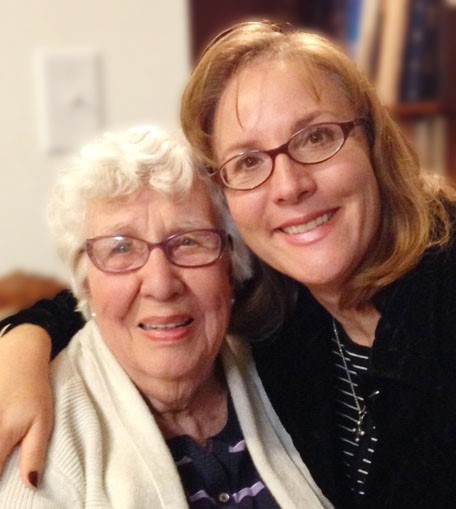
The author and her mom Lois.
She used to say that she had a lot of help, especially from my dad when we were all younger. And that having a lot kids close together was just what people were doing at the time. Now she would probably tell me she did the best she could and that she was far from perfect. And that she was also buoyed by a loose network of family, friends, neighbors, and others.
~
I wonder now what she would say about the precocious child who has turned into a strong and independent teenager. I imagine telling her of the latest tale and hearing her say, “Oh, Brenda,” lowering her voice on the “Oh” to add to the sense that she knew it was hard. Or maybe she’d shake her head and murmur words of commiseration. My child is much like one of my siblings, whose teenage years were punctuated by frequent conflict with my parents. Would my mom tell me she could understand the challenges of parenting an iron-willed but sensitive child? Or would she think of herself as a teenager, wishing that she had been nicer to her own mother? I never imagined my mom as a teenager but only as my mom and was surprised when she told me she regretted clashing with her own mom when she was young.
So perhaps this tells me that we never quite get it right and despite the anxiety, the self-doubt, the struggles, and even the loneliness, we are making it through.
My mother leaned on her own sisters, neighbors, friends, colleagues, and I am, too. I am banking on the collective wisdom of this vast community of mothers I am part of. They look like the friend who laughs with me and the one who offers a listening ear or a word of advice and then the one who just tells me I’m doing a good job.