Category: Books

  • Three Books at Once

    As a readaholic, I love getting lost in a story, whether fiction or memoir. A recent Strib article discussed reading two novels at once as a hedge against running out of books. Being without a book to read is terrible, but that’s not why I’ve begun reading several at once.

    For years, I read one book at a time, diligently plowing through like the good English major I was. Not only did I read one at a time, but I also doggedly finished what I started. 

    Now those rules don’t hold me. If I don’t enjoy a book I ditch it. Life’s too short to read books I don’t like. Especially since there are so many books I can’t wait to read (The Family Chao by Lan Samantha Chang, The Pages by Hugo Hamilton, Libertie by Kaitlyn Greenridge).

    Several things changed my habits.

    Thanks to my two books groups, I’ve read and enjoyed many books I might not have picked up on my own (e.g., We Have Always Lived in a Castle by Shirley Jackson, Grace by Paul Lynch). However, sometimes I’m lukewarm about the chosen book. I read it to be a good sport, but I start another book for fun. 

    Occasionally, I choose difficult books because I want to be better informed about race, aging, Millennials, or whatever. I’m committed to reading them and I learn a lot, but they’re not plow-through-able. Weighty subjects need to be taken in smaller doses. In between, there’s the pleasure of fiction. 

    I’ve also taken this approach with recent Nobel prize winners (The Buried Giant by Kazuo Ishiguro, The Last Gift by Abdulrazak Gurnah) and classic literature I read so long ago I’ve forgotten it (Jane Eyre by Charlotte Bronte). I read a little and mull it over, read some more.

    COVID and the heaviness of the world in the last six years have changed my habits. Being pinned in place away from my usual activities heightened my need for escape. The Pleasing Hour by Lily King and Perestroika in Paris by Jane Smiley took me away when I couldn’t travel.

    Often my concentration has been undermined in COVID-times, so I alternated literary fiction with mysteries/thrillers (State of Terror by Hillary Rodham Clinton and Louise Penny) or lighter stories (This Close to Okay by Leesa Cross-Smith, The Book That Matters Most by Ann Hood).

    A more recent phenomenon also supports my changed reading habits. Some nights I’m inexplicably sleepless for an hour or more. Then having several books to choose from helps.

    Now I’m unapologetic and unfussed about reading several books at once: (Hell of a Book by Jason Mott, Smoke Gets in Your Eyes and Other Lessons from the Crematory by Caitlin Doughty, Emma by Jane Austen). 

    How do you approach reading?
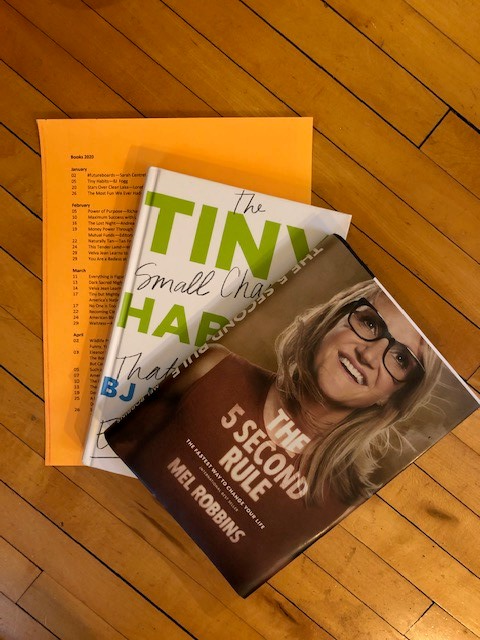
  • The Best Books I Read in 2020

    I’m no Oprah or Bill Gates, but like them, I create a yearend list of books that have impacted me. Most years, doing so is easy. Not this year.

    Thanks to the pandemic, instead of reading a book a week, I read more than twice that. These are a few that I found particularly absorbing, entertaining, thought-provoking or behavior-changing.

    Nonfiction

    The 5 Second Rule: Transform Your Life, Work, and Confidence with Everyday Courage by Mel Robbins. Despite the fact that she has a huge social media following and regularly appears on CNN, I’d never heard of Robbins until one of my friends sent me this book. The premise is simple: You need a get-started ritual to overcome your inertia. For Robbins, that ritual is simple: just count 5-4-3-2-1 and then act … get out of bed, send that email, clean the dirty sink. I’m amazed at how often the ritual has transformed my to-dos into ta-dones.

    Tiny Habits: The Small Changes That Change Everything by BJ Fogg. I was familiar with Fogg because I write a lot about behavior change, but I had no idea how powerful his approach could be. Essentially it’s a simple recipe: After I _________, I will __________. After I brush my teeth, I will do five pushups. After I get into bed, I will name three things I’m grateful for.

    Die with Zero: Getting All You Can From Your Money and Your Life by Bill Perkins. As a lifelong saver who has often put my future self ahead of my present self, this book opened my eyes to maximizing the value of my life experiences now, not at some distant point in the future when I may no longer have my health. And while I used to think that running out of money would be awful, I now think that having piles of it that I never got to enjoy would be even worse.

    Fiction

    Such a Fun Age by Kiley Reid. A fast-paced romp that made me slightly uncomfortable yet kept me laughing, this debut novel brought me face to face with inequities I, as a white woman in my 60s, barely have reason to notice. I enjoyed the flashbacks to high school and could relate to both the anger and embarrassment main character Alix experiences after having sex for the first time, and I walked away with newfound appreciation for all the nuances of discrimination.

    Velva Jean Learns to Drive by Jennifer Niven.The first in a series of three, this book, which I listened to rather than read, captured my heart as Velva Jean follows her mother’s dying wish that she “live out there in the great wide world.” In doing so, Velva Jean travels from an abusive marriage in Appalachia (the audiobook narrator does a great job of bringing the area’s accents to life) to the Grand Ole Opry. Along the way, she teaches herself to drive the bright yellow truck gifted to her by her brother Johnny Clay, who is also featured in the two subsequent books in which Velva Jean learns to fly and becomes a World War II spy.

    Stars Over Clear Lake by Loretta Ellsworth. Another historical novel, this book is set in the 1940s in Clear Lake, Iowa, where I used to gather with girlfriends each summer for an annual “no guys, no kids, no dogs” weekend that included a Saturday night dinner at the Surf Ballroom where much of the book takes place. The book—half love story, half mystery—explores the impact of buried secrets and the courage it takes to follow one’s heart.

    What books are on your best of 2020 list? I and my fellow Word Sisters would love to hear. Please share.

  • Affection for Collection

    “Madeline Kripke, Doyenne of Dictionaries, Is Dead at 76”

    That was the headline on a New York Times obituary that got me thinking about what it means to be a collector.

    Like Kripke, I have a collection of dictionaries. But unlike her collection, which took up her entire apartment and three warehouses, my collection—now that I’ve given away my two-volume Oxford English Dictionary and the magnifying glass it came with—consists only of a handful of paperbacks: The Pocket Oxford Dictionary, The Official Scrabble® Players Dictionary, Dorland’s Pocket Medical Dictionary, Cassell’s Compact Latin Dictionary and Drugs From A to Z: A Dictionary.

    As a writer, I refer to these and other dictionaries often. So normally I’d continue to hold on to them.

    But instead, I’m Marie Kondo-ing and letting go of what no longer sparks joy for me. In addition to the dictionaries and dozens of other books, I’m emptying shelves, drawers and closets that were once jam-packed with memory-provoking treasures—everything from journals and jewelry to purses, postcards and paintings.

    That said, I have several collections I’m not yet ready to part with: sea glass from my favorite beach, postcards from places I’ve traveled, prayer cards from funerals I’ve attended and just about every handwritten letter I’ve ever received. For now, I’ll be hanging on to them, in large part because I still value the memories they evoke.

    Taking inventory of my collections also has me thinking about my family and friends and what they collect.

    My sister Karen, for instance, collects ceramic chickens for her kitchen, while my sister Diane collects nativity sets from places she travels. My cousin Mary Ann, a quilter, collects fabric.

    Writer Cathy Madison, inspired by the pleasant memory of a green polka-dot clothed clown she used to carry as a child, collects clowns. And while fellow Word Sister Ellen Shriner doesn’t consider herself a serious collector, she does have half a dozen perfume bottles she thinks are pretty.

    My friends Diane and Alan, on the other hand, get a kick out of a bathroom basket of “weird things” they’ve collected from the sea, including broken exoskeletons and some mystery items they can’t even identify. The items bring back fond memories of past vacations and spark debates over who dove down to collect what.

    My friend Susan uses her journals to collect nametags from the events she attends, while my colleague John has spread his collection of vintage radios, which range from hip transistors from the 60s to large wooden consoles, throughout his house.

    Regardless of what we collect, our collections put us in touch with our past selves and sometimes with our hopes and dreams for the future. They also offer an ever-ready way to experiment with arranging, organizing and visually presenting ourselves and our experiences to ourselves, as well as to family and close friends.

    While I have valued and enjoyed my collections, many of which I began in my early 20s, some now feel more like clutter. I’ve even occasionally wondered if instead of being a thoughtful collector, I’ve crossed the line and become a haphazard hoarder. One reason is because I’ve moved some of my collections—once neatly organized and creatively displayed—willy-nilly to storage closets in my basement.

    Plus, I’m feeling weighed down by my possessions. I’m traveling more and beginning to think about downsizing, so I’ll likely set several more of my collections free in the weeks and months ahead. One reason is because isolating at home due to the coronavirus makes it easier to sift and sort, reflect and reassess.

    Do you have something special you collect?

    If so, what is it and why did you start collecting in the first place? How does your collection make you feel? Are you still adding new items, or have you, like me, begun sifting through your collection with an eye toward curating or even curtailing it? Please share.