Category: book lovers

  • Holiday Presents

    In response to queries about what I might like as a holiday or upcoming birthday present, I am wondering if I have hit “that age” or developed a stronger sense of being part of the universe?

    With the evil spreading in our country that has stripped families apart or made the simple costs of food, shelter and other necessities too expensive for others, how can I want anything? If I need to think about creating a list for days, I think I know the answer

    First, my deepest wishes: food, safe shelter, healthcare and education to be accessible in our country. People with compassion, wisdom, morals, the ability to use real language when talking, willingness to listen, commitment to collaborative decisions to lead government at all levels, in all nations. Narcissistic strong men be removed from positions of influence or power.

    On the personal level: A giant gift would be securing my family’s futures so that those of us aging don’t burden the younger, the middle generation continue to live the modestly comfortable lives they have achieved, the children reach maturity in a country that has found its way back to peace and prosperity while honoring the Statue of Liberty‘s invitation. It would be grand to find a small house for our last decades and free our family home for a family.

    But if my stumbling over the gift question is about approaching “that age” and actual physical items must be named, my gift list is simple: warm socks, two books, a box of English Toffee, framed photos, individual time with each family member in the coming year, donations made to food shelves.  

    Add new pajamas and a couple of white long sleeve polo shirts, this might have been my father’s list twenty years ago when he was the age I am now. And he is a good reminder of what holiday presents should include. He was someone who gave to others at holidays: food boxes we packed, a canned ham, cookies we baked, wrapped toys, sweaters and pajamas for others’ children, cash in a card, and because it was Wisconsin sometimes a bottle of brandy. 

    Time to get busy.

  • Disappearing—The Joy of Reading?

    I was sad to hear a book group friend say her 11-year old-granddaughter didn’t consider it a treat to go to a bookstore to choose a book—she doesn’t read books. I was slow to realize the books I’d been gifting my 10-year-old niece weren’t a hit. Not because I’d chosen boring stories but because she doesn’t enjoy reading. It saddens me they won’t have the pleasure of being immersed in the imaginary worlds I have so enjoyed.

    Although it sounds counterintuitive, fiction presents truths through the lives of made-up people.

    I’ve learned about worlds I wouldn’t have access to any other way. Through novels, I’ve entered the lives of a Black Texas Ranger, an 15th century Chinese physician, an escaped enslaved woman, a modern-day reporter in India, Korean deep-sea divers, and more. I’ve gained insight and empathy by seeing cultures beyond my own and feeling the dilemmas of people unlike me. Memoirs also offer me inspiration and perspective for my own life.

    Recently, the disinterest in reading novels and the related inability to read whole books has been receiving attention. Several theories may explain the change.

    Instead of reading whole novels, many middle school students read excerpts and are tested on their ability to write critical analyses of the excerpts. To be sure, critical analysis is an important skill, but it appears to have the unintended consequence of editing out the joy of completing a good, satisfying story. 

    Reading whole novels requires skills many high school students aren’t taught. They grow bored, can’t follow the plot, and don’t connect to the characters or themes.

    That puzzles me, because TV and movies still engage us. With “Game of Thrones,” “Succession,” or “Slow Horses,” viewers enter into invented worlds and can track the plot and characters, so why not in novels and memoirs, whether paper or Kindle books? Perhaps nonreaders have lost the ability to imagine. With TV and movies, the visuals are supplied.  

    Shorter attention spans are also part of the problem, and students aren’t alone in this. Myriad distractions clamor for our attention and our culture serves up lots of information in short bits—texts, Instagram posts, 35- to 50-word news summaries. In 20 minutes, I might read a dozen short clips instead of one 3,000-word article. Constant interruptions have diminished my powers of concentration. I can still enjoy a 400-page novel, but these days, I get restless and impatient with longer novels.

    I learned to love reading whole stories as a girl when there were far fewer distractions. At 8 years old, I draped myself across an upholstered chair and devoured Nancy Drew mysteries. By 14, it was Daphne du Maurier. Often, I wonder about the characters in novels I’m reading and am eager to find out what happens next. 

    I wish my niece, my friend’s granddaughter, and their peers could experience the gift of being immersed in good books. The joy of being transported to another time or culture. The hours of pleasure, escape, and knowledge.

  • The Best Books I Read in 2020

    I’m no Oprah or Bill Gates, but like them, I create a yearend list of books that have impacted me. Most years, doing so is easy. Not this year.

    Thanks to the pandemic, instead of reading a book a week, I read more than twice that. These are a few that I found particularly absorbing, entertaining, thought-provoking or behavior-changing.

    Nonfiction

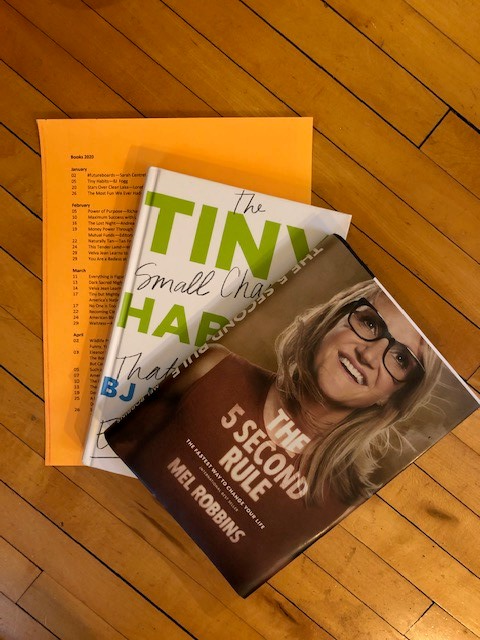
    The 5 Second Rule: Transform Your Life, Work, and Confidence with Everyday Courage by Mel Robbins. Despite the fact that she has a huge social media following and regularly appears on CNN, I’d never heard of Robbins until one of my friends sent me this book. The premise is simple: You need a get-started ritual to overcome your inertia. For Robbins, that ritual is simple: just count 5-4-3-2-1 and then act … get out of bed, send that email, clean the dirty sink. I’m amazed at how often the ritual has transformed my to-dos into ta-dones.

    Tiny Habits: The Small Changes That Change Everything by BJ Fogg. I was familiar with Fogg because I write a lot about behavior change, but I had no idea how powerful his approach could be. Essentially it’s a simple recipe: After I _________, I will __________. After I brush my teeth, I will do five pushups. After I get into bed, I will name three things I’m grateful for.

    Die with Zero: Getting All You Can From Your Money and Your Life by Bill Perkins. As a lifelong saver who has often put my future self ahead of my present self, this book opened my eyes to maximizing the value of my life experiences now, not at some distant point in the future when I may no longer have my health. And while I used to think that running out of money would be awful, I now think that having piles of it that I never got to enjoy would be even worse.

    Fiction

    Such a Fun Age by Kiley Reid. A fast-paced romp that made me slightly uncomfortable yet kept me laughing, this debut novel brought me face to face with inequities I, as a white woman in my 60s, barely have reason to notice. I enjoyed the flashbacks to high school and could relate to both the anger and embarrassment main character Alix experiences after having sex for the first time, and I walked away with newfound appreciation for all the nuances of discrimination.

    Velva Jean Learns to Drive by Jennifer Niven.The first in a series of three, this book, which I listened to rather than read, captured my heart as Velva Jean follows her mother’s dying wish that she “live out there in the great wide world.” In doing so, Velva Jean travels from an abusive marriage in Appalachia (the audiobook narrator does a great job of bringing the area’s accents to life) to the Grand Ole Opry. Along the way, she teaches herself to drive the bright yellow truck gifted to her by her brother Johnny Clay, who is also featured in the two subsequent books in which Velva Jean learns to fly and becomes a World War II spy.

    Stars Over Clear Lake by Loretta Ellsworth. Another historical novel, this book is set in the 1940s in Clear Lake, Iowa, where I used to gather with girlfriends each summer for an annual “no guys, no kids, no dogs” weekend that included a Saturday night dinner at the Surf Ballroom where much of the book takes place. The book—half love story, half mystery—explores the impact of buried secrets and the courage it takes to follow one’s heart.

    What books are on your best of 2020 list? I and my fellow Word Sisters would love to hear. Please share.