Category: authors

  • The Best Books I Read in 2020

    I’m no Oprah or Bill Gates, but like them, I create a yearend list of books that have impacted me. Most years, doing so is easy. Not this year.

    Thanks to the pandemic, instead of reading a book a week, I read more than twice that. These are a few that I found particularly absorbing, entertaining, thought-provoking or behavior-changing.
    Nonfiction

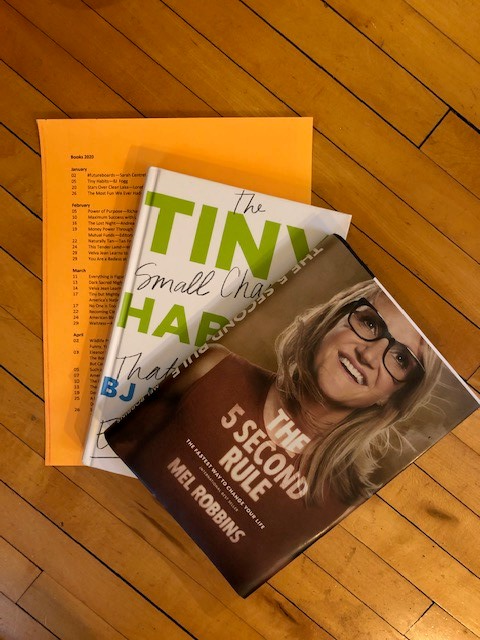
    The 5 Second Rule: Transform Your Life, Work, and Confidence with Everyday Courage by Mel Robbins. Despite the fact that she has a huge social media following and regularly appears on CNN, I’d never heard of Robbins until one of my friends sent me this book. The premise is simple: You need a get-started ritual to overcome your inertia. For Robbins, that ritual is simple: just count 5-4-3-2-1 and then act … get out of bed, send that email, clean the dirty sink. I’m amazed at how often the ritual has transformed my to-dos into ta-dones.

    Tiny Habits: The Small Changes That Change Everything by BJ Fogg. I was familiar with Fogg because I write a lot about behavior change, but I had no idea how powerful his approach could be. Essentially it’s a simple recipe: After I _________, I will __________. After I brush my teeth, I will do five pushups. After I get into bed, I will name three things I’m grateful for.

    Die with Zero: Getting All You Can From Your Money and Your Life by Bill Perkins. As a lifelong saver who has often put my future self ahead of my present self, this book opened my eyes to maximizing the value of my life experiences now, not at some distant point in the future when I may no longer have my health. And while I used to think that running out of money would be awful, I now think that having piles of it that I never got to enjoy would be even worse.

    Fiction

    Such a Fun Age by Kiley Reid. A fast-paced romp that made me slightly uncomfortable yet kept me laughing, this debut novel brought me face to face with inequities I, as a white woman in my 60s, barely have reason to notice. I enjoyed the flashbacks to high school and could relate to both the anger and embarrassment main character Alix experiences after having sex for the first time, and I walked away with newfound appreciation for all the nuances of discrimination.

    Velva Jean Learns to Drive by Jennifer Niven.The first in a series of three, this book, which I listened to rather than read, captured my heart as Velva Jean follows her mother’s dying wish that she “live out there in the great wide world.” In doing so, Velva Jean travels from an abusive marriage in Appalachia (the audiobook narrator does a great job of bringing the area’s accents to life) to the Grand Ole Opry. Along the way, she teaches herself to drive the bright yellow truck gifted to her by her brother Johnny Clay, who is also featured in the two subsequent books in which Velva Jean learns to fly and becomes a World War II spy.

    Stars Over Clear Lake by Loretta Ellsworth. Another historical novel, this book is set in the 1940s in Clear Lake, Iowa, where I used to gather with girlfriends each summer for an annual “no guys, no kids, no dogs” weekend that included a Saturday night dinner at the Surf Ballroom where much of the book takes place. The book—half love story, half mystery—explores the impact of buried secrets and the courage it takes to follow one’s heart.

    What books are on your best of 2020 list? I and my fellow Word Sisters would love to hear. Please share.

  • Celebrating the WordSisters

    This month, the WordSisters celebrate eight years of blogging and sharing our love of words and stories.

    Why a Blog?

    The WordSisters name came from our longstanding writer’s group (Elizabeth, Jill, Brenda, Jean, Rosemary, Lisa, and me). Several of us were working on books and the first tagline, “In it together from inspiration to publication,” reflected the blog’s original purpose.

    In 2012, Elizabeth and I had memoir manuscripts we hoped to publish. Experts recommended blogging as a way to attract agents and publishers. In 2016, North Star Press published Elizabeth’s memoir, House of Fire.

    Create. Connect. Inspire.

    Early on, Elizabeth and I were the primary bloggers. Attracting agents and publishers was our original motivation, but soon we were blogging for the pleasure of writing. We had things to say and stories to share. Plus, the discipline of contributing several blogs per month kept us writing. Some have been classic blogs; others are short personal essays. The blog’s tagline evolved to “Create. Connect. Inspire.”

     Since 2012, Our Circle Has Grown.

    Through the years Jill, Brenda, and Jean have also contributed. Cynthia, author of five novels and coauthor of 40 Thieves on Saipan joined us in 2017. Bev, author of What Do You Really Want? How to Set a Goal and Go for It! A Guide for Teens added her voice this year. Now the WordSisters is a collection of voices—each with a distinct style.

    The joy of writing brought us together under the banner of WordSisters. At eight years and counting, we’re still going strong.

    Thank you to our followers (4,900 now). Your likes, comments, and support mean so much!


  • Your Future Self Will Thank You


    Back in 2014, I attended a lecture at the University of Minnesota’s Center for Spirituality and Healing. The speaker was Kelly McGonigal, an author and health psychologist who teaches The Science of Willpower, a popular Stanford University course.

    According to McConigal, one of our biggest mistakes when making decisions is not picturing our future selves and how the decisions we make today will impact us in the years ahead.

    That’s one reason why so many people put off doing things that could make a big difference in the decades to come: eating well, exercising regularly, maintaining friendships, saving for retirement and other actions that research has shown makes a big difference to quality of life as we age.

    One way to set up your future self for success is by getting in touch with your hopes and dreams. I’ve been keeping a bucket list of mine for decades.

    But because that list has gotten unwieldly—in large part because it now serves as a catch-all for everything from climbing Mount Kilimanjaro to taste-testing brandy Manhattans to building a cabin with my partner Steve to visiting the world’s most beautiful libraries—I also now keep an index card on which I’ve written just 10 things I want to accomplish in the next 10 years.

    Even if I cross only one item off my index card every year for the next 10 years I’ll have a few accomplishments my future self will be able to look back on with pride as well as some experiences she can recall fondly.

    Manifesting Me

    Some years, I’ve called my future self into focus by giving her a name that had to do with one of my goals. One year, she was Author Artist. Shortly after, I signed a contract for my first book and become a real-life author.

    I’m not the only one who uses names to bring the future into focus. On a recent episode of the Meditative Story podcast, music producer Larry Jackson shared a story about his work with Jennifer Hudson. On the day of their recording session, she arrived with two Pomeranians. One was named Oscar. The other Grammy. Admitting his cluelessness, Jackson asked her why she’d chosen those particular names.

    Hudson’s response: “Well, I won an Oscar already and now we about to win a Grammy, ain’t we?” They did, and perhaps having two four-legged reminders of her future self-played a role in making that dream come true.

    There are also other ways to call our future selves into focus. Journaling and dream boards are two common methods, but one of my favorites is by projecting yourself into the future.

    One of my friend’s friends did that recently. She’s always dreamed of working for Spanx. So, one day, when in Atlanta for business, she spent an hour sitting in the Spanx lobby, picturing what it would be like one day if her future self really did work there.

    Ready, set … age

    Another tool that’s helped me get in touch with my future self is AgingBooth, a free face-aging app that lets you fast-forward your looks. Seeing what I might look like in 2050…when I’m 92…has helped me realize how much I’m looking forward to becoming my future self.

    Will she be kinder? Still able to play 18 holes of golf. Eager to discover new authors? Finally rid of her bad habits.

    What about you? How do you bring your future self into focus?

    Me in 2020, at age 62
    Me in 2050, at 92