Category: American Culture

  • Trying Hard to Embrace Winter (even though I hate being cold)

    Trying Hard to Embrace Winter (even though I hate being cold)

    Although this week is a blessed reprieve, winter came WAY too early to Minnesota. This year, we had high temps in the mid-20s on Veteran’s Day and by mid-month we had single digit lows. And snow. Jeesh.

    This unwelcome weather called for drastic rethinking of my usual approach: gritting my teeth, hunching my shoulders against the cold, and waiting for it to be over. Instead, I’m trying to embrace winter and focus on what I do like. So here goes—

    Drinking hot tea – Holding a hot mug full of tea warms you up. Drinking it warms you up even more. I don’t see much of my favorite mugs during summer, so it’s a treat to pull them out. I stash the peppermint and green tea with blueberry (good as iced tea) in favor of Celestial Seasonings Candy Cane Lane and Gingerbread Spice—teas that are sold only in winter.

    Eating homemade soup and stew – Stew is such an ugly word for the wonder that is Guinness stew (tender chunks of beef braised for hours in a rich beer and onion gravy served over champ – an Irish version of mashed potatoes made with green onions) or Hungarian goulash – not the hamburger hotdish, but beef simmered with spicy paprika and onions. Chicken mole chilé – spicy with a hint of cocoa – the taste is rich with nothing sweet about it. Tortellini soup with chunks of carrots, zucchini, and Italian sausage. Mmmmm.
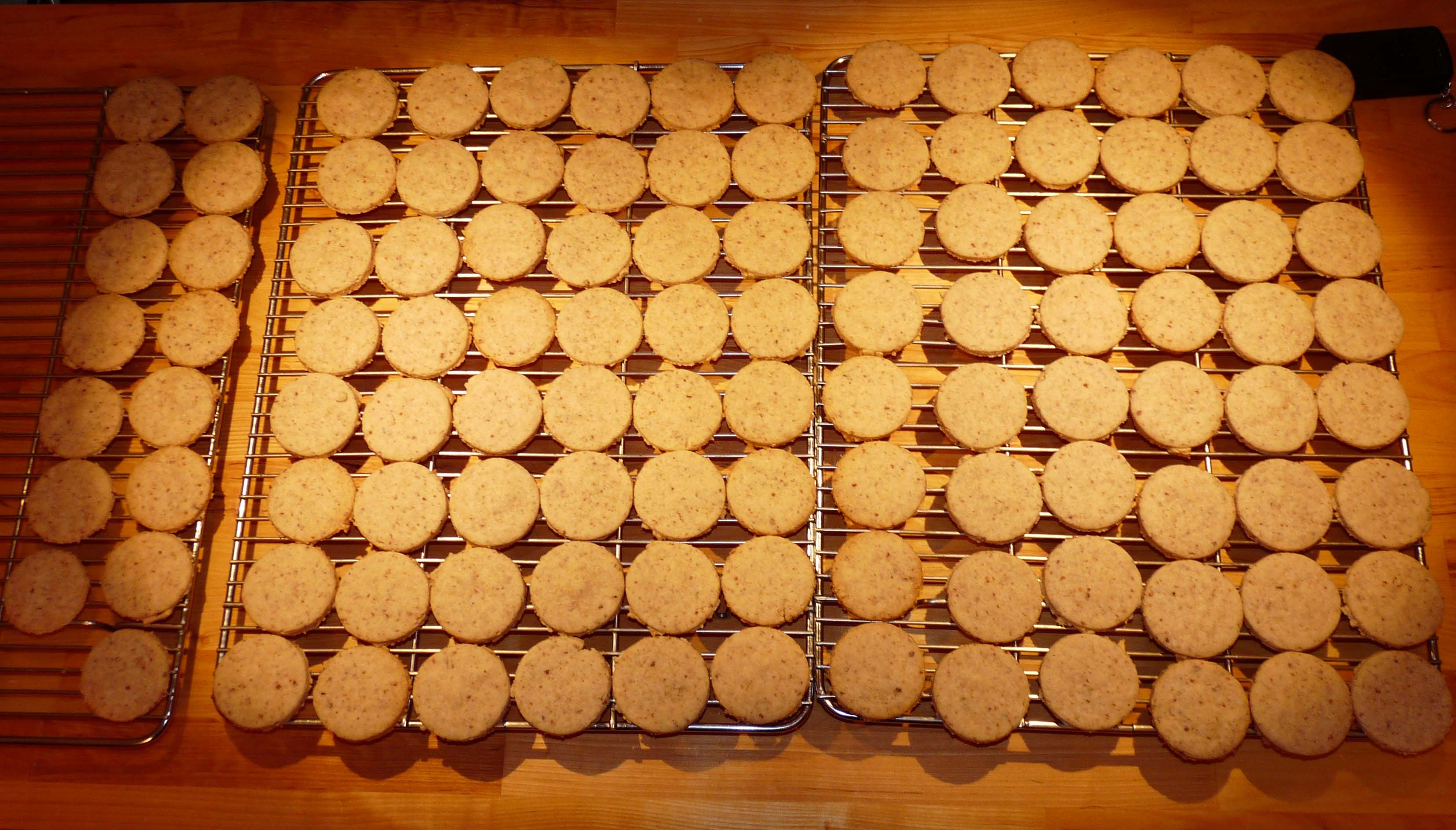
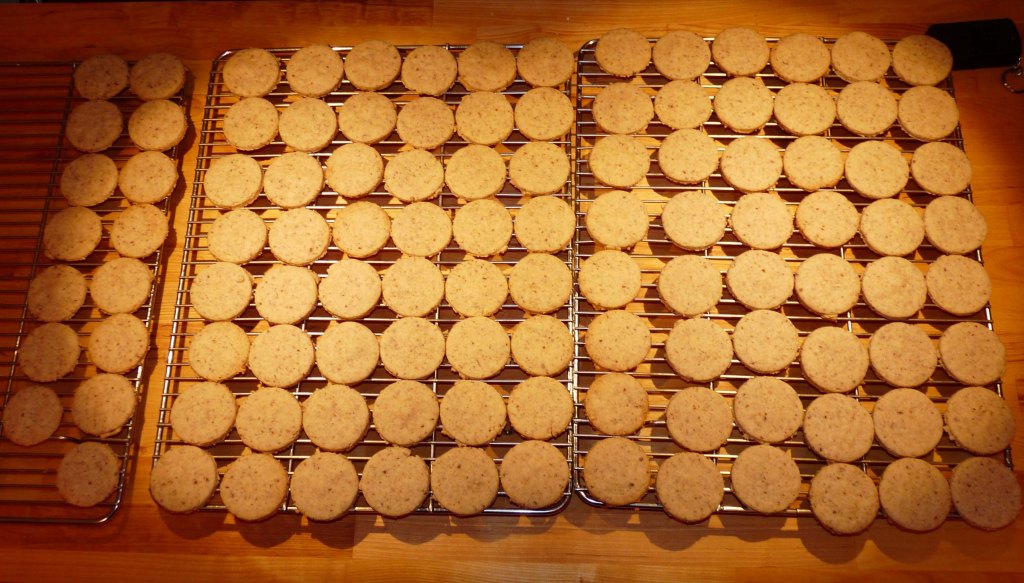
    Spitzbuben are sandwich cookies made with ground pecans, butter, flour and sugar. Raspberry jam holds them together. Don't tell my husband there's one missing! Quality control.
    Spitzbuben are sandwich cookies made with ground pecans, butter, flour and sugar. Raspberry jam holds them together. Don’t tell my husband there’s one missing! Quality control.

    Baking Christmas cookies – Maybe I should really say eating Christmas cookies since that’s mostly what I do. My husband is a whirling baking dervish who makes dozens of breads, spitzbuben, chocolate cherry espresso drops, spicy peanut butter cookies dipped in chocolate, and almond bars, while all I usually manage to make is a batch of ginger cookies and frosted sugar cookies.

    Watching TV shows while I exercise (re: cookies) – While I log miles on the treadmill, I catch up on the TV shows I never watch from April through October. I love going to the movie theater to see the year’s best movies. Plus, Mad Men and Downton Abbey resume in January (geeky fun – I can’t wait!)

    Wearing Smartwool sox – OMG are they expensive, but they work. My feet are warm and dry. So worth it. So are silk long johns, a puffy down coat, shearling boots, mittens, and earmuffs. Yes, I’m aware that by New York standards I’m one big walking Fashion Don’t. And I get tired of putting on all of that, but I hate being cold even more, so look out for the hot pink parka headed your way – that’s me.

    lightsSeeing Christmas lights, moonlight on snow, sundogs on January mornings – Yes, I hate that it’s full dark at 5:00 p.m. in December, but there’s something so fanciful about Christmas lights—they help tamp down the gloom. To me, it’s magical when the moon reflects off the snow and casts blue shadows—so occasionally I’m willing to don all of the gear described above so I can walk on a quiet winter’s night. Blue shadowsSundogs (flame-shaped rainbows that flank the rising sun like parentheses) appear only in the dead of winter when it’s really cold—a small compensation for being up early when it’s minus 20.

    I haven’t completely lost my mind. I still hate tear-your-face-off winds, shoveling snow, icy sidewalks, slushy streets, sooty snow clumps chunking off my car and hulking in the garage. And no, I’m not a skiing, skating, snowmobiling, ice fishing nut. But winter does have its rewards and if I’m going to win this battle against Mother Nature, I have to outwit her. Starting now. With Irish coffee – the kind with Bushmills and whipped cream.

    How do YOU cope with winter?

  • Celebrating the Gift of American Citizenship

    Sometimes I get discouraged about trends in American culture and politics. But recently, I was privileged to be a part of a U.S. citizenship celebration that pierced my cynical armor and helped me remember that it is good to be an American.

    Arwa, a middle-aged Jordanian immigrant, brought a feast to the adult English language learners’ (ELL) class where I tutor. She had just passed her American citizenship test, and she wanted to celebrate with her classmates and teachers.Screen Shot 2014-04-17 at 10.53.18 AM

    Learning English is hard. Every time students open their mouths, they’re likely to mispronounce a word, mix up the tense of a verb (I has a cold), mangle an idiomatic expression (We make party for my son), or be misunderstood because their accents are so heavy. They’re subject to constant corrections. To succeed, students have to be thick-skinned and persistent.

    Steve, who teaches the class where I volunteer, sets a supportive tone. He leads the students in cheering and clapping for each other. They understand each other’s embarrassment, so they are encouraging and kind—no mocking.

    We are teaching American culture as well as language, so we try to foster acceptance of other people’s customs, too. Steve sets up teams so African, Central American, Asian, Middle Eastern and Eastern European students must interact with each other and take part in playful competitions.

    So when Arwa passed her citizenship test, it was natural for her to celebrate with her classmates. The other students know how hard it is to persist. Everyone is far from home and misses their family, their food and customs from home, and the ready access to people who understand their worldview. They understand what it means to let go of allegiance to a homeland and embrace a new country.

    Sharing food is the language we all understand, so Arwa brought chicken shawarma, homemade hummus, lemon yogurt from scratch, little buns with a Middle Eastern version of pesto, salad, brown bread, and banana chocolate chip bread. She also had chunks of ham, salami and bologna as well corn chips, snack crackers, flour tortillas and soda.

    I worried briefly about how her classmates would respond to the food. Some eat meat, some don’t. Some eat pork, some don’t. The only hiccup was that we didn’t have forks. I watched Arwa spoon yogurt onto the bread so I put a dollop of yogurt onto a piece of tortilla. Soon the other students caught on and did the same. The North Africans (from Liberia, Somalia, Kenya, Egypt) recognized and relished the food. The Thai and Hmong students sampled more carefully, but were complimentary. The Hispanic students (from Mexico, Cuba, and Ecuador) spooned food into the tortillas and rolled them up. Everyone complimented Arwa on the food and thanked her. We all clapped and cheered for her because she is a citizen now.

    Throughout the spontaneous party, Arwa beamed. She is so proud to be an American citizen. I don’t know whether economic opportunity, war, love, or religious freedom (Islam is the majority religion in Jordan and she wears a necklace with a silver cross) brought her here with her husband and two children. It’s not the sort of thing we ask about in class.

    One time I helped her study for the citizenship test. I’m sure many native-born Americans would struggle with the test, and at times, I wasn’t always sure of the answers. She told me that she’d been studying for three years—that’s almost enough for a college degree. How many native-born Americans would work that hard to belong here?

    Arwa is so pleased and grateful to be an American. Perhaps she values it more because she worked to hard to achieve it. In the face of her accomplishment and pride, my cynicism about America’s shortcomings fell away, and my faith in the American dream was renewed.

  • When did cell phones become a cure-all for awkwardness and boredom?

    I sat in the classroom feeling awkward. The students were on break—some of them chatting in Chinese or Spanish, a relief for them after the rigors of learning English. Others were stretching their legs. I had 10 minutes until class resumed and I was once again a tutor.

    I reached for my cell phone and began checking emails. Not that I was expecting anything important, and indeed, none of the emails required my urgent attention. But I looked busy. Important, even.  Anybody looking at me might have thought I had vital emails that must be attended to NOW.texting

    When did cell phones become a cure-all for awkwardness and boredom? Why did I succumb to the feeling that I have to be connected and productive at all times?

    Before I became addicted to my electronic devices, I could amuse myself if I had a spare 10 minutes. Instead of isolating myself from interactions by fiddling with my phone, I might have wandered around and talked with someone. Maybe not my students. They’d be polite, but sometimes they need a break from “Teacher,” as they call me. But I probably would have found someone from another class.

    Or if I wasn’t in the mood to talk, I might have gone for a walk. I could have quietly thought my own thoughts without needing to look busy. I might have sat in the atrium people-watching. The clothes, faces and manners of the new Americans who are learning English tell a story—something the writer in me finds interesting.

    Before cell phones became so widespread, I would have thought it was fine to spend time doing nothing much. If I really really wanted to be productive, I could have planned dinner and made a grocery list.

    But none of those options occurred to me, because without meaning to, I have learned to engage with my device instead of with people. And I’m not alone in this behavior. A recent study of college students in 10 countries found that they “literally didn’t know what to do with themselves” when they had to live without their smartphones and other electronic media for 24 hours. And Arianna Huffington acknowledged this issue when she issued her challenge to unplug for seven days.

    With my cell phone handy, I don’t have to risk the slight discomfort of exchanging pleasantries with people I don’t know. I can talk with people who are far away, but I’m less likely to connect with the people close at hand.

    My phone rewards me with a sense of purpose—fake busyness in this case—but it helps me pass an awkward or boring moment. And it’s always there. Somehow I’ve let myself get sucked into feeling that because I can be connected, I must be connected. Really? Why? I didn’t need to know right that minute that my online order had shipped or that a blogger I like had posted something new.

    Don’t get me wrong–I’m not getting rid of my cell phone any time soon. Cell phones have vastly improved many kinds of communication. But I do want to restore my ability to cope with boredom and discomfort without resorting to my phone. I do want to be more mindful of the ways cell phones can isolate people instead of connecting them.