Recently, Lauren Griffiths went viral when she replaced her “professional” LinkedIn headshot with one that better reflects her current situation as a human resources consultant who’s working remotely. She proposed that looking authentic is powerful and ultimately more valuable than presenting a “perfect” image. The longstanding ideas about “looking professional” remain powerful, although many people resent and resist those guidelines. Her post led me to consider: What image do I want to project?
When my career was still active, I was well aware of the need to look polished. Looking younger would be even better, since the working world can be disrespectful of older women. Young was no longer possible (!) but I could manage youthful, especially if I colored my hair and wore attractive clothes and jewelry. Most women my age did the same.
Now, as a 66-year-old woman who’s retired from paid work, I no longer need to present a professional image or look any particular way beyond what pleases me. Griffiths wanted to present a more authentic professional image; women my age confront a similar dilemma. How do we present an authentic image as older women?
When and how do you allow signs of aging to show? Should I try to meet the world’s expectations for “attractive older woman”? In other words, look 55-ish until I’m 75? Do I try to hold the line at all costs? Should I continue highlighting my hair but skip surgery or Botox? Stop coloring my hair? Let go of the anti-aging fuss?
When Gloria Steinem turned 50, she threw a birthday party and declared, “This is what 50 looks like.” She looked good, which turned the idea being a crone at 50 on its head. 30 years later, she told the world, “This is what 80 looks like” while traveling in Africa—another example of aging well.
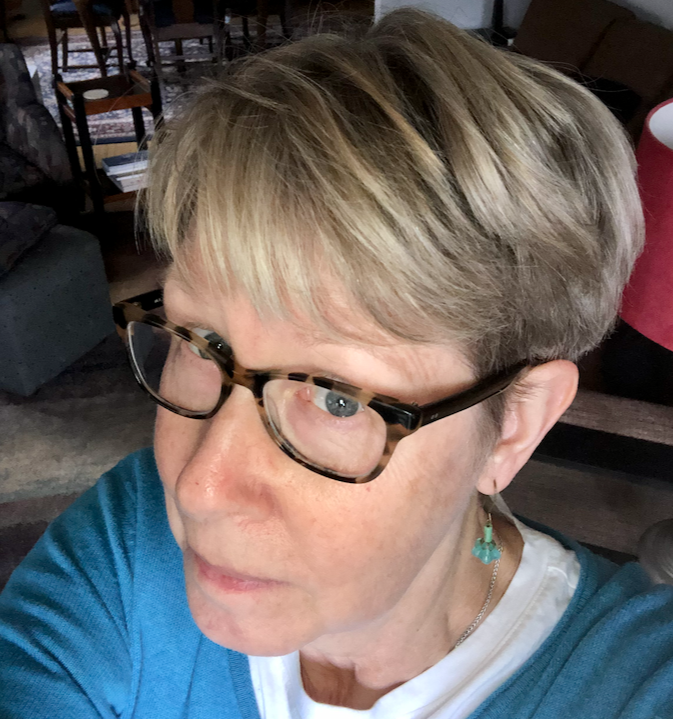
In transition: Blonde in front. Silver coming in in back.
My more modest version of her philosophy is to stop highlighting my hair. Pleasing myself will be the point, so I reserve the right to resume hair color if I prefer it. Either way, I will proudly say, “This is what 66 looks like.”
I first met Patty in 1978. We were both English majors at Drake University in Des Moines. I was in my early 20s, she in her mid-30s.
We didn’t have a lot in common.
I lived with a roommate I didn’t like in a campus dorm. She lived with her husband and young son in a four-bedroom house about 15 minutes away. I was a poor college junior who spent my weekends drinking beer that cost $1 a pitcher. She spent her weekends with her parents, swimming in their indoor swimming pool and sipping cocktails graced with fruit from their lemon and lime trees.
Both English majors, Patty and I were paired up on a class paper we worked diligently on to earn an A. I no longer recall what grade we received, but we became good friends in the process. She enjoyed hearing my stories about dorm life, and I liked hearing stories about her parents’ home and lavish lifestyle.
Looking back, what I think we enjoyed most was sharing our hopes and dreams with someone who not only truly listened, often for hours on end, but also believed in our ability to achieve those dreams.
A year later, in December of 1979, I graduated and moved back to Minneapolis where I went to work for the Minnesota Senate, first as a page and then as an intern researching DWI legislation.
In mid-August of 1980, out of the blue, I received a letter from Drake University’s English department offering me a graduate-school fellowship. In exchange for teaching two sections of freshman English and working 10 hours each week in the school’s writing lab, I would earn a master’s degree in English.
I wanted to accept the school’s offer, but I’d already spent all my savings getting my undergrad degree. And having been raised by a dad whose mantra was, “If you can’t pay cash, don’t buy it,” I was reluctant to take on more student debt.
But then Patty invited me to come live with her. And suddenly my dream of earning a master’s became a reality.
The rules for living at Patty’s were simple: two dos and two don’ts. Do empty the dishwasher each morning and do grocery shopping with her once a week. Don’t smoke pot in the house and don’t have sex with her husband (she’d once found him in bed with one of her best friends).
We quickly settled into a routine. Her husband dropped me off on campus on his way to work each morning, and Patty drove me home each afternoon after we had both finished our classes.
We read books and wrote papers, and spent our free time penning bad poetry, drinking beer (her husband worked at Coors) and frying ourselves in the sun.
We also talked a lot about our hopes and dreams. Mine started out modest, but she encouraged me to dream bigger and set goals. It was her encouragement that led me to set a goal of someday writing a book. (Decades later, thanks in large part to her, I did: a book on goalsetting that’s been translated into five languages and is helping young people around the globe set their own goals.)
I liked being part of Patty’s family. Quiet early mornings at the kitchen table sipping coffee and writing in our journals. Afternoons playing catch with her son or helping him with his homework. Weekends hanging out with her parents or her husband’s colleagues.
After 18 months, with classes complete, I moved back to Minneapolis.
For years, Patty and I talked often, regularly exchanged long stream-of-consciousness letters, some of which held our deepest desires and our darkest fears and visited one another now and again.
Eventually she and her husband divorced, and she moved to Arkansas. She also got sick: first with a mysterious disease that was never diagnosed, then with tuberculosis followed by heart disease. Along the way, she made me promise that I’d be at her funeral—no matter when or where—and that I’d make sure Lynyrd Skynyrd’s Free Bird was played.
But as the years passed, our letters got less frequent. And although we did come close to getting together in person a few years ago when I vacationed about 50 miles from her home, we never did as she’d woken up that day not feeling well and had to cancel.
I still wrote a couple of times a year. Sometimes I heard back, sometimes I didn’t. Then, I sent several letters that went unanswered. I wasn’t worried at first, but then sent a letter asking if I’d said or done something to upset her. When I still didn’t hear back, I wrote to her sister who called me immediately to tell me Patty had died several months earlier, most likely from a massive heart attack. Patty’s sister and son had wanted to tell me but didn’t know how to reach me.
There was no funeral. I’m glad, as I would have felt terrible missing it.
But I did download Free Bird to my phone. In honor of our friendship, I play it now and again, always with a heart full of gratitude to a forever friend who made a huge difference in my own life, not only by encouraging my early hopes and dreams but also by being the first friend who truly believed I could achieve them.
“How old are you?” The bike expert was putting a new battery into my cyclecomputer. How old am I? I wasn’t sure. I have had difficulty knowing how old I am. I’m going to retire next year at 63. On my birthday in September, I’ll be 62. I must be 61. 61 I told him.
“How much do you weigh?” I didn’t know that answer either. When was the last time I was on a scale? He must have taken my pause as a reluctance to reveal my weight. Before he could finish his explanation of why he needed my weight I made a guess and gave him a number.
On my bike ride home, I wondered, “If I didn’t color my hair, would that help me remember my age?” I don’t feel 61. If my hair was in its natural state, it would be completely silver or white. Maybe I’d look more my age. That is exactly why I have been coloring my hair for years in the first place. I didn’t want my children to have an old mother. I figured I’d wait until after they graduated from high school to go natural. Then the pandemic came. Now seems like a perfectly good time to work with all those feelings that grey hair will bring.
Sitting in the salon chair, I could see a family resemblance reflected in the mirror. I never wanted my mother or Aunt Annie to slide in and out of my face. With grey hair that might be exactly what I get.
Hiking up the ski hill, I imagined that our trip to Japan and our climb up Mount Fuji this coming July was still on. That trip may or may not happen. Like the rest of the world with this pandemic, my family and I are on a wait and see. Laboring for breath walking up the steep incline felt great. My entire body was committed to reaching the top. Once there I was graced with the Minneapolis skyline. I will continue to climb and descend regardless of COVID-19. Grey hair will certainly happen.