Category: aging

  • Mortal

    Daffodils and forsythia are in bloom here. Egrets and ducks have returned to the pond. We all made it through another winter, a difficult season with plenty of cold, snow, and ice. 

    When I was in my forties, I wrote a short story about a woman whose first serious high school boyfriend was drafted to serve in Vietnam. He would die in battle and be remembered as perpetually nineteen. She went on to college, married, had children. As her son prepares for junior prom, she is reminded of Bernie. On the anniversary of his death, she writes him a letter about what it has been like to age decades beyond her teens.

    Late in 2022, I prepared for serious surgery. The surgeon called me a ‘low risk’ patient and young for my physical age. Tests showed no other options. All was successful, except emotionally I landed in part of the world described in Atul Gawande’s Being Mortal.  He writes that we tend to consider aging a failure, or weakness, rather than a normal process. As we live longer and longer, medical processes becomes part of our experience. Doctors know how to preserve life, but not how to help patients cope with how life continually changes.

    Like most surgery nothing looks different to others, but I know where the scars are and what each means. I know the medications that support carrying me through a normal life expectancy. I am also learning their downsides. I haven’t returned to tap dancing because the studio floor is slippery, and I am still fighting to return to my prior rock-solid balance. Down dog is back on my aspirational list, but for different reasons than undeveloped muscles.

    In the weeks between the first time a doctor said, “maybe six months, certainly not more than a couple of years,” and the night before surgery, I thought about not seeing my granddaughters grow up, about the writing projects that might not be published, about my unwillingness to let life go. When I stopped pushing to be the person folks expect, my fatigue was immense. With surgery on the schedule, I slept a lot, read a lot, thought even more. Because I am used to being productive, I labeled that week practicing recuperation. 

    I have had friends die of cancer without the medical miracle surgery offered me. I am humbled and so respectful of how they faced the eventuality of their passing. 

    This spring I wonder how to make these next many years meaningful. A wise friend told me the body needs at least six months to recover from major surgery then encouraged me to give my emotions the same time. A good plan. I’ll enjoy the daffodils and forsythia, then the tulips and lilacs. The demands of regular life are close enough.

    With love to my brother, Darrell J. Frisque, who passed too young on April 14, 2007.
  • My First Attempt at AI-Powered Writing

    Artificial intelligence is all the rage, so I decided to use it to generate my February Word Sisters post.

    My request: write a rhyming poem for women 50+ about the joys of aging (though I also briefly considered “the realities of aging”).

    First I tried anyword.com, but didn’t love what it generated, so I turned to chatGPT. In less than 30 seconds, here’s what I received.

    As we age, we gain wisdom and grace

    Our wrinkles are lines that tell our life’s pace

    We’ve lived through hardships and moments so sweet

    And we’ve learned that life is a journey, not a defeat

    We no longer chase fleeting trends

    Instead, we embrace our truest friends

    Our bodies may change, but our spirits stay strong

    And we continue to sing life’s sweetest song

    We relish in the simple things

    Like watching the sun set, and what the day brings

    We find joy in a book or a warm cup of tea

    And appreciate the beauty in things we see

    We know that time is fleeting and precious

    So we take moments to pause and reflect, never reckless

    We find beauty in the moments we share

    And embrace every opportunity to show we care

    So let’s embrace this new chapter with pride

    And enjoy the joys of aging with every stride

    For we know that with each passing day

    We become wiser, kinder, and better in every way

    As a career writer, I’m still pondering how I might use AI-powered writing, but there is one thing I do know: I couldn’t have written a poem so quickly. And while I don’t think it’s a great or even a good poem, I do believe there’s value in not having to start with a blank page.

    Have you experimented with AI-powered writing? If so, what tools have you used and what’s been your experience?

  • The Clock is Ticking for All of Us

    Monday, November 10, 2036.

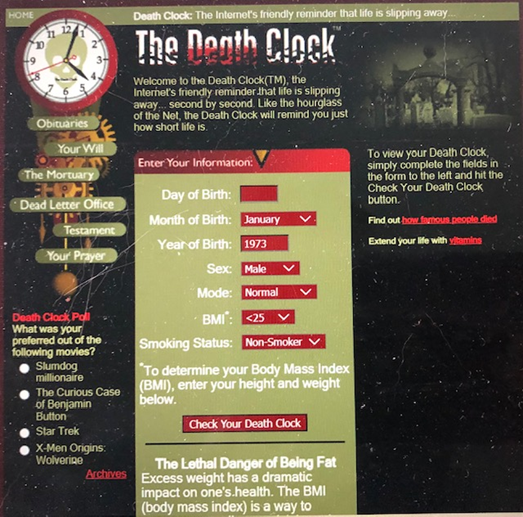
    That’s the day I’m expected to die according to DeathClock, billed as “the Internet’s friendly reminder that life is slipping away.”

    While I don’t believe my death will occur on that particular day and do hope I’ll live quite a bit longer than age 79, I find myself thinking both about the quantity and quality of the years I have left, no doubt prompted by the fact that I will turn 65 in a month.  

    On the short end of my projected lifeline, I think of my parents, both of whom died at age 70, my dad after a year-long battle with lung cancer (no surprise as he smoked for 50+ years) and my mom in an instant from a heart attack linked to Vioxx, the drug she was taking to help manage her arthritis (a drug reported to triple the risk of heart attack). If I die at their age, I have five years left.

    On the other hand, if I live as long as my maternal grandmother and my paternal grandfather, I have 25 years left.

    Either way, I hope to stay mentally, physically and emotionally healthy so that I can spend my time doing things I enjoy and making a difference in the lives of others.

    The desire to do so has got me thinking back to one of the best books I read in 2020: Die with Zero: Getting All You Can From Your Money and Your Life by Bill Perkins. Thanks in large part to it and to a financial coach I recently hired to help me shift from saving for the future to enjoying my money—and my life!—now, I am finally beginning to do so.

    So whether my death comes next year, in 2036 as predicted by DeathClock or, as I hope, years after becoming a healthy centenarian, I am determined to hear the ticking clock as a call to action rather than a countdown to my final days. I hope you are as well as I’d love to have you and all Word Sisters along for the journey.