To Louis and Octavia

An enthusiastic three-year-old ran craft materials to the kitchen table. She had a project in mind, a puzzle to build out of tongue depressors. 

I was not enthusiastic about the project which, as many projects, would lead to painting which might lead to painting herself. In fact, I was tired and working hard to be gentle as she taped sticks together. When a washcloth became necessary, I got it damp at the sink, looking at her head bent over a row of painted wooden sticks. 

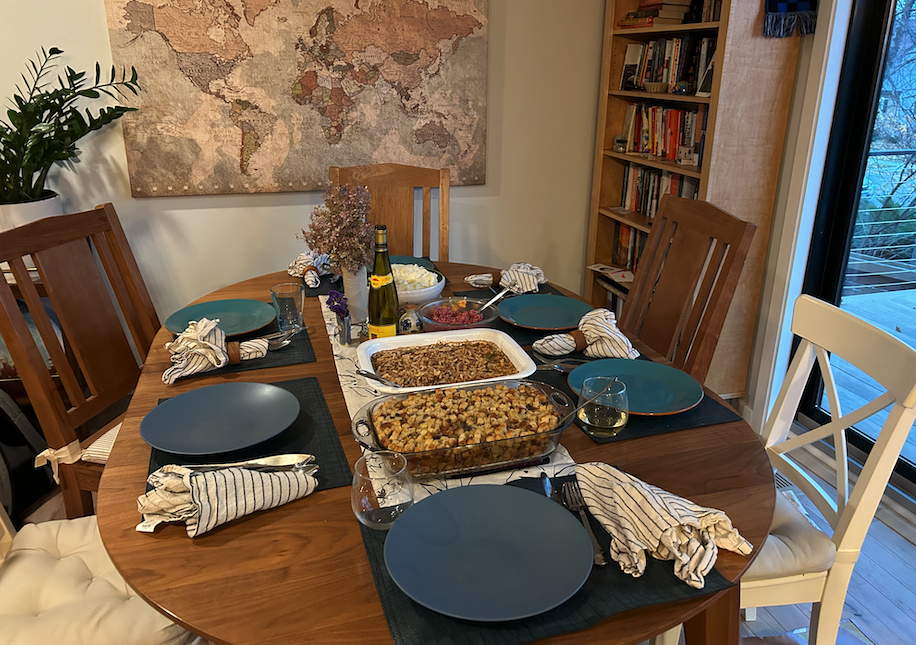
The oak table where she worked on a protected area was made in 1902 when Louis Cravillion married Octavia Orde, my paternal great grandparents. How I miss my Grandma Tavy. My grandmother died following childbirth, so Octavia cared for her grandson. As a woman of the age, I am now, she cared for me. I sat on one of these chairs while she braided my hair, ate meals she cooked, or colored. My mother worked in town.

After my great-grandfather died, we had moved in with her. My parents remodeled the kitchen and dining area storing this oak table for a new Formica and metal model. Eventually an apartment was finished upstairs so she would have her own place. The table returned. Eating breakfast in my designated chair, it was possible to watch everyone come to the new post office across Main Street. Patterns were cut to make clothes, cookie dough rolled out, homework completed.

After her death, the table was refinished and set up as my parent’s game table. As they downsized, it came to be mine. Our children ate and did homework and projects on a glass surface that protected the oak. Today’s artist is one of their children. 

Stories of six generations of my family have been exchanged here. Men have returned from wars to a first home meal, baptisms and weddings celebrated, hard decisions made, children loved. Great grandma’s quiet and calm presence participated in half of its history. I see her hands now show in mine; her brown eyes look back from our mirrors. I can only hope I carry some of her wisdom to those who sit at this table, her blood mixed in their veins. I am not so tired.

Traditions Evolve

Great Aunt Wilma was a fixture at our Thanksgiving gatherings during her latter years. She was widowed with no children, so my parents invited her to join us. 

Elegant with her silver French twist, stylish earrings and deep brown eyes, she preferred to sit with the guys talking sports or politics (back when that was an acceptable topic). We had plenty of help and cooking wasn’t her forté, so she didn’t don an apron and join the women.

We gathered at my sister’s home in Ohio. After years of hosting, Mom was ready to let her kids handle holiday meals. Until my parents died, our sons, my husband and I traveled from Minnesota to celebrate Thanksgiving with my extended family. My husband’s family had different Thanksgiving traditions, so we didn’t have to choose.

For years, my husband and I have been the creators of holiday gatherings like Thanksgiving and Christmas. Days before, we’d clean the house, finalize the menu, make an epic shopping trip, check the table linens, plan the flowers, and start prepping dishes that could be made ahead, then cook and clean up on the actual holiday. As our sons got older, they and their wives also prepared key dishes. However, my husband and I were the event managers who were responsible for making the meal go smoothly. We were happy to do it.

But family traditions evolve. When our sons married, we began sharing them with their wives’ families. Each year we’ve had conversations about which day to hold our Thanksgiving and Christmas gatherings. After a bit of trial and error, we determined that Thanksgiving dates could be flexible but Christmas was less so. 

When grandchildren came on the horizon, my husband and I understood our traditions would change again. We are welcome and important, but as grandparents, we are stepping back to a supporting role for holiday gatherings. 

The focus has shifted to our granddaughters’ needs. Younger babies might be content to be held during a lengthy Thanksgiving meal, but older babies are not. They get bored and want to play. Ideally, both babies should have a quiet place to nap. This year, that will be at the home of our oldest son and his wife, where both babies can be accommodated. 

Shortly before the hungry horde descended last Sunday

Similar things are happening in the larger circle of my Ohio family. My sister no longer hosts a large family dinner at Thanksgiving. Now she visits two of her daughters who live in a nearby state. My brother and his wife will join friends for Thanksgiving since their children are also hours away.

My bachelor brother, who used to help my sister and me with cooking and cleaning up at our large Thanksgiving gatherings, is now slated to become a guest at a niece or nephew’s Thanksgiving table. When we spoke of the changes, my brother and I joked that now he has become Aunt Wilma. 

A Simple Thank You

“I’m not a kid, anymore”, my son said. Why was I then having to cajole him into writing thank you cards? Isn’t that an adult thing? Jody and I had a gathering of up to fifty people to celebrate – and more importantly – to recognize his graduation from Dunwoody College of Technology. 

Our son didn’t want a basket to be set out for cards. “It looks like I expect something, then,” he said.  

He wore a hooded sweatshirt, graciously accepted the cards given to him, and slid the cards into his hoodie pocket. Later he transferred the cards to his cubby.

My son graduated from Dunwoody with honors. Earlier, I had pointed to his Cum Laude and Outstanding Attendance designation on the commencement program. “You did that,” I said. “Me and Mama Jody never once got you up for school. We never once asked you if you had class work to do. You did that.”

He looked pleased. “I know.”

But, to write a thank you card?

Ever since our son and daughter could hold a crayon, the expectation was to send thank you cards for birthday and holiday gifts. In some ways, it was easy for them. A thank you card is made of two halves. Our son would have one half and our daughter the other. They each would draw a picture displaying their own unique personality. Jody and I would address and mail the cards.

Juan balked at drawing a picture. “I’m not a kid, anymore.”

In retrospect, I probably should have expected his pushback sooner.

My son and daughter are members of the first social generation to have grown up with access to the Internet. They are labeled digital natives. Both consume digital information quickly and comfortably through electronic devices and platforms.

Where does that leave the digital immigrants? The grandparents, aunts and uncles, and family friends who grew up dominated by print before the advent of the Internet.

We would like a thank you card, and we would like our children to send thank you cards.

Is it enough for our children to say thank you in person when handed a card? I’m sure that my son did that. He is sociable, polite and courteous. I’m old-fashioned. I haven’t let go of the idea that the written word is important. Our son did end up sending thank you cards. He did the absolute bare minimum.

Will thank you cards, thank you texts, emails, etc. become antiquated? Will it be all thought, all energy driven? Appreciation transmitted without electronics. Mind to mind. A glow of light. If asked, the children will say that we are already there. It’s us digital immigrants that must catch up.

One Generation Gives Way to the Next

When our sons were small, my husband and I invented our own customs for Christmas, because my parents and his lived hundreds of miles away. Making the holiday special was up to us. We missed our extended families, but we were free to do whatever appealed to us—there was no other schedule or tradition to consider.

A few years ago

We read “The Night Before Christmas,” filled stockings with candy, assembled big toys like the play kitchen, and added batteries to toy guitars and handheld games. We took a bite out of the cookies left for Santa and scribbled “Thanks!” on the notes our sons wrote (Santa has good manners). 

As our boys got older and Santa became a sweet memory instead of an actual visitor, our habits changed. The four of us began cooking elaborate meals together—three days of them. Christmas Eve Eve’s dinner would be whatever the group craved—maybe Southern BBQ or cassoulet. An Italian feast (calzones, fagotch*, and homemade pasta) became a required ritual for either Christmas Eve or Christmas Day, and the third meal might be something fancy like Beef Wellington. Later we welcomed our sons’ girlfriends (now wives) into the kitchen.

When they married, we understood some traditions would have to flex; after all, our daughters-in-law and their families have traditions, too. Changes have already begun. This Christmas the six of us will be together on Christmas Eve. My husband and I will miss our three-day extravaganza, but believe this is the right way forward.

If we have grandchildren, I envision more changes on the horizon. I’ve watched and learned from friends and family who have married children and grandchildren. They’ve all had to adapt and invent new approaches to holiday gatherings. My brother and sister-in-law spend either Thanksgiving or Christmas with their married child and her family, but not both. Other relatives get together after Christmas, because their child’s divorce means accommodating two separate parents and three sets of grandparents. A friend doesn’t see her children and grandchild until New Year’s Day—scheduling the group at Christmas has gotten too complicated.

My friends and family don’t relish being alone on Christmas, but they accept the situation and make the best of it. As grandparents, they are no longer the center of holiday celebrations—their adult children and grandchildren are. It’s their turn now.

I expect changes will continue for my family. As my husband and I age and grandchildren arrive, we’ll adapt again and again. Gracefully, I hope. After all, this is how life is supposed to go. One generation gives way to the next. Inherent in raising children is the assumption they’ll become independent adults, and as a parent, I will be less central. One day, they’ll be responsible for arranging (and cleaning up!) our holiday celebrations, and eventually their children will do the same for them. 

That’s as it should be.

 *The family’s phonetic spelling for a form of focaccia in which ground meat, tomato paste, fennel seed and other spices are spread on bread dough, rolled up, baked, and sliced into pinwheels.

As The Wind Blows

That’s what our daughter says.

When she first landed in Hawaii, we enjoyed our daily chats with her.

Jody and I asked her about the phone calls: too much, too little, how are you doing? We wanted to be present for her and yet also give her the space she needed.

We knew we were at the end of our daily calls when three weeks later we disrupted her at breakfast. Dining at IHOP with newly found college friends, she left the table to answer our call.

“Oh, yeah, so you don’t need to call me anymore,” she said.

“Wait. Wait. Wait,” Jody and I responded. “We expect at least a weekly phone call.”

It took Crystel a few weeks to remember whether it was a Wednesday or Thursday that we were going to call. That made for a fortuitous two phone calls in a week. The parents were being weaned from adult daughter contact.

Facetime worked the best. At least we could see her, study her face, discern if anything was off, and she could make faces at us in the camera and use it to check her brow line.

We had been asking her the same questions, week after week. How is school? How are your roommates? How is the dining hall? What plans do you have for this weekend? Our weekly conversations changed the first time she used the line, “As the wind blows.” I felt like she was putting us off. Dismissing us.

She had been planning an outing with her roommates to swim with the sharks. It didn’t happen because as the wind blows.

I thought she was being disrespectful. I told her that we needed more engagement from her. She needed to add to the conversation.

After the phone call, when I had time to cool down, I realized that what she was saying was true. Isn’t that the way of most college students and young adults – as the wind blows. And didn’t I embrace spontaneity? Encourage her to follow her joy?

Personally, I love being in the moment, being able to go inside to determine my path or action. I phrase it as introspection.

We’ve learned to anticipate the changing winds. She’s made friends, adventured to the northern parts of Oahu, flew to Maui for a weekend, snorkeled, cliff jumped, and learned to surf. She did eventually swim with the sharks.

Crystel requested and received a permit for solo hiking on the island of Kauai for the first week in January. Though she explained that maybe she would explore the island with a friend and do day excursions, she didn’t know yet.

Letting go of our adult child is a kite in the wind. I’m proud of her. A bit nervous for her. And hope the winds always blow strong and true.

“Ua pa mai ka makani…” / “The wind has been blowing…