Author: Ellen Shriner

  • You’ve Come a Long Way, Baby

    I’ve never met Kathy Mayer, but we have the Toledo Fire Department in common.

    In 1984, she was one of the first women firefighters to join the fire department, where my Dad had been a fire chief until the late 1970’s.Screen shot 2013-03-12 at 10.04.35 PM

    According to a recent article in the Toledo Blade, Mayer is retiring after 28 years. Whether she meant to or not, she broke barriers, and she has much to be proud of.

    In the early 1980’s, firefighters worked 24 hours on and 48 hours off. Firehouses were a men’s club—the men slept dormitory-style and there was one bathroom. I don’t know what accommodations were made for women firefighters when they came on the department.

    From what I know about fire department culture, I’m pretty sure that in the early years, she and the other women put up with a lot of guff and practical jokes at the very least and outright hostility at the worst. And it wasn’t just the firefighters who resisted women firefighters—some of their wives also worried about their presence. Would living in close quarters lead to affairs? During a fire, would their husbands have the same backup from a woman as they would from a man? Although I count myself as a feminist, I think those were legitimate concerns.

    However, the women had to pass the same physical tests as the men: rolling a fire hose (heavier than you think, especially with the metal couplings), pounding a sledgehammer on a target more than 50 times, climbing several flights of stairs in firefighting gear while carrying a hose, and also carrying a 100-pound weight (the assumption was, that if the person being rescued weighed a lot more than that, the firefighter would be expected to call for help).

    At first, Dad resisted the idea of women firefighters. Although he retired before that issue came up, he still identified with the fire department. But because my sister and I were in our twenties then, and Margo was interested in being a firefighter, he had to rethink his views. Even though he was skeptical, he didn’t want Margo to be discriminated against. But I suspect he was relieved when she decided not to pursue a career as a firefighter.

    Despite the inherent challenges, Kathy Mayer persevered.  She joined the fire department, later became a paramedic, and eventually gained the respect of her coworkers. I give her a lot of credit for making a 28-year career out of the fire department.

    Like the 1970’s Virginia Slims ad headline said, “You’ve come a long way, baby.”

    Kathy Mayer embodies the vision so many Baby Boom women had when we joined the workforce in the late 1970’s and early 1980’s—women holding their own in nontraditional fields. That is the subject of my memoir-in-progress, Colette’s Legacy.

  • Lemonade, Anyone?

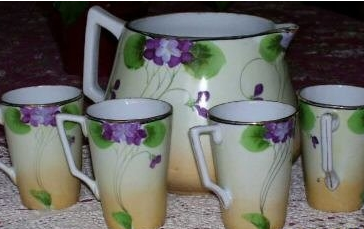
    For years, a hand-painted Nippon china lemonade set has had a place of honor in my dining room. My grandmother, who was born in 1885, gave it to me. Mimmie, as we called her, had a 4th grade education (hence the spelling “Mimmie” instead of “Mimi” as others might have spelled it). Screen shot 2013-02-24 at 2.04.44 PM

    Mimmie’s maiden name was Margaret Zoe Mominee. She was born in a log cabin in Mominee Town, which is east of Toledo in Northwest Ohio. Mominee Town was at the crossroads of Corduroy Rd. and what used to be called Big Ditch Rd. (perhaps the names were descriptive of the roads at the time). Family lore has it that Mimmie’s French Canadian ancestors came through Windsor, Ontario, past Frenchtown Township in Michigan and settled a little south of Lake Erie.

    Map circa 1900
    Map circa 1900

    Mimmie was an easygoing cheerful woman. She laughed easily and didn’t fuss when her grandkids (my two older brothers, younger sister, and I) grew restless and squirmy during. Every week, we drove across town with my Dad for a visit. There was nothing to do at her house, but she’d pull out an old red rubber ball for us to bounce outside.  Or my sister and I could look through the button collection in the drawer of her treadle sewing machine. When we’d had enough, she’d offer root beer floats, which she called “brown cows.” We also got chalky pink or white mints from the covered candy dish that sat on the built-in china cabinet in her dining room.

    Centered inside on one shelf was a yellow lemonade set painted with violets and a gold rim. On another shelf was a blue and white chocolate set that was painted with pink flowers.  It was also Nippon although it looked like Bavarian china. Nippon porcelain was made between 1891 and 1921 in Japan. It was a less expensive version of the European tea, lemonade, and chocolate sets popular at the time. The pieces could be collected at Sears, Montgomery Ward, grocery stores, gift shops and dime stores. These porcelain sets were some of the few fancy things Mimmie had, and more than likely, she bought them a piece at a time. When my sister and I admired the sets, Mimmie told us they’d be ours one day.

    Looking back, they’re a puzzle.  Mimmie was very practical and down-to-earth. She made many of the cotton house dresses she wore. She’d create a pattern from the old dress and “run up a new one on the sewing machine” as she said. She only wore jewelry with her one good dress—a navy blue crepe dress with a white lace collar. And she only wore her good dress to church or family occasions.

    She was a good cook and liked to bake, but she made Boston brown bread in empty vegetable cans, banana cupcakes (to use up bananas going bad), and oatmeal cookies, our favorite. Mimmie was not one to make shortbread cookies or fussy foods suitable for a ladies tea. But I wonder if she ever invited her sisters or women friends over for lemonade. And if she didn’t use the sets, but kept them for good, did they meet some yearning for nice things? A yearning I share, which I why I coveted the set as a girl.

    Today, the sets are collectible and valuable. But after dusting them and keeping them for good for 30 years, I’ve decided to invite friends over for lemonade this summer.  And if a cup gets chipped, so what? Except for my sister, no one will ever care about this set as much as I do, and she has her own set!

    A book called The Secret Life of Objects by Dawn Raffell inspired this blog. I’ve decided a lot of my things have stories to tell, too.

  • The Unintended Consequences of Random Acts of Kindness

    My 91-year-old Mom has an old green bomber jacket she wears for quick trips to the store.  The color is scuffed off of the elbows, and the knit cuffs and waist are pilled. The jacket isn’t good enough to wear to church, but it’s too good to throw away. And she likes it, or at least she did until the other day.

    She was checking out at the grocery store and the clerk had bagged two small sacks, when Mom realized she didn’t have much cash with her. Even though Mom had several credit cards in her wallet, she didn’t think to use one of them—to Mom, grocery shopping is a cash operation. Flustered, she told the clerk to put back one of the bags. She didn’t have the money for both.

    As she was walking out, the woman who’d been standing behind Mom in the checkout line caught up with her and handed Mom the second bag of groceries. This generous middle-aged stranger had paid for them. Mom managed to thank the woman, but she was mortified.

    Mom’s convinced that the well-intentioned stranger saw an old woman wearing a ratty coat and concluded that Mom couldn’t afford to buy groceries. Mom has a comfortable income, so the idea that she might seem in need of charity was profoundly embarrassing to her. Mom gives generously to charities—she’s accustomed to being the giver. She’s not supposed to be the receiver. She’s proud of being in good shape financially.

    My sister and I suggested other possibilities: Maybe the stranger was just being nice—everyone’s had the experience of coming up short at the checkout. Maybe the stranger was just trying to spare Mom the hassle of a return trip to the store.  Maybe Mom reminded the woman of her own mother.

    Mom was unmoved by our explanations. She doesn’t want anyone thinking she’s poor and feeling sorry for her. She’s shopping for a new winter coat she can wear to the store.

    * * *

    I had a similar experience when I was shopping at the farmer’s market. I was debating whether or not to buy my collie a smoked dog bone. I’d picked up and put back several bones while the vendor was selling me on the merits of his smoking process. I concluded that the bones might be too splintery for my dog and decided not to buy any.

    I felt a little bad about wasting the vendor’s time, so I stupidly said I didn’t have that much money with me, and the dog didn’t really need the bone. I wanted to move on and figured the vendor couldn’t argue with that explanation. But another shopper overheard the conversation and insisted on buying the $2 bone for me. I tried to refuse, but she said she wanted to treat my dog. So I let her give me the bone. I didn’t want to squelch her generous impulse. Better to be gracious. I’d get over my embarrassment.

    Those random acts of kindness—moments of pure generosity—had surprising consequences. Instead of being pleased and grateful, Mom and I felt stupid. Embarrassed to be seen as needy. Guilty that we’d contributed to the perception. We’d expected to be the givers, not the receivers.

    However, when I’ve truly needed help—say when a stranger helps me jump a dead battery—I am grateful and delighted that the world has such good-hearted people in it.

    I still like the idea of random acts of kindness and want to be more open and accepting of what the world sends my way.

    cosmic smooch
    cosmic smooch