Author: Ellen Shriner

  • On Losing My Ambition (Open Letter to 35-Year-Old Hiring Managers)

    Recently I had dinner with my friend C., who mentioned that after years of freelance writing, she was interviewing to be a marketing communications manager—a position she’s eminently qualified for.

    She confided that during the preliminary phone interview, the interviewer expressed concern that C. wouldn’t be satisfied with being a mid-level manager. Perhaps C. would be uncomfortable taking direction from the younger director of the organization. C. paused during this anecdote, with her eyes wide and eyebrows raised. We both burst out laughing and couldn’t stop.

    “Being the director is the last thing I want! I just want to do the kind of work I’ve been doing . . . but someplace else. For me, learning the rhythms of that office will be challenging enough,” C. said and paused for a sip of white wine.

    “I know! I just want to do interesting work with coworkers I like and be respected for what I know,” I said.

    I’m not sure when I lost my ambition for climbing the corporate ladder, but it’s been gone for a while.

    womanclimbingladderEven saying that feels odd. I have always cared about my career, and I’ve gone to some trouble to have one (got a graduate degree, made several cross-country moves in pursuit of jobs, been a working mother). But I simply no longer have a driving need to be promoted. Unlike Sheryl Sandburg, who encourages working mothers to be all they can be career-wise (see Lean In), I leaned back a long time ago.

    When I was in my 20’s and early 30’s, my career was my main focus. But my priorities broadened after my sons were born. Instead of pursuing a classic corporate marketing or ad agency path, I launched my own freelance writing business. Would I have made different decisions if the workplace had been more flexible? Maybe. But having my own business worked well for me—stacked hat logo

    a) It gave me the flexible hours I wanted when my sons were growing up so I could be a bigger part of their lives. They spent fewer hours in daycare. In the summer, I’d occasionally knock off early and we’d go on excursions—the beach, the zoo, or the park. When they were sick, I’d be home. I still had deadlines and needed to work late after my husband returned from his job, but it was easier to manage. Plus, I could volunteer at their school and go on their field trips.

    b) With half a dozen clients, I could have the creative variety that’s often lacking for ad agency copywriters. Instead of being the head writer on the agency’s Visa team, I’d write for Land o’ Lakes, Visa, Radisson, Medtronic, Sears—whichever account was active that week.

    c) As a freelance writer, I had more free time to write personal essays and memoir pieces—the kind of creative writing I’d always wanted to do.

    I made choices that supported the life I wanted; my decisions did not advance a traditional career path.

    Shortly after my second son was born, while I was still working full-time, I was offered the opportunity to be promoted from senior copywriter to associate creative director. It was hard to say no—at that point I still had traditional ambitions and wanted to advance. But I turned down the promotion, because between work and family, I was already at or beyond full capacity. I simply didn’t have the energy to do more and to do the job justice.

    Several years ago, I chose to leave my freelance business behind (it stopped being as much fun and my sons were grown) and take a part-time job writing marketing communications for a children’s hospital. I’ve had several chances to go full-time and get back on the classic path to career advancement. Ambition flickered in my heart. I briefly heard the siren song of advancement, “You’ve got more in you–you’d be good at that job.”  But I leaned back again. New logo 2

    I have other goals and responsibilities now—

    a) Having the flexibility to help my siblings care for my 91-year-old mother in Ohio

    b) Having fun with my husband who recently retired

    c) Making time for my creative writing projects

    As I told C. during dinner, “Hiring managers don’t have to be so worried about Baby Boomers. A lot of us don’t want to take over anything. Work is just one of the things we care about. We have a number of priorities.

    C. and I raised a toast to that reality.

  • Stuffed

    Unlike Elizabeth (I’ve Never Had Something Not Burn), I have lots of stuff—a houseful of it! More than I need. But I have trouble parting with it.

    I really like my stuff and so much of it has a story.

    I got the 1930’s wrought iron floor lamp from my parent’s basement. Now it’s painted blue, but before that it was red, and at one time it was black. I made the small nine-patch quilt because I loved the 1940’s retro print fabric. My bookcases are filled with books that mean a lot to me. I like the mission style desk I bought and refinished years ago.  I still like this stuff.  It makes me happy to have it around. I feel at home because it’s here. And that’s just my office. Lamp & quilt

    Lurking in my office closet are piles of old writing samples and presentation supplies related the freelance writing business . . . that I gave up a year ago. I also have paper, clay, jewelry, knitting and craft supplies that I rarely use.  But I might.

    Just a few of my bowls . . .
    Just a few of my bowls . . .

    Or what about all of the bowls I own? Bowls I made years ago when I had access to a pottery studio. Bowls I bought at art fairs. Bowls I picked up in antique stores. I could dirty bowls for several weeks before I’d run out of clean bowls.

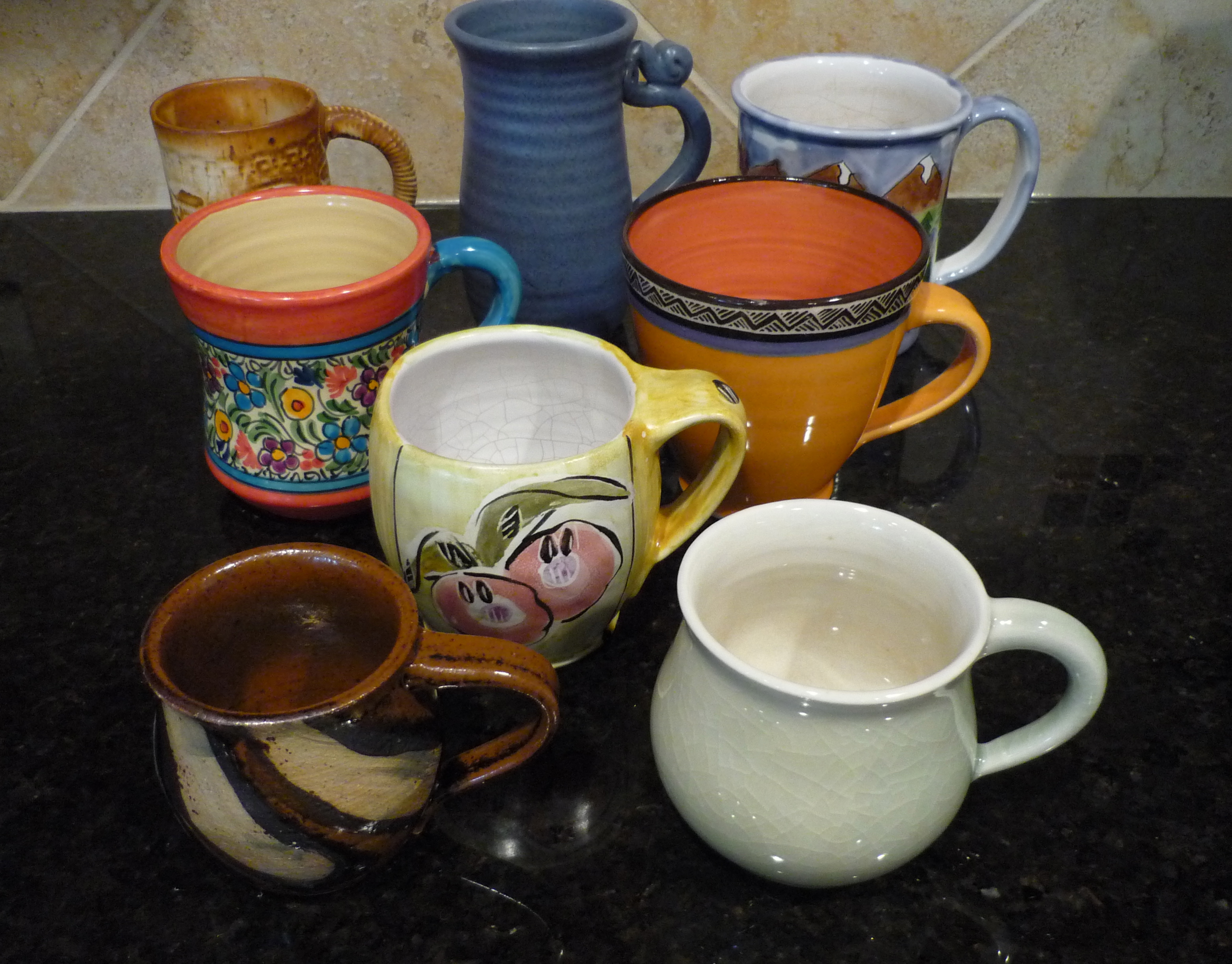
    And mugs! That collection is even bigger. I could tell you where each one came from—Spain, the North shore, a friend, and on and on. I love them all, but really, how many mugs does a person need?!? Occasionally I give some away when the cupboard gets too full, but there’s still a box of mugs on a basement shelf (don’t tell my husband).

    These are just my favorites . . . I have more!
    These are just my favorites . . . I have more!

    The stuff I’m keeping is still good. I might need it someday.

    The classy interview suit I don’t wear—the pants are kinda tight and I’m not looking for a job right now. Will it be hopelessly out of style the next time I’m interviewing or have a funeral to go to?

    My box collection. I save shoes boxes and Amazon boxes so I can send cookies and presents to my family in Toledo.  Really, three or four would suffice, but I’m sure I have at least a dozen. My husband has learned to nest them so they take up less room and he weeds them out carefully so I won’t notice and squawk.

    Lately, I’ve realized that having a lot of stuff can be oppressive.

    I have to dust it, protect it from breaking, or store it.  Managing my stuff takes time and thought. Not just the housekeeping, but also the emotional upkeep of caring about my stuff—remembering the person who gave it to me and feeling torn when I want give it away. Deciding what to keep and what to give away is hard, so I don’t do it very often.

    Even divesting myself of all this stuff will be hard. 

    I’ve visited too many estate sales in which old hot water bottles, empty picture frames, spare light bulbs, rusty garden tools and other stuff nobody wants was lined up for sale next to kitschy-enough-to-be-cool Christmas decorations. But the sad useless stuff tainted my pleasure in getting a deal on some cookie sheets or a pie plate that my sons actually needed.

    Recently, my sister spent hours cleaning and pricing stuff for a garage sale. It seemed like a good idea at the time, but in the end, she didn’t sell that much, so a lot that stuff went to Goodwill anyhow.

    A good friend just pitched 19 years’ worth of teaching materials—all those lesson plans, readings, exercises, student samples—that treasure is irrelevant now that she’s retired. But I know she was sad to say goodbye to several decades of a profession she was passionate about.

    My husband and I talk about moving to a smaller house someday. If we do, we’ll have to shed a lot of our stuff. I wish I could give it directly to someone who needs it—somebody just starting out who wants a lamp . . . or some bowls. I’d like to give my still-good stuff in a more personal way than just having Goodwill or the Vietnam Vets collect it. I wish I could hand it to somebody who will actually like it and enjoy it the way I have.  I daydream about placing an ad that says, “Come get some great, well-loved stuff—FREE!”

    No doubt I’ll be sad when the time comes to move, because I’ll be shucking off an identity and lots of memories. But I hope my life will feel a lot lighter and simpler—more carefree.

  • Because You Need a Good Laugh

    The following list originally appeared in 1999 in the Washington Post as winners of a “Funniest Analogies Ever Written in a High School Essay Contest”

     My favorites are #2, 9, and 25.  What are yours?

    1. Her face was a perfect oval, like a circle that had its two sides gently compressed by a Thigh Master.

    2. His thoughts tumbled in his head, making and breaking alliances like underpants in a dryer without Cling Free.

    3. He spoke with the wisdom that can only come from experience, like a guy who went blind because he looked at a solar eclipse without one of those boxes with a pinhole in it and now goes around the country speaking at high schools about the dangers of looking at a solar eclipse without one of those boxes with a pinhole in it.

    4. She grew on him like she was a colony of E. coli, and he was room temperature Canadian beef.

    5. She had a deep, throaty, genuine laugh, like that sound a dog makes just before it throws up.

    6. Her vocabulary was as bad as, like, whatever.

    7. He was as tall as a six-foot, three-inch tree.

    8. The revelation that his marriage of 30 years had disintegrated because of his wife’s infidelity came as a rude shock, like a surcharge at a formerly surcharge-free ATM machine.

    9. The little boat gently drifted across the pond exactly the way a bowling ball wouldn’t.

    10. McBride fell 12 stories, hitting the pavement like a Hefty bag filled with vegetable soup.

    11. From the attic came an unearthly howl. The whole scene had an eerie, surreal quality, like when you’re on vacation in another city and Jeopardy comes on at 7:00 p.m. instead of 7:30.

    12. Her hair glistened in the rain like a nose hair after a sneeze.

    13. The hailstones leaped from the pavement, just like maggots when you fry them in hot grease.

    14. Long separated by cruel fate, the star-crossed lovers raced across the grassy field toward each other like two freight trains, one having left Cleveland at 6:36 p.m. traveling at 55 mph, the other from Topeka at 4:19 p.m. at a speed of 35 mph.

    15. They lived in a typical suburban neighborhood with picket fences that resembled Nancy Kerrigan’s teeth.

    16. John and Mary had never met. They were like two hummingbirds who had also never met.

    17. He fell for her like his heart was a mob informant, and she was the East River.

    18. Even in his last years, Granddad had a mind like a steel trap, only one that had been left out so long, it had rusted shut.

    19. Shots rang out, as shots are wont to do.

    20. The plan was simple, like my brother-in-law Phil. But unlike Phil, this plan just might work.

    21. The young fighter had a hungry look, the kind you get from not eating for a while.

    22. He was as lame as a duck. Not the metaphorical lame duck, either, but a real duck that was actually lame, maybe from stepping on a land mine or something.

    23. The ballerina rose gracefully en Pointe and extended one slender leg behind her, like a dog at a fire hydrant.

    24. It was an American tradition, like fathers chasing kids around with power tools.

    25. He was deeply in love. When she spoke, he thought he heard bells, as if she were a garbage truck backing up.