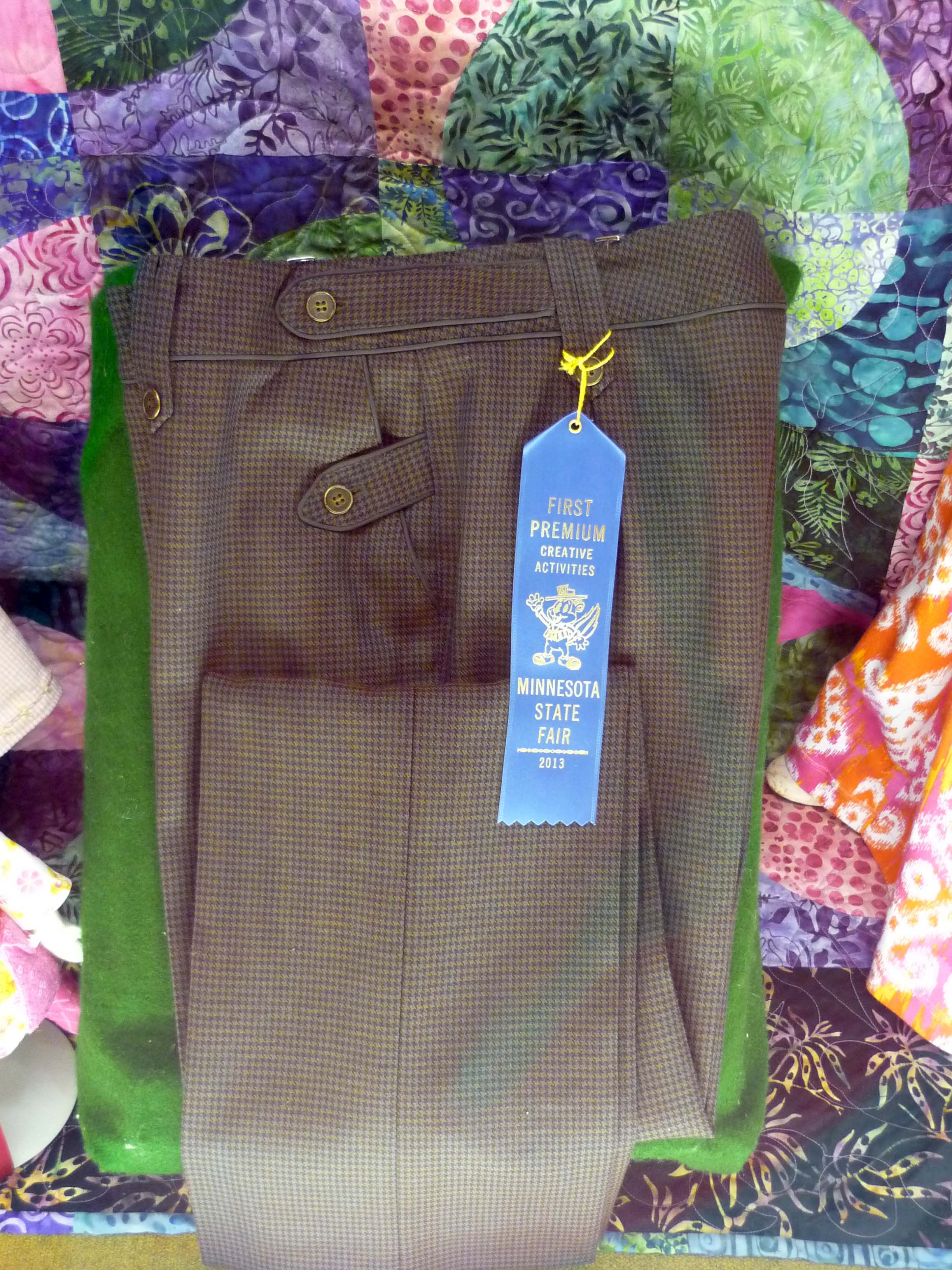
Cicadas have begun their whining buzz. Summer is nearly over, and I’m not ready for it to end. But the Minnesota State Fair helps ease me into fall. One of my favorite parts of the fair is the Creative Activities building, especially the displays of quilts, embroidery and homemade clothing. I love looking at all the clothes, especially the women and girls’ clothes.
Some are so well crafted that they are worthy of designer labels. But others have ambitious designs that are not fully realized. The seamstress (and it is almost always a she) may have chosen a fabric that was too thin and cheap—broadcloth where a challis would have draped better. Or perhaps the topstitching widens gradually instead of being even and regular. Maybe the fabric is an odd choice for a tailored suit. These are my favorite pieces.

I understand the excitement the seamstress felt when she first envisioned the clothing. Her belief—that if she sewed carefully enough, she could make something worthy of a ribbon at the State Fair—resonates with me.

The gap between her vision and the items in front of me doesn’t matter. Perhaps the seamstress feels drop-dead gorgeous when she wears her outfit. Or maybe she simply took pleasure in working with the color, texture and design, just as I did when I was learned to sew in as a girl in Ohio.
The summer I was 10 years old, I rode my fat-tired blue bike to sewing class at the Singer store for eight weeks. It was hot and there was no shade. My bag of jumbled fabric and pattern pieces banged against my leg as I pedaled and sweated block after block for a mile and a half.
Inside, the icy cold store had a cotton sizing smell, like a shirt that’s just been ironed. Unwinding and unwieldy bolts of fabric tilted into the crowded aisles, a feast of color and texture. Shimmery pastel polyester. Dark floral challis. Fine woolen houndstooth checks. Lush jewel tone velvets. Rustling moiré taffeta with its woodgrain texture. Beyond the fabric were the arcane supplies called notions. Stamped tin needle threaders. Rickrack, lace and ribbons. And row after row of buttons—plastic Scottie dogs, domed brass buttons, and sparking rhinestones.
At the back of the store were pattern books and possibilities. Looking over my shoulder, my sewing instructor directed me to the “Very Easy” patterns at the back of the book. Her pointy fingernail tapped at a V-neck jumper and a simple sailor dress. “Why don’t you write down some of these pattern numbers, and your Mom can help you decide when you come to buy fabric?”
By the time I returned with my mother, I was in love with my vision. I’d spent days imagining the possibilities for the sailor dress pattern I’d chosen: white with jaunty red trim or dusty yellow with navy accents or maybe red with red, white and blue trim. I finally chose tomato red kettle cloth for the dress with white for the collar and red, white and blue ribbon as an accent. For the first time in my life, I was caught up in a rush of creativity and self-expression as heady as that of any artist.
In class, I chafed at the exacting requirements: sewing 5/8”seams that didn’t drift to 3/4” or 1/2”. In the pattern, the darts in the bodice were pictured as sharp narrow angles turned into triangles with a line of stitching, but my first attempt was more like a lightening bolt than a straight fearless line. I was also surprised at how hard it was to sew the back darts, gradually tapering both of them into slender matching crescents. Every thread had to be knotted off tightly and neatly trimmed. But I was determined to master the craft of sewing, so I could bring my vision into being.
Though my head ached from concentration, the armhole facings for my sleeveless dress were still lumpy and irregular, instead of the smooth ovals they were meant to be. My zipper had to be ripped out and re-done three times. I got discouraged as my vision of the dress dimmed in face of the rumpled panels I guided under the presser foot and flashing needle. The dress I imagined was just out of reach, stylish and perfect in my mind’s eye.
One afternoon when the dress was nearly done I was particularly dejected. I knew my dress looked childish and stupid. I was overwhelmed by its imperfections. My teacher noticed my expression and said, “All you need to do is wash this and press it. It will look great.” I wasn’t sure that was true, but I wanted to believe her.
I washed and pressed my dress for the end-of-class style show, and she was right: you could hardly see the mistakes. As I walked across the stage, my dress’s crooked interfacing seams no longer mattered. I felt as chic and self-assured—everything I’d envisioned.
As a city kid, entering clothing for a ribbon at the Ohio State Fair wasn’t part of my experience—I’d never even been to the state fair, since it was three hours away in Columbus. But I didn’t need a ribbon. I was already proud of my achievement. So it wasn’t long before I was planning my next dress. Skirts, long vests, and other dresses followed. My sewing grew more accomplished, but never would have been considered professional.
In high school, I didn’t have as much time for sewing, and I had begun to make enough money babysitting that I could buy most of my clothes. Though my interest in sewing my own clothes had dwindled, my enjoyment of the creative process flourished. During college, I transferred my love of color, texture and design to pottery and jewelry making. In my 20s, I sewed curtains, pillows covers and bedspreads to furnish my various apartments.
Through the years, my interest in making things has not waned. My home is filled with imperfectly rendered projects: a quilt that was too ambitious for my design skills, though it has appealing colors and fabric. Stoneware bowls that are a little heavy. The porch pillows whose pattern was too busy for the loveseat they were on. Halloween costumes that were only basted together and would fall apart if my boys got too rough with them. The small watercolors that were fun to do but just seem amateurish now that I’m done. I don’t mind that these projects turned out pretty well instead of perfect. I enjoyed the rush of inspiration I felt when I first imagined them and the pleasure I took in creating them.
In the Creative Activities Building, I look over this year’s award-winning projects along with the others that like mine, fell short of their maker’s original vision. I hope those optimistic seamstresses discover, as I have, that the thrill of the creative process is the point.