Author: Ellen Shriner

  • Graduation 2024

    The School for Adults teachers coaxed me to attend the Honors Program and General Education Diploma (GED) Graduation because I’m a volunteer tutor. I was somewhat reluctant since graduation usually means long speeches, uncomfortable seating, and potential boredom, but I’m glad I showed up. The pride of the students being honored touched me. 

    I followed the crowds of American-born and Spanish-speaking students and their families as they streamed in. All were dressed up—women in dresses and heels, men in fashionable clothes. In other families, the women wore special hijabs—dark colors embroidered with gold threads or embellished with gold sparkles along the cuffs. Everyone’s children wore their finery. 

    The place looked and sounded like a party—music played, a long table was laden with cupcakes and other sweets, and round tables were covered with pastel tablecloths ready for families to gather after the ceremony. I found a place at the back of the hall next to another tutor, a retired engineer from India who helps students with math.

    My role is working one-on-one or with small groups to help adult learners improve their writing and reading comprehension. Some of the students are native English speakers who got off track and didn’t finish their high school degrees. Others are immigrants learning sufficient English so they can attend college or keep up with their children’s schoolwork. Some students have university degrees from their home countries but have to start over here with a GED. When I tutor students, I ask their goals, but I don’t ask why they dropped out of school or what their immigration status is. 

    I was pleased one of the GED graduates I know was a featured speaker. She’s in her early 20s and a native speaker, so her language skills are good. She didn’t need much from me–math was her nemesis. For four years she showed up, sitting quietly in the back when class met in person. During COVID, when classes and my tutoring went online, she was in and out of class, but she persisted.

    Her speech was plainspoken but so heartfelt. Her pride in earning the GED, a milestone many of us take for granted, showed. Now, with the equivalent of a high school diploma, she plans to work full time to save money for college. 

    Another GED graduate I know is a woman from Sudan. Her written and spoken English are very good, she and was so skilled in math that she could have taught the class. I met with her once when she wanted an explanation of a writing assignment. She required a GED so she can pursue her dream of going to medical school. 

    A student speaker in his 30s spoke in heavily accented English about leaving Venezuela. He has a family and was established in his career, but political turbulence forced him and his family to leave. He spoke with passion about his gratitude for the opportunity America gave him. Now that he had his GED, he hopes to become an electrician and have his own business one day. 

    The majority of the students made level gains, meaning they advanced from basic to intermediate or from intermediate to advanced classes. Level gains merited a ribbon which students wore proudly. Their accomplishments are so hard won. 

    I am in awe of these students’ persistence. Their progress is slow. Many start and stop because they’ve changed jobs or don’t have daycare. Most don’t have time to do schoolwork at home. But week after week, year after year, they show up. I wonder how many of us who finished high school by 18, would work as hard to get a GED. The facts of their stories may sound ordinary, but for them, the diploma is life-changing. 

    So often I feel discouraged about the state of the world, but seeing the students’ pride and sheer joy in their accomplishments renewed my faith in humanity. 

  • Seeing Forward and Back

    I’ve cared for enough older women in my family to see the frailties I may have in the coming years. I’ve learned to be patient with their slower pace. I accept the extra steps they take to stay in charge of their lives—switching glasses and putting them away carefully and doublechecking locks. I already do that. I’m accustomed to the effort invested in maintaining dignity—looking where I’m walking, dressing comfortably, but well. So far, I’ve managed to avoid the flat bedhead spot so many older women seem unaware of!

    Some days I feel exactly how old I am. My hip twinges a little. Or I can’t think of a word and it comes back five minutes later. I have a wealth of experiences and insights but the wisdom to know I should refrain from giving too much unasked-for advice. At this stage of life, my outlook is measured. Realistic.

    Other days I feel like I’m fifty. Nothing aches. I’m energetic, ready to tackle big projects, and confident they’ll turn out well. The future is off in the distance and looks bright. I’m optimistic.

    My thirties are also vivid—relived through the lives of my daughters-in-law. Revived by their pregnancies and new motherhood. I remember how fascinating my changing body was and how much it mattered to have a few maternity clothes I really liked. 

    1989

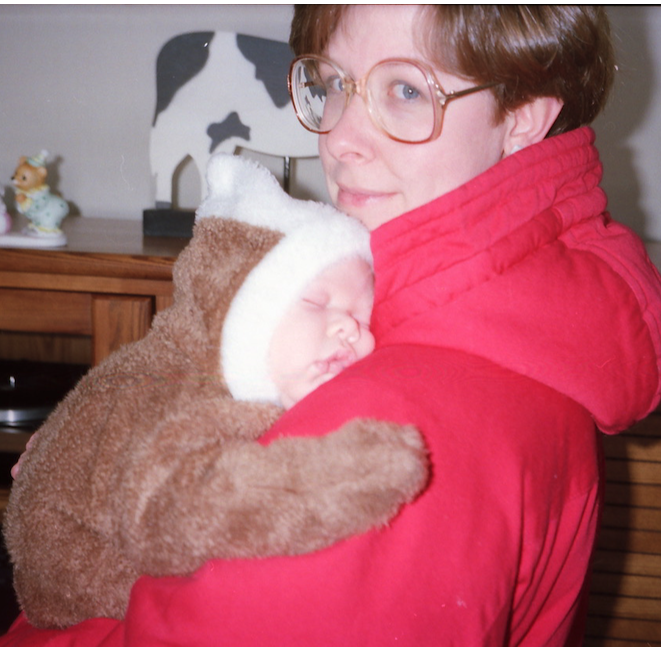
    I haven’t forgotten the fog and overwhelm of life with a newborn. How every little thing worries you. I also know you can grow bored by the long repetitive days, no matter how much you love your child. How ready you can be to use your brain for something besides calculating the hours since the last feeding. But the sweetness of cuddling a sleeping baby tempers that restlessness.

    When my son hands me his baby, our past, present, and future converge.

  • “Why, in my day . . .”

    Growing up, I recall elders recounting tales about life before some innovation. Today, the advent of artificial intelligence (AI) is a hinge moment like so many technological advances I’ve experienced in the last 40 years. I look back on past breakthroughs with wonder and nostalgia. I’m trying to come to terms with current developments.

    1984 – Desktop Computers

    I roll my eyes when young volunteer coordinators enquire if I’m comfortable with computers. In 1984, my boss handed me boxes for an Apple IIe desktop computer and an amber monitor (orange type on a black screen) and told me to set them up so I could write marketing and training materials. 

    1989 – Internet

    Today, that old setup is quaint and humorous—a one-color monitor, 5¼ inch diskettes, a computer that didn’t connect to the Internet . . . because the World Wide Web wasn’t mainstream until 1989-90.

    When the Internet became commonplace, we used painfully slow telephone dial-up modems with their crackling static and rubber band sound. Modems meant I no longer had to courier work product files to my customers on diskettes, which had shrunk to 3½ inches. 

    1994 – 2001 – Search Engines and Websites

    In the mid-1990s, search engines like Yahoo, AOL, and Netscape came on the scene and Search Engine Optimization (SEO) helped people, products, and businesses get found. Google started in 1998. It’s hard to imagine a time before Google, when research meant visiting a brick and mortar library to use printed resources that might be checked out to someone else.

    As websites grew common, having one for my business became important. A friend and I designed and rolled out mine in 2001. Several versions followed until I retired it several years ago.

    1996 – Cell Phones 

    For me, the next technological cliff came around 1996 or 1997 when small cell phones arrived. They made calls. That’s it. If you had the patience to tap number buttons repeatedly, you could eke out texts. No camera. No Internet. No email. No music. No maps. Next, I owned a different dumb phone that opened to a qwerty keyboard. Around 2005, I acquired a fancier flip phone with a camera. Woohoo! Before long my 35mm digital camera was obsolete.

    2007 – Smartphones

    The world shifted dramatically again when the iPhone was introduced in 2007—the best of the available smartphones. Cell phones had enabled me to keep up on client calls and emails seamlessly when I was away from my home office—in other words, an early version of remote work. Staying connected with family became immensely simpler too.

    2007 – 2008 – Facebook & Twitter

    The advent of social media—Facebook and Twitter along with their many step-children—has transformed the world. How we discover, understand, and consume news. How we see ourselves and connect with or demonize others. There’s no denying social media’s far-reaching impact. Despite my mixed feelings about Facebook, it’s where a number of readers find our blogs. 

    Now – Artificial Intelligence

    Evidence of artificial intelligence is everywhere—Siri and Alexa, helpful spelling prompts in texts and emails, blank-eyed, AI-drawn models in ads, and who knows how many AI functions we are unaware of. 

    AI makes me uneasy. But I don’t want to be a Luddite, so I’ve told myself I really ought to dig in, try to understand its scope, possibilities, and implications . . . insofar as any non-AI developer can. I’ve begun experimenting with ChatGPT as a research tool (think of all the data it accesses), but it’s never going to be writing my blogs! Count on 100% Ellen, all the time.

    Five years from now, when the next technological wonder launches, who knows what we’ll be saying?