Author: Ellen Shriner

  • Thinking of Mom

    Sun pours in our bedroom, a converted attic. When I make the bed, I pull the sheet and quilt back together and snap them like Mom used to do. They settle into place with a tiny poofing sigh. The golden wood floor is warm as I circle the bed and fluff the pillows.

    Coming in from the car, my sack of groceries is heavy. I shift hands to lock the garage door, shift again to unlock the back door. I ponder dinner possibilities and think of Mom facing this daily challenge. Although she was a good cook, plenty of times she wasn’t inspired either.

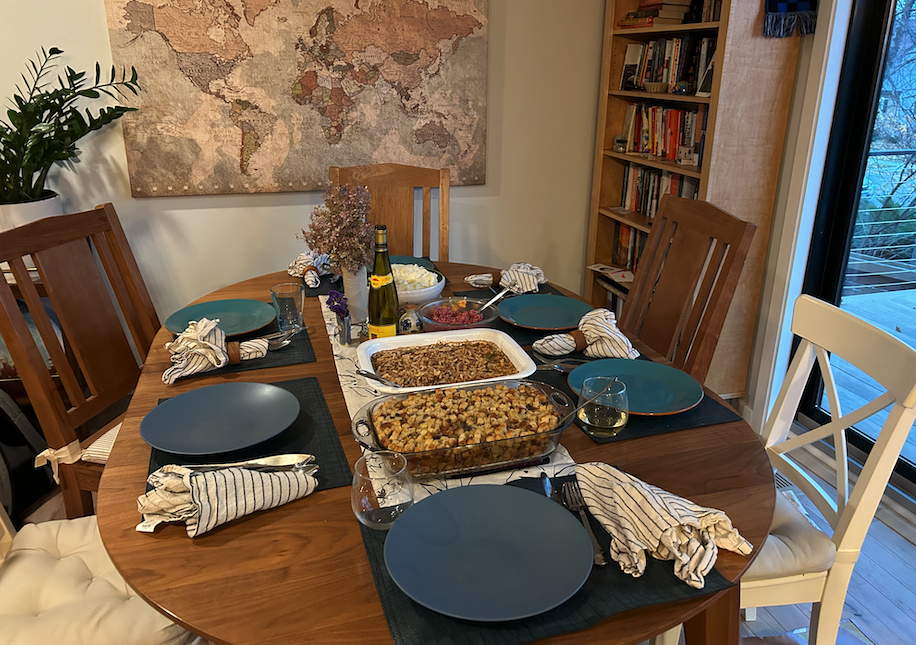
    Some nights, I gather up our crumb-laden tablecloth after dinner to shake out on the back step like Mom used to do. Nobody does this anymore. Not tablecloths. Or shaking out crumbs. But I like it. Before dinner I clear the dining room table of clutter and set the table the way she always did—forks, knives, spoons, and napkins. We often put away the spoons unused but it pleases me to do it her way.

    Minutes after we sit down, I hop up to blow my nose and dab my eye. Whenever I start to eat, they run just like hers did. Some neurological blip we share.

    In the evening, my husband reads the news on the sofa and I read in my chair. We comment on the day’s events, share something about our sons and their families or tomorrow’s plans. Ordinary things, but we’re so content and companionable. I think of Mom and Dad doing the same.

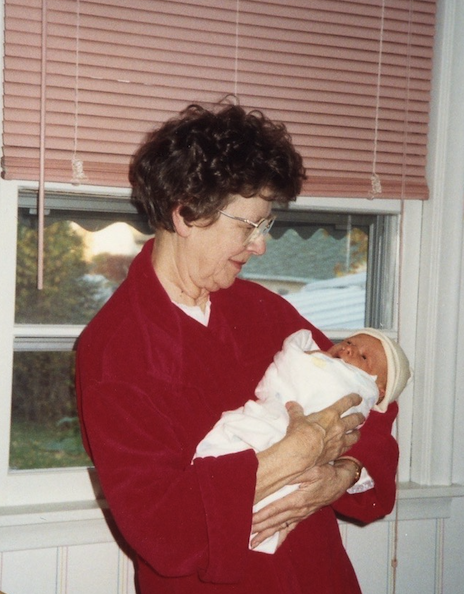
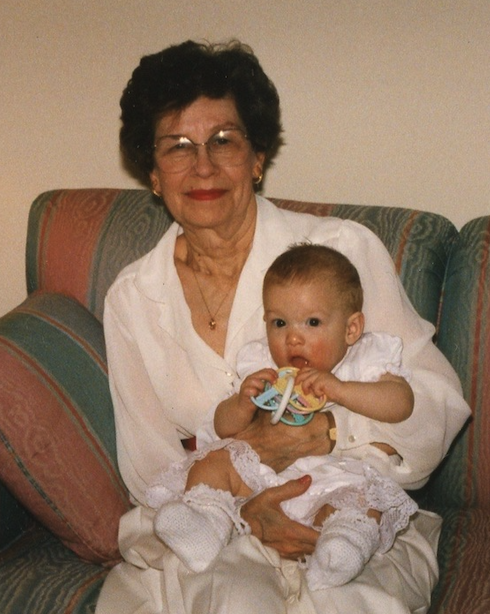
    Mom was 67 and already a grandmother to my brother and sister-in-law’s three, when our oldest son was born. When our youngest son was born she was 70. Even though we lived four states apart, we talked often, so she was familiar with our sons’ personalities and milestones. 

    Mom with our oldest

    I think of the way she got down on the floor to play with them. I do the same with my 10-month-old granddaughter, who crawls over me to get a toy or bounces in time to the music I play for her. When a diaper change upsets my 8-week-old granddaughter, I lean in close and say, “It’s OK little one. You’ll be alright,” in a low quiet voice, the same way Mom soothed our youngest.

    Mom with our youngest

    Mom comes to mind often and I wonder how she felt going about her days. At 70, was she achy in the mornings like I often am? Was she happy and looking forward with pleasure to most of her days? Was she carefree? Nah, my life is good but not carefree—hers wouldn’t have been either. 

    How often did the specter of aging shadow her? She had to be aware that one day her health would decline, friends and family would grow ill and die, and she would probably outlive Dad. Could she keep all that in the background? Did she think—like I do—that “I’m still healthy and capable. These are the good years”?

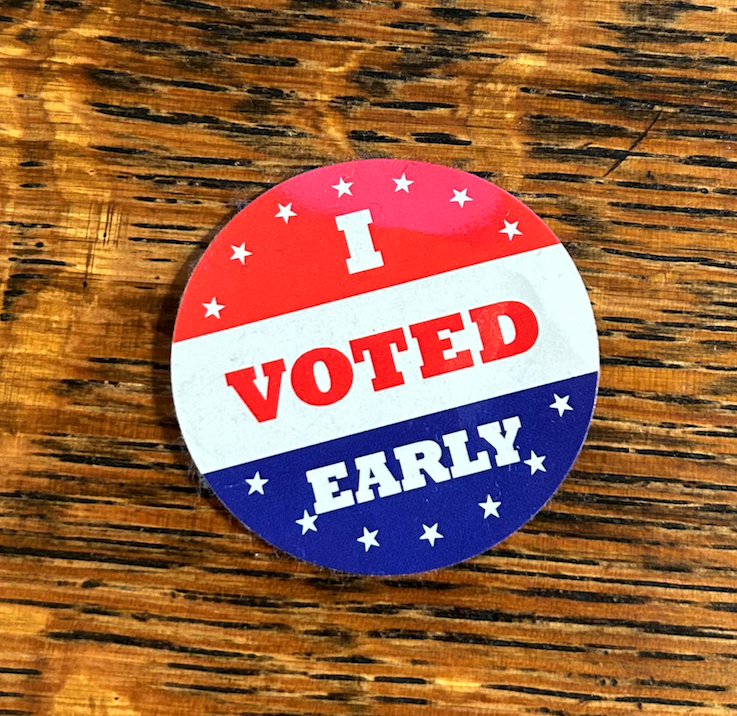
    Mom died 10 years ago on Election Day, the only time I didn’t vote. Instead, I got in the car to begin the long drive to Ohio for her funeral. It wasn’t a presidential election, but I felt bad about missing the vote. Mom and Dad were part of the Greatest Generation. They were fierce believers in democracy. Dad fought and Mom sacrificed during WWII so democracy could thrive throughout the world. Please support democracy with your vote.

  • Write Anyway

    Every birthday I consider what the past year has brought and what I hope the upcoming year will bring. This year as I entered a new decade, my focus was also tempered by the awareness that my time isn’t unlimited, and I want to use it well. What will the coming days and years consist of? Family and friends, health upkeep, travel, fun and for me, writing. 

    At first, asking what role writing will play in my life seems silly. Creative writing isn’t something you have to retire from. I can write as long as the words and ideas come. But the deeper question is—What are my expectations about publication?

    Widely published authors like Stephen King and Joyce Carol Oates can continue publishing as long as they care to. It’s a different matter for the writers I know, who have a modest number of publications. Like it or not, the marketplace may decide for them. Because it’s a personal and potentially painful decision, writers don’t always discuss the dilemma.

    In the past 20 years, I’ve written two book-length memoirs, but I’m not seeking publication for either of them. I learned what I could about writing books, but it wasn’t enough. The real gift is what I discovered about myself through the writing process. I’m proud of myself for doing the work. I’m at peace with the idea the books won’t be out in the big world. 

    Instead, I’m focusing on writing short memoirs, essays and blogs. My talents and skills are better suited to short pieces. Most years I publish one or two. Not a breath-taking record, but enough for me. Knowing my words and ideas find an audience in an anthology, literary journal or blog is plenty. 

    Publication plays a small part in my commitment to writing. I write because it helps me make sense of my world.

    Two quotes sum up my outlook. The first comes from a blog by Amy Grier who was struggling with her writing and the state of the world in November 2020. Her thoughts are still relevant:

    Writing tethers me to the world in a way nothing else does . . . I don’t know who will be president, what’s happening to my country, even what will happen to me. But I’m going to write anyway. It’s my remedy for despair. It’s how I will survive.”

    The next comes from an interview with Margaret Atwood, who offered a few rules for writers. After making practical writerly suggestions, she also said this:

    “Nobody is making you do this: you chose it, so don’t whine.”

    For as long as it pleases me I will honor my creative nature and write anyway.

  • Peach Seed Mystery

    I have very few memories of the man I knew as my grandfather (Mimmie, my great aunt and Pa, my great uncle raised my father). Pa was a white-haired smiling presence during our weekly visits to Mimmie and Pa’s duplex. He was a quiet man, but many 77-year-olds would struggle to find something to say to a 5-year-old. During one conversation, I recall him teasing me about having “strawberry blonde hair.” I was sure he was mistaken. I had “yellow” hair. 

    He also fed squirrels on their wide front porch. Pa would make a clicking sound similar to a tsk to call them, and the squirrels would take shelled walnuts from his open palm. Apparently, he was unaware or unconcerned about squirrel bites or rabies. He taught me to make the clicking sound but told me never to feed the squirrels without him. He’d gotten in trouble with Mimmie when a squirrel slipped into the house and climbed the drapes. After that he was more careful.

    I’m not sure how I came to have his peach seed monkey—whether he gave it to me because I liked it or if it came to me after he died when I was 8. It’s a peach pit carved in the shape of a monkey and it has tiny red eyes. As a girl I was sure they were rubies, my birthstone. That peach seed monkey was forgotten in a drawer of keepsakes until recently, when I read The Peach Seed by Anita Gail Jones (a novel I recommend). 

    Before the novel, I didn’t know carving peach pits was a thing. I used to assume Pa carved it, but now I speculate about its origin. Born in 1882, he’d lived through WWI, the Great Depression, and WWII by the time I knew him. Was the peach seed monkey a bit of tramp art he bought during the Great Depression to help somebody who needed a handout? Did he pick it up as a novelty at a county fair? Did a friend show him a peach seed monkey and Pa decided to carve one? He might have.

    Pa liked making things. He was a firefighter stationed in a neighborhood that had few fires. To pass the time during slow shifts, he made a small burgundy afghan using a technique that was a cross between weaving and braiding. Mimmie, and later, my mother used the afghan when they took naps.

    I’m left with this odd artifact, scattered memories, and a lot of questions. I keep it in my office along with other mementoes that bring to mind my parents and grandparents. 

    I still prefer to believe the monkey’s eyes are rubies.