“In it together—from inspiration to publication” is the WordSisters theme, and today I want to congratulate Elizabeth on the publication of her memoir, House of Fire (North Star Press, 2016).
House of Fire is the realization of a writing dream begun 13 years ago when Elizabeth entered the MFA program at Hamline University. The book is also the culmination of a personal journey that began when she was a little girl growing up on a farm in Western Wisconsin.
From the time she was 4 until she moved away from her family of origin at 19, she was sexually abused. Incest caused two pregnancies, which resulted in one abortion and one adoption. Although the memoir documents those soul-sapping experiences, the book focuses on healing and the transformative experience of creating a healthy family.
The path to parenthood was bumpy sometimes, but Elizabeth and her partner Jody were determined and persistent. In 2003, they adopted two infants from Guatemala. Today, their created family is happy and healthy—wonderful in itself—and also a testament to people’s incredible capacity to heal and move from pain and loss to joy. Elizabeth would be quick to tell you that sexual abuse doesn’t have to define a person. She is surviving and thriving.
Recently, a request for volunteers to decorate personal journals caught my eye. The organization requesting help—The Family Partnership—says journaling is helpful to their counseling clients. I’ve kept a personal journal off and on since I was a teenager, and it certainly improves my mental health. Journaling also provides useful material for my writing projects.
Writers are always advised to keep journals. In high school, when I first realized I wanted to be a writer, I drafted poems and stories in spiral-bound stenographer’s notebooks. In graduate school, I made notes about some of the encounters I had as an ER clerk.
One of my early journals
From the beginning, my journals also included impassioned blurts—here’s what’s bothering me and why. Finding words for my surging feelings made them concrete and more manageable. The process of writing calmed me. Often I felt like, “There. Now I understand what upset me and I feel better, so I can move on.” I thought the insights might be useful someday. If I ever feel so concerned about XYZ again, I can return to this hard-won insight and get feeling better, faster.
That’s funny now. I’m never going to be 19 again. Why would I need to look up the entry about fighting with my parents?
The journals became historical as well as therapeutic.
Journaling reminds me about how I got to this place in life, and that’s useful. I’m not still a heartbroken 24-year-old graduate student or an overwhelmed 34-year-old mother. Seeing that I’ve grown and changed is reassuring. I do figure things out. Things do get better.
Asking why and wondering about the meaning of certain events, comes naturally to me and is central to the essays, memoirs, and blogs that I write. I’m making sense of the big world as well as my own world.
A friend hand made this journal, which I used while teaching at UMM
When I was in my late 30’s and early 40’s, I began writing essays and memoir in earnest. Then the old journals offered valuable documentation about what happened when I was 24 or 27 and what I thought of it.
Rereading passages from old journals can be cringe-inducing. When skimming old journals, I understand why some people view them as the height of self-involved navel-gazing. Who is that whiny awful person? But that’s the magic of keeping a journal—within its pages, I can be my worst self on my worst day and spare the rest of the world a lot of my angst, anger, depression, and tedious analysis.
That’s also the danger of keeping a journal. The words and feelings included there would necessarily be taken out of context by anyone reading them. I journal when I’m confused or distressed. Good times don’t require explanation and analysis. I want to keep the journals for my use, but at some point I will need to get rid of them, since I won’t always be around to say, “I was having a bad day when I wrote that. I don’t still think that.”
My recent journals are much smaller– 5×7, in this case
But the writer and philosopher in me resists. I’ve been writing about my life for 20 years. There might be some good material in there. I hate to dump it now!
If you keep a journal, how do you use it? Will you get rid of them at some point?
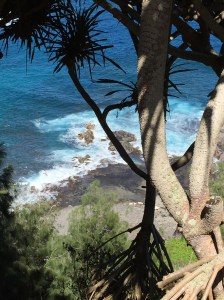
Since getting my iPhone, I’ve begun taking tons of photos, especially when I’m vacationing. During the nine days I was in Kauai I took 361 photos—mostly of scenery and quirky objects, occasionally of my companions.
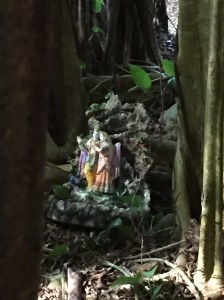
near Kilauea lighthouseTiny shrine under banyan tree at Hindu monastery
That’s about 40 per day. Why not? It’s fun. Taking pictures has become a way of heightening the experience. Documenting and remembering it. But sometimes I wonder: when I’m focusing and framing shots, am I more in the moment or less?
There’s something acquisitive about taking pictures.
Click. There. Now I’ve got it. This moment and this place are mine. I can revisit them whenever I want. I’m hoarding a treasure of memories. At some future point, seeing this vista, cool object, or time with friends may be just the tonic I need.
Of course I’ve got a beachy sunset photo — it’s Hawaii!
Initially, I might share a handful of photos on Facebook. Snap a funny scene and text it to a friend. After I return from a trip, I fuss with the photos in Photoshop, cropping them or adjusting the lighting. It’s a second way of enjoying the sights. Sometimes I create screensavers. Once in a while I make a printed calendar.
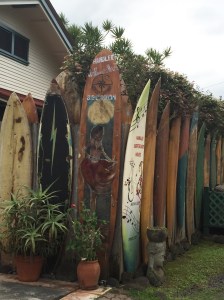
Surfboard fence in Hanalei
Having photos allows me to relive the good times. Except that after my first wave of enthusiasm, I rarely do.
Bird of paradise at Allerton McBryde Gardens
At least my photos are easy to store.
I’m grateful that I don’t have to deal with storing my collection. I think of the albums and boxes of pictures my parents had. Some of them are precious—that’s our history. My three siblings and I lined up in front of the tulip garden at Easter. There we are sprawled in swimsuits on the dock at Lake James.
But the photos from when my parents were in Hawaii? I’m glad they had the experience, but the images mean very little to me. I wasn’t there. I don’t know the stories. Is there any reason to save those prints now that my parents are gone? Similarly, my Hawaii photos won’t mean anything to my kids either. They weren’t there.
Fortunately, my fascination with photography doesn’t require much effort or upkeep. As long as I have loads of gigabytes, digital photos are easy to keep.
There’s one picture I didn’t take in Kauai.
In Hanapepe, they have a Friday night art gallery crawl. At 6:30, it was dark except for a few streetlights and the lights from shops. The air was cooling but the breeze was still gentle. A dozen shops opened their doors and a handful of food trucks gathered. Several musicians performed here and there—folk music and traditional Hawaiian music.
An old black pickup truck was parked under a streetlight. The front of it was painted with orange and yellow flames. Hot pink bougainvillea bushes were planted in the truck bed and they bloomed lavishly. Alongside the truck, a woman in a lawn chair was making leis.
I really wanted to take that photo, but it seemed wrong. Did I have the right to the photo if I didn’t want to buy the lei? Probably didn’t matter. People must do it all the time. That truck is meant to attract attention. Specifically, tourists’ attention.
After a while, she got up and shook some flowers from the tree behind the truck. Had a cigarette. A friend of hers stopped by with a brown bag of food.
I let the moment pass. It was too dark for my phone’s camera. It wouldn’t have seen all the color and details my eyes registered during the 20 minutes that I sat on the curb across the street from her eating spicy chicken curry.
I appreciate both kinds of images—the photos because they can trigger a story and the remembered images that have become vivid because I found the words to turn them into stories.
 House of Fire is the realization of a writing dream begun 13 years ago when Elizabeth entered the MFA program at Hamline University. The book is also the culmination of a personal journey that began when she was a little girl growing up on a farm in Western Wisconsin.