Every year fall delights me. Nondescript shrubs and trees surprise me with their dazzling colors. The cool air and shorter days are visceral reminders that we are not simply brains attached to keyboards and phones, but human animals subject to the rhythms of nature. Being part of a cycle that has been going on every year for eons restores my perspective. I hope these photos refresh you, too.
The pleasing artistry of primary colors—coreopsis, salvia, and burning bush
The exuberance of neighborhood Halloween decorations
The surprise of seeing three construction workers on a seven-story building across from the hospital cafeteria
The peaceful beauty of a golden tree arching over Minnehaha Creek
Winter will be here soon enough, but for now, I’m immersing myself in everything this fall offers.
When my husband and I travel in the United Kingdom or Europe, we always visit some of the great cathedrals. That may seem odd, since neither of us is very religious. But cathedrals like St. Paul’s in London embody history, politics, and faith in a very visceral way and I’m very interested in history. The experience encompasses the best and worst of human nature.
The Shock and Awe of Churches
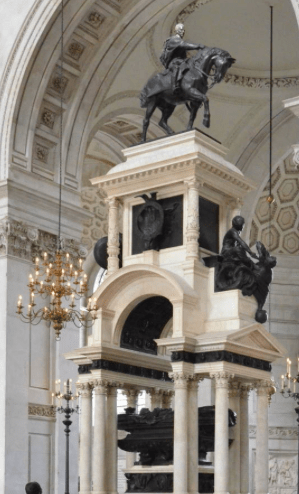
The architects and benefactors of great cathedrals intended to create a dramatic impact. And St. Paul’s does. The cathedral is an architectural marvel. The main aisle of cathedral goes on and on—while standing at one end of the church, I can see the other end, but just barely. The arched ceiling and dome soar high above the seats. Everywhere I look there are intricate decorations and many are covered with gold. I immediately feel small and insignificant in face of all the space and history, but that feeling gives way to a faint unease.
Photo by DAVID ILIFF. License: CC-BY-SA 3.0. Wikimedia Commons furnished this photo of the nave. Tourist photography isn’t permitted in the church.
Sightseeing in a Place of Worship
Though I’m no longer a practicing Catholic, that upbringing is ingrained in me. It feels odd to see the whole gamut of tourists wandering around snapping photos (where permitted), peering at inscriptions on statues, ducking into alcoves, zigzagging across aisles in front of the pulpit and behind the altar, talking and pointing. There’s something distasteful about it, although obviously, I’m a tourist doing the same thing.
The premise of sightseeing in church is complicated. Many cathedrals charge admission and I assume the money helps maintain the building. Perhaps the religious authorities are also trying to give ordinary people access to a beautiful and potentially inspiring place.
Tijou gates – Photo by DAVID ILIFF. License: CC-BY-SA 3.0. Wikimedia Commons
Incredible Excess
Cathedrals like St. Paul’s, the duomos in Florence and Siena, and St. Peter’s in Rome, all contain elaborate decorations—intricate mosaics, detailed wood and stone carvings, painted frescoes, golden candlesticks, chalices encrusted with jewels, lavishly embroidered altar cloths. The excess is fascinating but off-putting. I think about all of the money invested, perhaps for the glory of God but also as a demonstration of the power and wealth of the church, whether Anglican like St. Paul’s or Catholic like St. Peter’s in Rome. At first I am awed by the gilt and filigree, but then reminded of the greed, intolerance, and corruption that religious institutions have displayed historically.
Politics and Religion Are Intertwined in St. Paul’s
St. Paul’s was originally built as a Catholic church in 604. In 1087, it was demolished by fire. Rebuilding began in 1087 and the church was reconsecrated as a Catholic church in 1300. The Protestant Reformation, begun by Martin Luther in 1517, in response to the corruption in the Catholic Church, swept through Europe. In 1534, King Henry VIII split from the Catholic Church and established himself as head of the Church of England, so he could marry Anne Boleyn.
Politics and religion remained intertwined and turbulence continued in England until the 1660’s. During this period, St. Paul’s fell into disrepair and was used for a variety of things, including a marketplace. In 1666, King Charles II commissioned architect Christopher Wren to rebuild St. Paul’s, but the Great London fire destroyed the church and work was delayed until 1669. The church was completed in 1710. Now an Anglican church, the new St. Paul’s reflected the politics of the day.
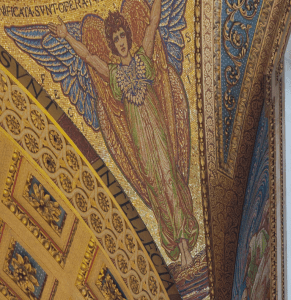
In the dome is a mural with scenes from the life of St. Paul. It was painted in muted colors—a departure from the colorful decoration in Catholic churches. Statues and imagery of saints and angels is limited, in keeping with Protestant philosophy. Instead, statesmen like the Duke of Wellington and Admiral Lord Nelson are ensconced in huge lavish crypts. St. Paul’s remained a more somber looking place until the 1890’s, when Queen Victoria declared that it was dreary and uninspiring and asked to have mosaics installed.
The influence of politics is evident in the lavish decor, which speaks of wealth and power of the monarchs, the Church of England, and England itself. It’s also obvious in the inclusion of statues of political figures instead of religious figures.
I dislike the dichotomy and wish it could simply be an inspiring place of worship. But then I recall the way thousands of people flocked to St. Paul Cathedral at the end of World War II and realize that for many ordinary people, the cathedral is a spiritual place as well as a national symbol.
God in the Details?
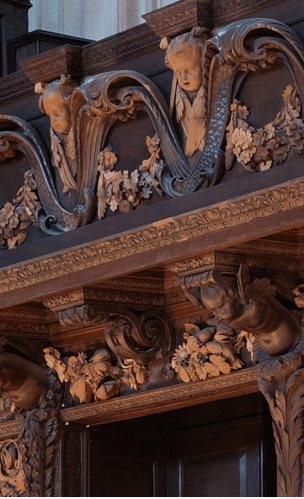
Then I focus on the decorative details and think of the craftsmen who spent years setting tiny tiles to create the mosaics. Or the woodcarvers who labored and fussed over the leaves in the choir stall borders. Or the metalsmiths and artists who made the Tijou gates and the chalices. Hundreds of artisans throughout the church’s history worked to create something important and lasting. I want to believe that devoting years and years of their lives to the work was an expression of their faith. Thinking of the craftsmen restores my appreciation for the cathedral.
Photo by DAVID ILIFF. License: CC-BY-SA 3.0 Detail of quire (choir) mosaics.Photo by DAVID ILIFF. License: CC-BY-SA 3.0. Detail of wood carving in choir stalls.
As I settled into my seat at the movie theater and muted my phone, an unwelcome thought sneaked in, “Is going out to the movies risky behavior?” I stifled it quickly, “A crazed gunman in the old-fashioned Edina Theater? That’s silly.” Worrying about my safety at movie theaters never used to cross my mind. I resent having to consider it now.
It’s disturbing to realize so many of the ordinary things I do put me in the kinds of places where mentally ill people or terrorists choose to murder and wreak havoc. However, I have no intention of curtailing my activities.
Shopping at malls – I don’t spend much time in malls, but while there, I have never worried about my safety. However, the shoppers in the mall in St. Cloud, Minn. or near Seattle, Wash. probably didn’t give it a second thought either.
Tutoring at the high school – I love the work I do tutoring adult immigrants and have never felt remotely threatened by any of them. The students I know are hardworking and determined to learn, get better jobs, and live the American Dream. But schools and colleges have been the scene of mass shootings in recent years. Perhaps I should be worried, but I refuse to be.
Visiting international cities – I enjoy traveling overseas, but because of the history of terrorism in London, Brussels, and Paris, I will have to consider my safety in airports as well as in the cities themselves when I go. Losing my luggage or getting pickpocketed seem like more realistic threats than terrorism, but I can’t help being aware of the potential for an attack.
Often, public places happen to be the settings where a personal grudge is played out—I might not be the target—but I still could be injured or killed by a stray bullet. The issue is not that one middle class white person has to think harder about her safety. It’s that no matter who you are or where you live in America, you are at risk of mass shootings, because of our gun laws and cultural tolerance of violence.
Equally troubling is that zealots with knives, trucks, and bombs threaten people across the world, not just Americans.
I remain defiant. There are no easy solutions to gun violence and terrorism. But part of the solution has to be resistance—resisting the impulse to hide and resisting the impulse to shrug and say, “Oh well, what can you do?” We have to keep fighting for change.
Although terrorism and acts of mass violence are now part of our reality, I refuse to give in to fear. I’ve never been a daredevil, but I have no intention of giving up activities I love like movies, shopping malls, tutoring, or traveling.