Author: Ellen Shriner

  • Artifacts

    I’m at an odd intersection. The familiar objects from my childhood look like history to the rest of the world.

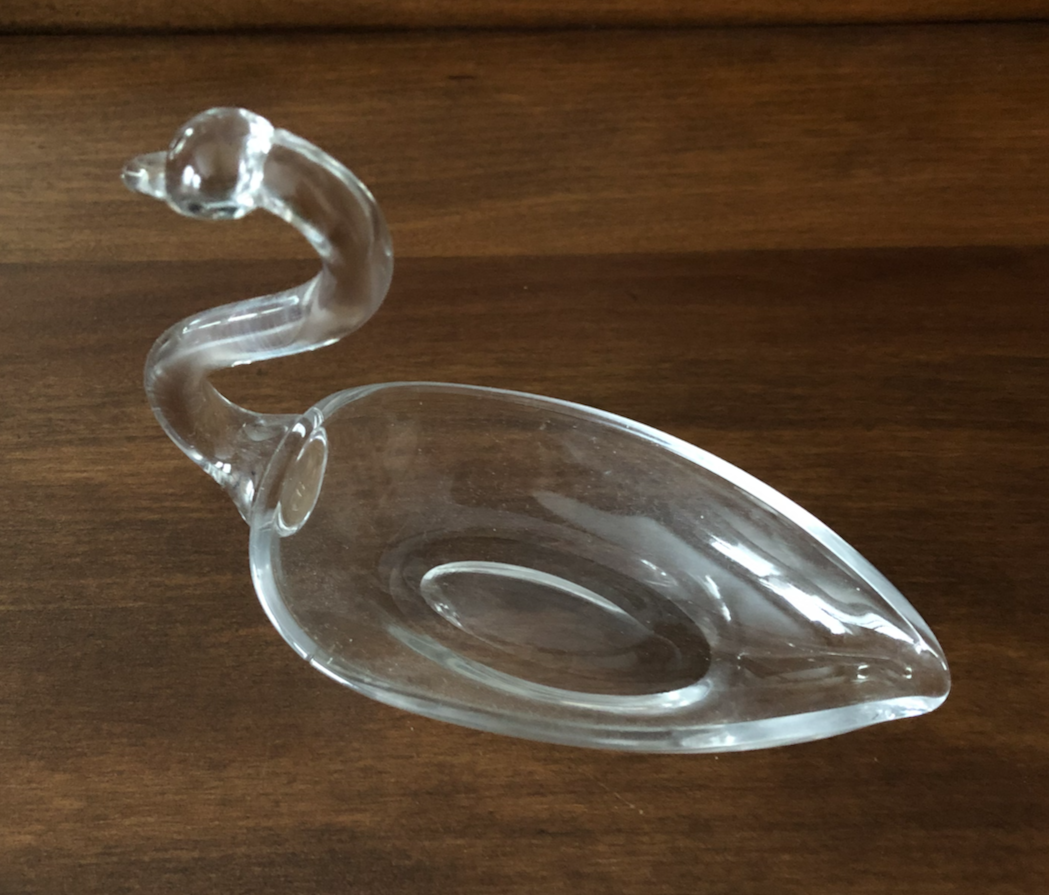
    In the Before times when I casually shopped, I’d spot artifacts from my childhood at antique stores. Huh?!? Toys like Barbies and transistor radios, kitchen items like Pyrex bowl sets and milk glass spice jars, decorations like ashtrays and the glass swan currently on my buffet are . . . old enough to be collectible. Antiques. 

    More startling was the realization that the purpose of those childhood objects will soon be obscure. Who fills decorative jars with spices anymore? When I was growing up, most homes had several ashtrays. Now they’re rare. 

    I value antiques from my grandmothers like Depression glass decanters, silver trays, cut glass salt cellars, aprons, and dresser scarves (what I prefer to think of as ‘true’ antiques). Their quaintness and the memories they call up appeal to me, but I rarely use them because they are so high maintenance. If I want younger family members to appreciate those antiques, I’d have to explain their purpose and tell stories about people they’ve never met. 

    Bringing the objects and the people who used them to life is hard, but here goes.

    Last week I made a pecan pie from scratch using my grandmother’s old wooden rolling pin. Although I never made pie with her, she was the one who liked to bake, so I feel that connection when I use it. I floured an old embroidered linen towel and rolled out the crust on it, which brought to mind one of my grandmother Mimmie’s housekeeping tips.

    She was from an era when women were expected to embroider towels, pillowcases, and dresser scarves (pretty cloths that covered up a lot of a dresser top to protect the wood—a lot of energy went into protecting furniture in her day). She or one of her sisters embroidered the towel which also had to be starched and ironed so it would look nice while hanging in the kitchen. 

    As a girl, I wondered how I was supposed to use such a fancy towel. Mimmie showed me her secret: dry your hands on the part that doesn’t show—the part that hangs closest to the wall on the towel rack. That way the pretty ironed front would stay nice for a few days. No surprise that I use terrycloth towels in my kitchen!

    Beyond the ‘antiques’ in my life is the realization that my lived experiences are also the stuff of history, but that’s a story for a different day! 

    What’s the oldest thing in your house? Does anyone besides you know what to do with it or why it matters?

  • What Image Do I Want to Present?

    Recently, Lauren Griffiths went viral when she replaced her “professional” LinkedIn headshot with one that better reflects her current situation as a human resources consultant who’s working remotely. She proposed that looking authentic is powerful and ultimately more valuable than presenting a “perfect” image. The longstanding ideas about “looking professional” remain powerful, although many people resent and resist those guidelines. Her post led me to consider: What image do I want to project? 

    When my career was still active, I was well aware of the need to look polished. Looking younger would be even better, since the working world can be disrespectful of older women. Young was no longer possible (!) but I could manage youthful, especially if I colored my hair and wore attractive clothes and jewelry. Most women my age did the same.

    Now, as a 66-year-old woman who’s retired from paid work, I no longer need to present a professional image or look any particular way beyond what pleases me. Griffiths wanted to present a more authentic professional image; women my age confront a similar dilemma. How do we present an authentic image as older women?

    When and how do you allow signs of aging to show? Should I try to meet the world’s expectations for “attractive older woman”? In other words, look 55-ish until I’m 75? Do I try to hold the line at all costs? Should I continue highlighting my hair but skip surgery or Botox? Stop coloring my hair? Let go of the anti-aging fuss? 

    When Gloria Steinem turned 50, she threw a birthday party and declared, “This is what 50 looks like.” She looked good, which turned the idea being a crone at 50 on its head. 30 years later, she told the world, “This is what 80 looks like” while traveling in Africa—another example of aging well.

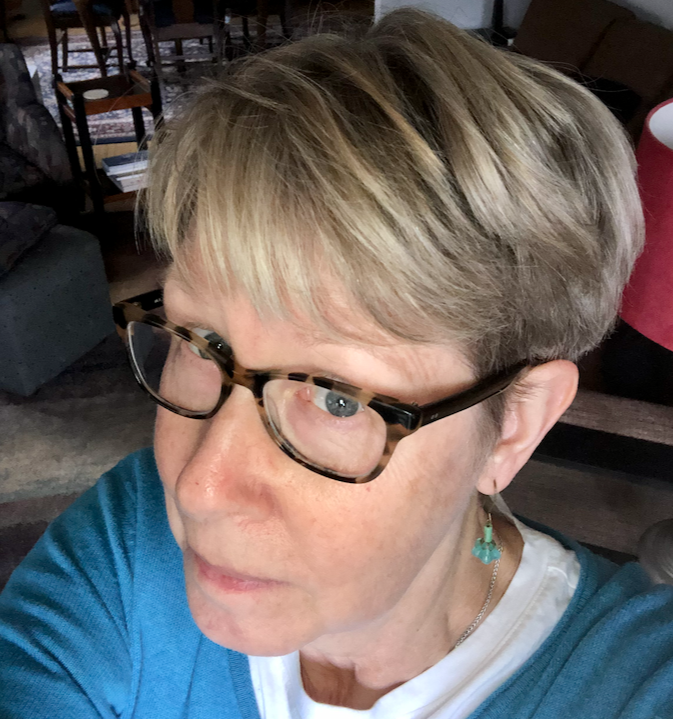
    In transition: Blonde in front. Silver coming in in back.

    My more modest version of her philosophy is to stop highlighting my hair. Pleasing myself will be the point, so I reserve the right to resume hair color if I prefer it. Either way, I will proudly say, “This is what 66 looks like.”

  • Keeping Track

    I come from people who keep track of everything: groceries to get, bills to pay, upcoming events, the day’s experiences, and past events.

    As a young woman, my mom kept a diary that noted what mattered in her days: starting a novena and that a guy she was dating was kind of full of himself (they were happily married for 67 years anyhow). WE’RE AT WAR! she wrote in December 1941. Later in life, she recorded the weather daily on small pads of paper she kept next to the sofa. At her funeral, my cousins told me my uncle (her brother) had also kept meticulous notes—some about his garden, others about the weather. We marveled at the shared habit.

    When my mother-in-law recently moved, at least 20 years’ worth of journals turned up. I was aware of her habit because she often asked how to spell something we’d served for dinner. Cioppino or ratatouille. She enjoyed keeping notes about what we ate and did during visits.

    I’ve gotten an extra measure of documenting genes. Off and on since high school, I’ve kept personal journals in which I work out confusing feelings. I also make entries in a gratitude journal to remind myself of what’s good and right in my world despite the pandemic and trying political times. I document garden plans—what’s planted where and ideas for next year’s garden. I have lists of books I want to read along with books I’ve already read and what I thought of them. When dieting, I keep track of my exercise and meals.

    I’m not alone in those habits, but for me, it doesn’t stop there. I have a ridiculous number of notes in my phone app. Supposedly 194 of them, but that can’t be right! Poems I like, blog ideas, writing tips, ideas for pottery projects, a list of lawn chemicals that won’t harm birds and pollinators, the steps for starting the snow blower. The notes go on and on!

    My reasons can be practical. I want to remember something or find it quickly, and my phone is always with me. I tell myself I’m being efficient and orderly . . . but maybe ‘obsessive’ would be more accurate! Other times, keeping track is an emotional impulse. My personal and gratitude journals help me maintain equilibrium.

    The habit of keeping track intrigues me. I think there’s something universal, something beyond the practicality of grocery lists, receipts, and calendars. The same impulse that leads people to document their lives on Instagram or Facebook, keeps me writing extensive notes and ongoing journals. It’s what caused my relatives to make daily diary entries.

    As far as I know, my mom didn’t consult her weather notes after the fact. My uncle might have looked up which kind of tomatoes did well. I don’t know if my mother-in-law refers to her notes to remind herself of a previous year’s Christmas dinner. I suspect she doesn’t.

    I believe the impulse to keep track is a way of saying, “I was here. My life matters. To me.”

    What do you keep track of?