Author: Elizabeth di Grazia

  • Borrowed Time

    Rain hammered the passenger van, rattling the metal like gravel tossed against a tin roof. Each burst sounded closer, louder, as if the storm were trying to break its way in. Why today, of all days, when Juan was visiting his birth family?

    We had planned it so carefully. We’d even had a kind of rehearsal the day before with Crystel’s birth family. The sun shone right up until the moment we left the amusement park. It couldn’t have been more perfect, her birth family and extended family gathered for lunch, then rides. Laughter. Fun. Unity. All the while, Jody and I worked quietly together, reading each other’s cues, me opening the bright orange Pollo Campero boxes, warm with chicken and fries, and her spreading the food across the tables and twisting open bottles of soda.

    Outside, the rain was relentless, steady and unforgiving, as if reminding us again and again: there is no escaping the comparisons, no matter how hard we tried.

    Jody and I insisted, repeatedly, “You can’t compare, kids. Your birth families are different. Circumstances are different. You are both deeply loved by your birth moms and families, that’s what matters. No one is better, and no one is less. What you can do is help each other through these visits.”

    That became our refrain across five birth-family visits, beginning when they were nine.

    Guatemala was both their birth country and our vacation destination. We hiked. We cliff-jumped. We wandered through villages. Volcanoes rose near and far, and water threaded our days, rivers, lakes, sudden downpours. We even considered buying a home there, going so far as to meet with realtors and walk through properties for sale.

    Some days ended with rainbows.

    Juan and Crystel, now twenty-one, encouraged and supported each other during their visits. Crystel insisted Juan stay close to her, and Juan counted on her to be the cord connecting him to his birth sister.

    Comparisons drizzled in. Rain or sun. Large family, small family. City or remote mountain village. Kiosk trinkets or hand-woven cloth.

    Juan traced circles on the fogged window and said nothing. With his other hand he held tight to his girlfriend Aryanna, pressed close beside him, as if neither of them wanted to risk losing the other. It was her first time in Guatemala, and in a short while she would meet his birth mom.

    Rain pressed in from the outside, forcing us closer together. The windows wouldn’t clear. Plans changed again and again. Finding Juan’s birth mom, Rosa, and explaining where we could meet her became a chore. We had to rely on others for communication. Juan and Crystel, after years of schooling, spoke Spanish hesitantly, enough to get by, not yet fluent.

    Crystel kept checking her phone, chuckling to herself, probably on WhatsApp with the group chat her oldest birth sibling had created. I watched her, the quick way her fingers flew across the keypad, and felt a swell of relief. She was in charge now, exactly what Jody and I had hoped for. Beneath that relief was an ache I couldn’t quite name. Her spirit, bubbly, light, unrestrained, lit the van. It was the best part of her.

    I wasn’t in control. Exhausted, I leaned my head against the damp windowpane and let my knee rest against Jody’s. She reached for my hand and held it tight. Our warmth gave me a moment’s reprieve, just enough. I had done so much research before our Guatemala trips, planning the vacation and each birth-family meeting. There was always something new to look forward to, some adventure we hadn’t tried yet. Hang gliding off a volcano was supposed to be the latest, a plan the rain scrapped at the base of the mountain road.

    What Jody and I could control was bringing the kids to see their birth families. Before every visit there was a crescendo, the build-up, the tension, the pressure to get it right. We had only four to six hours. And then we took our children back home.

    How is that fair?

    We had the children for a lifetime. We could bring them for a visit and then leave. I wonder now if each visit left a bruise we couldn’t see, a reminder that reunion was always followed by another leaving.

    All of these thoughts churned in the relentless rain. Plans shifted to meeting at a mall.

    Would the visit be enough? It had to be.

    The mall rose out of the sprawling city, volcano silhouettes in the distance and palm fronds brushing the edges of the parking lot. Jody squeezed my hand, then let go. “We’re here,” she said, gathering the gift bags. Inside, the rush of air-conditioning wrapped around us, a shock after the humid air that smelled faintly of rain and exhaust. Spanish pop music echoed off the tiled floors, layered with bursts of laughter. My eyes widened like a kid at Christmas. Bright storefronts glowed in rows, mannequins in glossy shoes, phone screens flashing. I hadn’t expected this in Guatemala. It could have been the Mall of America. A kiosk brewed coffee dark and sweet, the scent mingling with fresh bread and fried empanadas.

    “Beth,” Jody urged, “keep walking.”

    “Yeah, you’re staring again, Mom,” Crystel said.

    Rosa, Juan’s birth mom, and Ani, his sister, spotted us first.

    Rosa reached for Juan’s hand. “Mi hijo,” she whispered.

    I saw Jody step slightly back, giving them space, her eyes shining but fixed on Juan, as if she were willing him courage.

    Juan’s smile was small, careful. “Hola.”

    We had come for adventure, hang-gliding off volcanoes, cliff-jumping into clear water. The real leap was here, in a mall court, watching our son meet the woman who first held him. I held my breath.

    Aryanna, full of anticipation, studied Rosa’s face, wanting this distant mother to see her as Juan’s special person. Crystel had already sidled up to Ani, a few years younger than she and Juan, slipping an arm through hers. They stood there together, comfortable as sisters. Each of them loved Juan in their own way.

    In that bright, echoing mall, families shopped for shoes and phones while ours tried, in four short hours, to stitch together a kind of love that would hold until the next visit.

    Visits that were never promised. Only hoped for.

    On the drive back to the hotel, a faint arc appeared in the clearing sky, the beginning, maybe, of double rainbows. I wondered which of us would feel the bruise first, and how long it would linger.

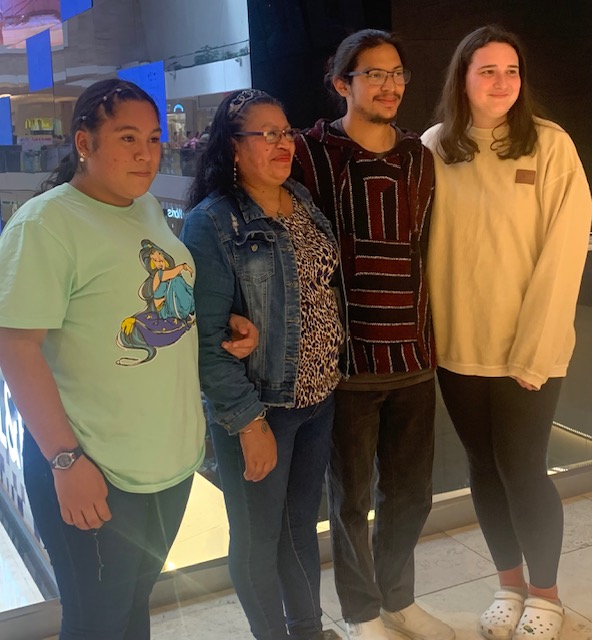
    Ani, Rosa, Juan, Aryanna
    Ani, Rosa, Juan, Aryanna (Juan’s girlfriend)
  • WHEN LOVE MEANT CHOOSING MYSELF

    Crystel walked left on the beach. I walked right. We were done with each other for the day. Discovering the wonders of El Paredon, on Guatemala’s Pacific coast, would be done alone. I was not willing to follow her, and she was not willing to follow me. The blue ocean was anything but quiet. It roared with its own intensity, a restless turbulence wrestling against itself. Beyond the break point, surfers waited. Under my feet, the striking black volcanic sand glimmered with heat and stretched as far as I could see. Tall palms and weathered beach huts dotted the coast.

    Earlier that morning at the surfboard rental hut, she had said it again, sharp and familiar, “You don’t have to talk for me.” This had become her refrain at twenty-one years old. I’d thrown up my hands, “I was just asking which board might be easier for you to surf with.” This was who we were now. Crystel couldn’t let me parent, and I couldn’t stop being her parent.

    Eventually, we would circle back. We always did.

    I walked toward a tangle of driftwood and chose it as my turnaround point. Somewhere between that black sand and the roaring ocean, the joy of being with her returned.

    At a beachside restaurant, wooden tables were planted right into the sand. A thatched roof swayed gently above, letting the warm air carry the sound of waves through the open sides. Surfboards leaned in a tidy stack nearby. Backpackers drifted in and out: sunburned, barefoot, unhurried. Mellow music floated from a speaker behind the bar. I texted Crystel the name of the place. This time, she didn’t ghost me. When the message bubble appeared with her reply, I felt surprise first then thrill. We weren’t done with each other after all.

    The next morning, I brought her a smoothie and pastry in bed. I’d been up for hours, already through my own breakfast, the typical Guatemalan spread of eggs, refried beans, plantains, tortillas, fruit and endless coffee. I lounged beside her considering our air-conditioned room. It was the exact opposite of our homestay, almost unsettling pristine. It felt new, as if someone had built it yesterday and aired it out just for us. The walls were off-white. No pictures. No nails or hooks. No sign that anyone had ever stayed here before. Fresh white towels lay folded in perfect stacks. Crystel was curled up in starched sheets, a quiet bundle in a bed that felt too clean to be real.

    There was no furniture. Just the bed, the air-conditioning, and Spanish music drifting from the TV.

    I had gotten what I asked for, but would it work? Would four days of salt air, sun, rest, and a spotless hotel room loosen the grip of the PTSD that held tight beneath my ribs? Would this respite from dirt, crumbling sheetrock, clutter, and questionable bedding reset my body?

    At last, I had a night of sleep, my body no longer on high alert, scanning for danger. I slept, truly slept. Before we left our homestay, I folded my scratchy blankets and placed the dingy sheets beside the washer, hoping a simple wash would be enough and that somehow, I could carry this newfound tranquility forward.

    Our push-pull relationship momentarily eased. From the beach, I watched Crystel battle the surf, fighting against the relentless beach break. Waves slammed in from all directions, crashing into each other. Even mounting her board was a struggle. Still, she kept at it, and ultimately, like I knew it would, determination pulled her through. We strolled the dusty streets of El Paredon, followed her restaurant recommendations, and watched the sun go down side by side.

    In the taxi back to our homestay, my stomach tightened. Four and a half hours ahead of us. It started as a cringe then expanded into worry. Can I do this? Will this time away be enough? I wanted it to be. I wanted what Crystel wanted, an authentic Guatemalan home, language immersion, community, conversations around the table. But the farther we drove the more numbness seeped in. That old childhood response, the one my body learned when danger was close. Suddenly, I wasn’t sure any length of time away would be enough. As the landscape shifted outside the window, I could feel my peace slipping away.

    “I put your washed bedding back on the bed,” said Maria. She pulled me in for a grandmotherly hug. A bowl of warm soup and tortillas waited for us on the table.

    I went to find Crystel.

    “Mama Beth,” she whispered, “I think the little boy slept in my bed while we were gone. Stuff is moved around.”

    “Does that bother you?”

    “No. I just ignore it. I don’t think about it.”

    Crayola markings covered the wall. This was probably his room when there were no guests. When we arrived, he likely slept with his parents. I had asked Crystel before we left for El Paredon if she’d like her sheets washed too. She had declined. “I just don’t think about it,” she repeated.

    That night, I spread my washed sheet back over the mattress, though it still looked unclean like it had held on to someone else’s sleep. Before I layered the heavy wool blankets, I inspected the sheet closely. I searched for any sign of fleas. If I saw a patchy shadow, I pressed my finger to it to see if it moved. On one faded spot, I found the shell of a bug, small as a seed, light as paper still clinging to the fabric.

    I crawled into my extra-large sleep sack, long enough to swallow my whole body and still fold over the pillow. I slid into it feet-first and pulled it up past my shoulders. The top flap had an extra panel, meant to tuck over a pillow, but I used it like a barrier, a clean layer between me and whatever might be hiding in the bedding. I cinched the hood around my neck and pulled the pillow flap across my face like a shield. It wasn’t just something to sleep in. It was something to hide in.

    Sleep would not come. My body stayed alert. Racing. Listening. Braced for danger. It felt like being sixteen again, waiting for the fight in my parents’ bedroom to turn violent. There was no fighting in this house, but the clutter, dirt and disarray were enough. They carried me back in time.

    “I should be able to do this,” I kept telling myself.
    “It’s not so bad.”
    “I can handle it.”

    But those were the exact words I used to survive my childhood. Back then, I had no choice.

    Here I did. I wasn’t the abused girl anymore. I could choose differently now.

    That realization changed everything.

    The next morning, before breakfast, I started researching hotels with kitchenettes. My worry about the homestay family losing money faded, our stay had already been paid. Jody supported me leaving, she had listened to my tears too many times. I just didn’t want to disappoint Crystel. I had let her lead our days, pick restaurants, navigate cobblestone streets, but this choice was mine. I didn’t need to keep trying to make this work.

    I made the reservation, and instantly, the guilt arrived. It felt like I was going to get in trouble, really in trouble. As if someone might hit me, punish me for speaking up. A part of me felt like I’d told on someone. Betrayed them. What would happen now? Would they stop talking to me? Reject me? A bad thing was coming, I could feel it.

    This had happened before.

    When I reported the incest in my family to the police, the same thoughts spiraled through me, What will they say? What will they do to me? Who will I lose? And all those fears came true. They did reject me. They did ostracize me. I already knew this terrain, the ground where doing the right thing still carries a cost. I’d paid this price before, and my body remembered it before my mind did.

    When I told Crystel I had made a hotel reservation for us her face fell. And then I had to ask her to tell the family we wouldn’t be living there.

    Punishment didn’t come. A reflex older than motherhood. Maria gathered us in for a family photo, her, her daughter, her son-in-law, their five-year-old son, and us. Crystel and I were folded seamlessly into their circle. Grief, relief, and tears rose up all at once. Once again, I was leaving family.

    Of course, our last breakfast at the homestay was Crystel’s “BEST EVER” and she was slow to meet me out front.

    At sixty-five, I had finally learned that caring for my mental health was not selfish, it was necessary. I honored myself, and in doing so, I preserved the part of me that could love my daughter fully.

    Crystel and I stepped forward, not perfectly, but together. I couldn’t stop the waves, inside or out, but I could decide how I met them.

    El Paredon sunset
  • SAD TIGER, My Coffee Table Book

    Sad Tiger by Neige Sinno, sits prominently displayed on my coffee table. It’s not an illustration book of art, travel, or architecture. It’s not a photo book of exotic animals.

    Sad Tiger is a powerful memoir that weaves Neige Sinno’s memory of sexual abuse and reflects upon literary works by authors who were abused and authors who wrote about abuse.

    It’s the most complete book about abuse that I have read. It’s my story. My all-embracing 4-year-old, 9-year-old, teenager, and adult self-story.

    Underlined sentences mark the early pages, but soon it became expeditious for me to place a vertical line in the margins highlighting entire passages. When I had an especially strong reaction to a passage, my vertical line became an elongated bold exclamation mark.  

    Emotion would build in me, and I’d write in the margin. There was no order or plan for my discourse. A conversation with myself, my mother, a memory would drive me to write in the top, sides, and bottom margins. Words would be vertical, horizontal or slanted, near the author’s words that elicited the feelings.

    I didn’t start out knowing that this book was going to be displayed on my coffee table. I didn’t intend to write or make any notations in the author’s memoir.

    It was instinctive, like breathing. On the first paragraph I underlined, “Even if you’ve not experienced it, the traumatic amnesia, the bewilderment, the silence of the victim is something we can all imagine or think we can.”

    In the second paragraph, when she wrote about the perpetrator’s assumed experience, I asked, Really that’s what it was like?

    Her words rang true.  “… And after it’s over, getting dressed, going back to family life as if nothing had happened. And once the madness has taken hold, doing it again, doing it again and again, for years.”

    I was in awe, too, that my family could go on as if nothing had happened. The sexual abuse, the violence, the awful words said quietly, shouted, or screamed. Survival was day by day, moment by moment. Wary and alert, vigilance didn’t stop the abuse. I could never escape but I could steel my body to not feel when it came. Even today, 51 years later, I can easily recall my stomach dropping and my impending sense of dread when I realized that I was trapped in a car in the middle of winter on a remote road. My older brother forced me to the back seat. We were supposed to be going to my beloved Aunt’s house—the reason I agreed that I would ride along. A gunshot sounded. No, I realized, with his weight pushing down on me, it was a tree limb snapping from the extreme cold. I don’t even remember if we made it to my aunt’s or what we did once we arrived.

    I hear my brothers’ saying, Why are you still writing about this? (As if we were ever really going to have a conversation about their assaults). I answer, Fuck you. It’s mine to write. You shouldn’t have fucking raped me if you didn’t want me to write about it.

    “A person rapes in order to exist,” I underlined. I have long thought that my oldest brothers raped me to have some semblance of power in the family. A response to the chaos of our life with our alcoholic father, our mother, and the on-going bedlam of being farm poor with 11 other siblings. Calamity struck every few years. Our barn burnt down when I was in 3rd grade. A few years later, our house burnt down. It wasn’t if something was going to happen, it was always when. My belief was they raped me because they could.

    I pressed pen to paper, Where were you, Mother? How could you not know? I wish someone had saved me! I wish someone cared enough. Was brave enough. Had the courage to confront what was easily seen.

    In the end, I saved myself and my three younger sisters. Like the author, I reported the abuse to the police when I was 19. I was afraid that my mother wouldn’t protect them, the same as she didn’t protect me. I would never have forgiven myself if I allowed it to happen to my sisters. I was no longer at home, mothering them, protecting them.

    And like Sinno, I am drawn towards books written by survivors. She says:

    “Many books are published every year by survivors. Mostly fiction. Whenever I come across one, I always like to flip through it. Some are well written, some not. Either way I read them with the same eye. I am looking for a description of the facts. I want to know exactly what he did, how many times, where, what he said, and so on.” Same, I wrote in the margin.

    I came across her book, Sad Tiger, in The New York Times book review section, May 2025. Sinno has said that Sad Tiger was written “out of necessity”, as an act of survival and understanding. Writing it was a way to reclaim her own story – to move from being the “object” of violence to the “subject” who names it.

    House of Fire: A Story of Love, Courage, and Transformation is a book that I had to write. The sexual abuse that happened to me isn’t me. It was done to me. It doesn’t define me. With writing House of Fire and telling my story, I brought the truth into the light and claimed my freedom. I cut the cord that bound me to my family and found me.

    Keeping quiet about abuse lets abusers win and minimizes your own life. Says, I’m not important. I’m not as important as the abuser. As the pedophile.

    Fuck you, I say.

    I love my life. There’s a deep peace in sitting on my deck, listening to chimes as leaves whisper and clouds float through the blue sky. I am in the moment, knowing my truth, living my truth, and speaking my truth.

    I’m immensely proud of who I am. Who I always was. A fighter with a belief in myself.

    I don’t write so that the abuse disappears. It will never disappear. It’s in my bones. My thoughts. My world. My very cells.  

    An elongated bold exclamation mark highlights one of the author’s final sentences, “Like so many others I was raped, I was defiled and betrayed at an age when all you have is trust, and yet I grew up to become an adult who has not raped or defiled or betrayed another person in return.”

    Same. With my wife, I’ve raised two children to adulthood. Slowly, intentionally, I made my body mine again. For so long my body was numb to pain and my tears stayed locked away. Now they flow easily. That is the work of love.

    I have a coffee book that’s all about me, my travels, my journey, and it sits next to mine.